The most complete guide to Crete: 221 places on the map, 23 routes and 49 articles — with photos, videos and the story behind every place. No sign-up, no trackers.
Routes drawn along real roads
Weather at every stop
Full-text search
“Near me” by geolocation
Create your own printable itinerary
Satellite, terrain, dark mode
Works offline
⌕
Searches 1.7 million characters of descriptions, not just names
—places
4regions
—routes
—with video
Search results
—
Interactive map
Find what is near you
Filters narrow the map and the list at once. Zoom out and pins group together.
Region
Category
Фильтры карты
Landmarks
Featured places
RegionCategory
Routes
Ready-made day trips
Individual places
Articles about landmarks
Paximadia – the “rusk” islands in the Bay of Messara
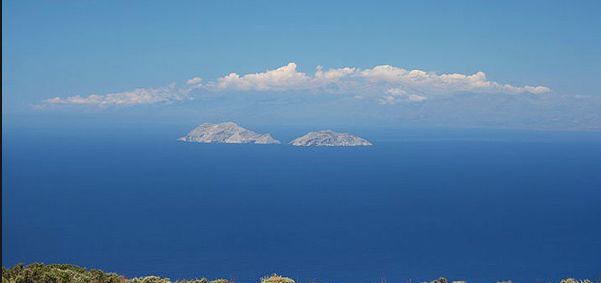
The Greek Παξιμάδια means “rusks” – the hard, twice-baked bread that Cretans have always taken with them on sea voyages. The outlines of the two islands recall two large pieces of it. In popular speech they are also Elefantaki, the “little elephant”, for the pair lie so close together that from a distance they merge into a single shape, like a baby elephant lying in the water.
Two islands and the open sea
The Paximadia lie in the Bay of Messara, some 12 kilometres or 7.5 nautical miles south of Agia Galini and about as far west of Matala. They are the summits of a submarine massif: Megalo Paximadi, the Great Island, on the west, rises about 252 metres above the sea, Mikro Paximadi, the Small Island, on the east, 166 metres; together they measure roughly three kilometres in length. They are divided only by a narrow strait which the fishermen call Bougazi.
In ancient tradition the islands were called Dionysoi – after the god Dionysos, lord of wine – and were reckoned to the waters of Phaistos. Cretan legends also connect them with the hunting of Artemis and Britomartis. The tale that Apollo and Artemis were born on the Paximadia belongs to a local version of the myth of Leto; in the most widespread pan-Hellenic account Delos is the birthplace of the twins.
The islands are uninhabited. They can be reached only by water – on an excursion caique or trip boat leaving from Agia Galini or from Kokkinos Pyrgos. Beside Cape Sakouleva, the western point of the Great Island, a single slender rock stands up which from the sea resembles a kneeling sphinx, turned towards Megalo Paximadi.
The Small Island has four tiny beaches of pebbles and crystal-clear water, and on the Great Island chiefly the cove of Varkaki; the area around Cape Sakouleva is held to be the wildest part, almost unearthly in appearance, and indeed the whole of the Great Island is a place of vertical cliffs. The sheer walls display rocks in an astonishing range of colours, between them open caves, the largest of which is called Tzigouna, and even small freshwater springs break out on the barren rocks. The water is deep and intensely blue close inshore, so that the islands are prized for snorkelling and spear-fishing.
The mythological names of the Paximadia
In old and in more recent Greek traditions alike the islands bear other names: Dionysoi and Letoai. One legend connects them with the hunting of Artemis and her companion Britomartis. Another tells that Leto bore the twins Apollo and Artemis here; it fits that Leto was worshipped at nearby Phaistos under the epithet Phytia. Since in the usual ancient version Delos is the birthplace of the two gods, the story of the Paximadia belongs expressly to Cretan local tradition and is not the single, common Greek variant of the myth.
How to see the Paximadia
Trips to the islands depend on the weather and normally run in the warm season; from Agia Galini they are then offered daily, and it is not unusual for dolphins to keep the boat company for part of the way. The layered rocks, the abrupt cliffs and the contrast between the bare islands and the green shore of Crete are best seen from the water. There is no shade on the islands and no facility of any kind, so drinking water and sun protection have to be brought across.
The Paximadia are more than a bathing place: they are a rare stretch of the south coast where geology, the history of seafaring and mythical memory are concentrated in a tiny archipelago – with the Libyan Sea to the south and, behind, the panorama of southern Crete from Mount Kedros to the Asterousia Mountains. They have a place in fiction too: the islands play a prominent part in Klaus Modick’s German novel “Der kretische Gast”.