The most complete guide to Crete: 221 places on the map, 23 routes and 49 articles — with photos, videos and the story behind every place. Everything is open and free: no sign-up, no paid sections and no advertising, open or hidden. You can install the guide on your smartphone as an app.
Routes drawn along real roads
Weather at every stop
Full-text search
“Near me” by geolocation
Create your own printable itinerary
Satellite, terrain, dark mode
Works offline
⌕
Searches 1.7 million characters of descriptions, not just names
—places
4regions
—routes
—with video
Search results
—
Interactive map
Find what is near you
Filters narrow the map and the list at once. Zoom out and pins group together.
Region
Category
Фильтры карты
Landmarks
Featured places
RegionCategory
Routes
Ready-made day trips
Individual places
Articles about landmarks
Agia Triada – a palatial centre of the southern Messara
Agia Triada lies about three kilometres from Phaistos at the western end of the same ridge, on the north slope of a low hill, only thirty or forty metres above sea level, overlooking the valley of the Geropotamos, whose course can be followed from here to the nearby coast at Tymbaki. The view extends across olive groves and greenhouses to the Libyan Sea and to Psiloritis. The site comprises a Minoan royal villa, a town, an agora and a cemetery. The present name comes from the nearby church of the Holy Trinity; what the place was called in antiquity is not known, though some scholars have searched the written records for its Minoan name – one candidate is da-wo, a place that appears on dozens of Linear B tablets from Knossos in connection with large stores of grain.
The name and the Christian churches
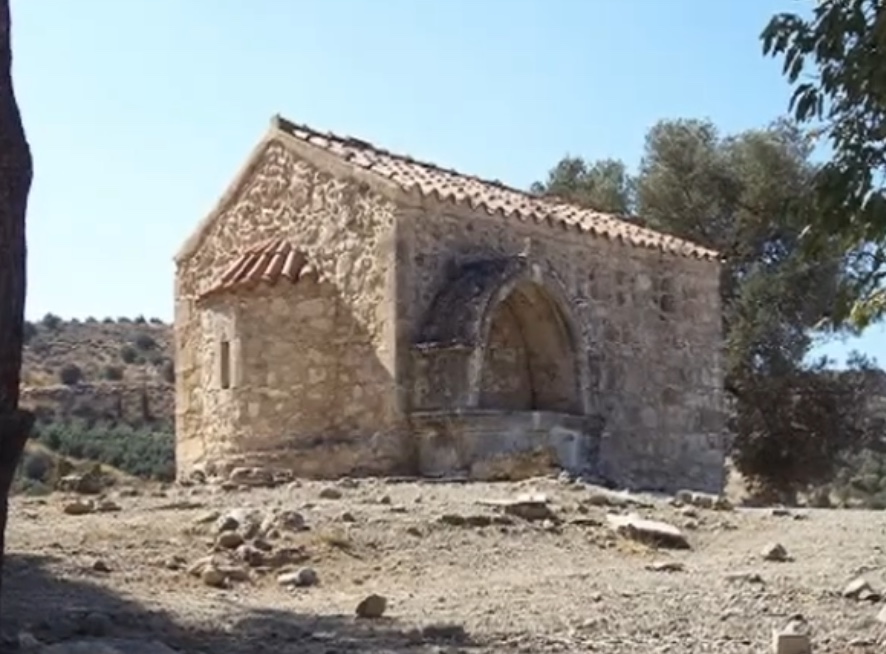
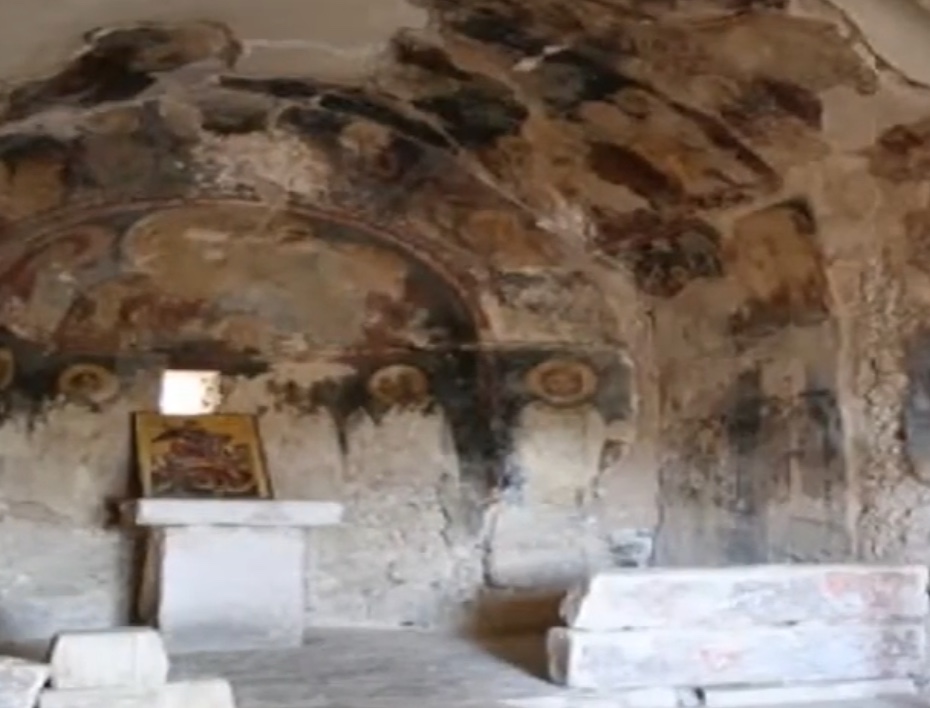
The church of the Holy Trinity, a twin-aisled chapel of the Venetian period, stands a little to the south-west of the ruins; it belonged to a village that was abandoned at the end of the 19th century. In the middle of the excavated area rises the little church of St George Galatas, with frescoes of the early 14th century. The place became known to archaeologists when Luigi Pernier noticed the remains in June 1900 and the Italian Archaeological Mission, under the direction of Federico Halbherr, began systematic excavation in 1902; the work lasted until 1914, was resumed several times – by Luisa Banti, by Doro Levi and Clelia Laviosa in the 1970s, and from 1977 by Vincenzo La Rosa – and was not definitively published until the 1980s. It showed that the spot had been inhabited since the Early Minoan period, that the villa was built around 1600 BC and that it was destroyed by fire around the middle of the 15th century BC. Afterwards new buildings rose over the debris, among them a megaron of Mycenaean type and a town with an agora – a long hall behind whose piers and columns a row of shops was ranged. This later town in its turn came to an end in the 13th century BC.
The royal villa and the paved roads
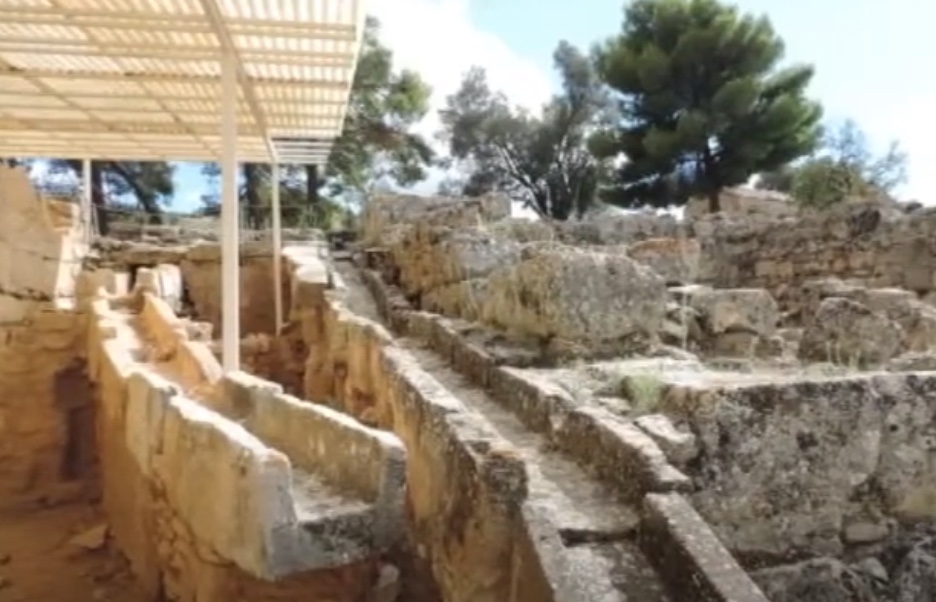
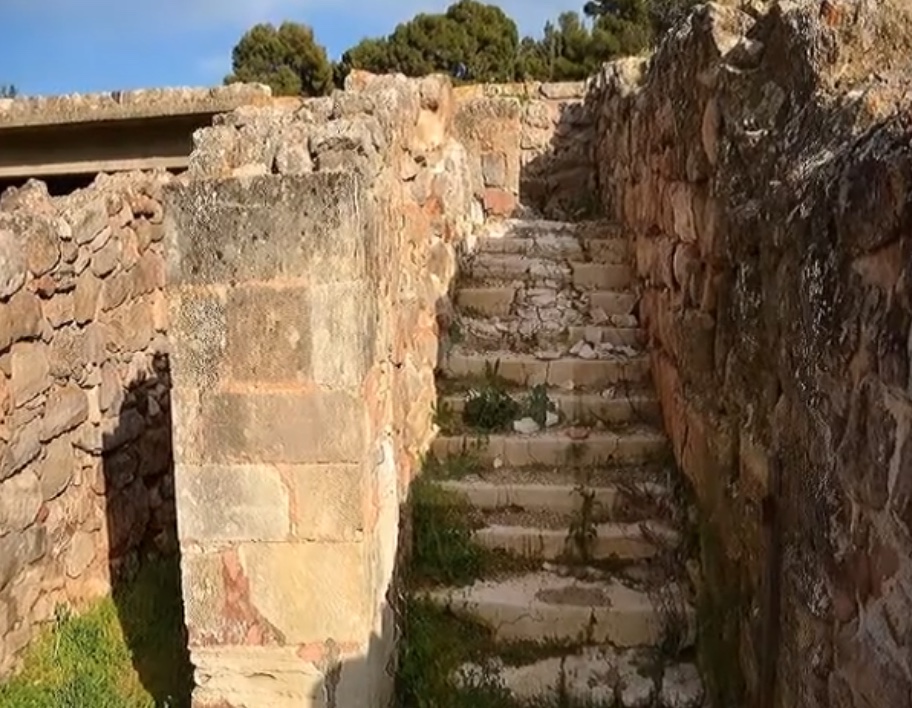
The villa consisted of two wings forming an irregular, L-shaped plan. The ground floor survives; staircases inside prove that there was an upper storey. In the north-western part lay the owner’s living quarters – the central hall, a colonnaded court, light wells and cult rooms, fitted with alabaster slabs and benches along the walls; to the south came storerooms and service rooms, including three large magazines for the produce of the estate. A broad paved road, stretches of which survive, linked the complex with Phaistos; a further ramp led, it is assumed, towards the sea. These roads make it plain that Agia Triada was part of the palatial system and no remote country house. North-east of the villa lay the village of farmers and craftsmen, which is older than the great house and flourished after it was built; a potter’s kiln of the villa’s own period was found during the most recent campaigns.
The archive and Minoan writing
In one of the rooms the archive of the house was discovered: clay tablets with inscriptions, and with them numerous clay sealings bearing seal impressions – three-sided nodules and some two dozen roundels, discs of clay stamped along the edge. The texts are written in Linear A, the script that remains undeciphered to this day; with well over a hundred tablets – about 150 in all, found in several parts of the villa and in a house of the village – Agia Triada possesses the largest known collection of this script. All of them belong to the last phase of the villa, the years before the fire that destroyed it. So far as numerals and pictorial signs for grain, wine, oil or figs can be made out, the documents reflect the work of an administration: the book-keeping of goods coming in and going out, of property and dues. For the later levels, when Crete was under Mycenaean influence, there are also reports of Linear B, the script of the Mycenaean Greek administration.
The painted sarcophagus of Agia Triada
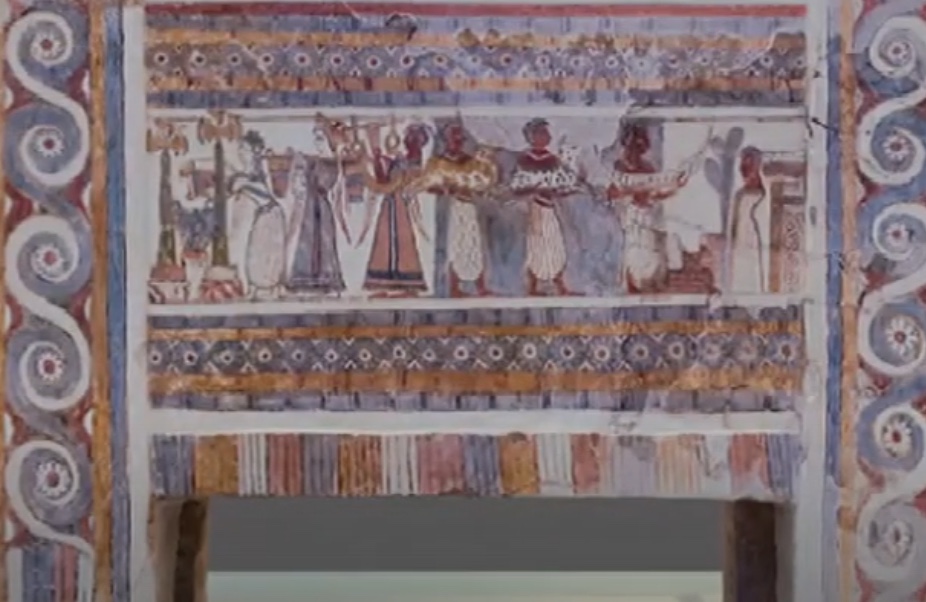
In the cemetery north-east of the settlement, where there are also two Early Minoan tholos tombs, a limestone sarcophagus came to light on 23 June 1903 in a small built tomb, a chamber measuring just 3.8 by 4.2 metres; its finder was Roberto Paribeni. It is 1.37 metres long and is dated to about 1370 to 1320 BC. Its plastered surfaces are covered with polychrome scenes executed in the technique of wall painting and framed by bands of spirals and rosettes. On one long side a priestess pours a liquid into a vessel set between two double axes on which birds perch, while a woman behind her brings two more pails on a yoke and a musician in a long robe plays the seven-stringed lyre; men in skirts of hide carry calves and a model boat towards the figure of the dead man, who stands motionless before his tomb. The other long side shows the sacrifice of a trussed bull on a table, its blood running into a pail, to the music of the double flute and with a procession of women approaching. On the short sides goddesses ride in chariots drawn by griffins and by wild goats. The sarcophagus, restored in 1956, is kept in the Archaeological Museum of Heraklion and is regarded as one of the most important works of Minoan art.
Agia Triada and Phaistos
The history of Agia Triada is closely bound up with that of Phaistos: the two sites grew up in the same valley, drew on a common economic network and lived through similar upheavals of the Minoan age. After the destruction of the palaces Agia Triada did not vanish but carried on as a centre of administration and crafts – indeed in the Late Minoan period it seems even to have surpassed Phaistos in importance. Later a sanctuary kept the memory of the place alive: votive figurines were being dedicated among the ruins again in the early Iron Age, and after a gap of some three centuries small shrines were built in the Hellenistic period, when Phaistos controlled the site and Zeus Velchanos was worshipped here. The Romans, finally, built a villa on the hill after their conquest of Crete.
A walk through villa, town and cemetery, and a little way along the old road, shows vividly today how palace culture was interwoven with the daily life of the southern Messara. The site is far less visited than Phaistos and offers hardly any shade. There is a joint ticket for both sites, and anyone with time to spare can round off the visit at nearby Vori and its Museum of Cretan Ethnology. The finds themselves – stone vases, frescoes, tablets and the sarcophagus – are to be seen in the Archaeological Museum of Heraklion.