The most complete guide to Crete: 221 places on the map, 23 routes and 49 articles — with photos, videos and the story behind every place. No sign-up, no trackers.
Routes drawn along real roads
Weather at every stop
Full-text search
“Near me” by geolocation
Create your own printable itinerary
Satellite, terrain, dark mode
Works offline
⌕
Searches 1.7 million characters of descriptions, not just names
—places
4regions
—routes
—with video
Search results
—
Interactive map
Find what is near you
Filters narrow the map and the list at once. Zoom out and pins group together.
Region
Category
Фильтры карты
Landmarks
Featured places
RegionCategory
Routes
Ready-made day trips
Individual places
Articles about landmarks
Limni Preveli – fresh water on the Libyan Sea
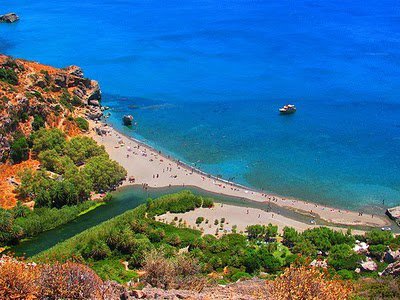
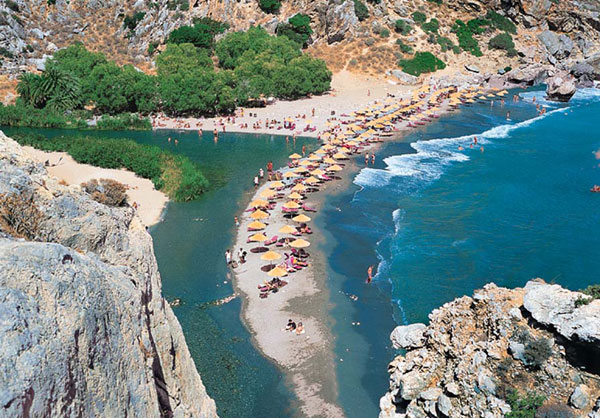
Preveli is known as Limni (Λίμνη), “lake”, and as Finikas (Φοίνικας), “place of palms”. The mouth of the Megalopotamos forms a small lagoon that passes gradually into the open water of the Libyan Sea. Here one can bathe in the cool fresh water of the river and in the salt water of the sea, and watch the two meet on the sandy shore. Off the beach a striking rock, heart-shaped to the eye, rises from the water; it appears in almost every photograph of the bay.
The beach is reached by a steep path down from the road between the Kato Moni and the Piso Moni of Preveli; excursion boats also come from Plakias and Agia Galini, weather and swell permitting. In the river bed are scoured rock pools and small waterfalls, and upstream the path continues into the Kourtaliotis gorge – strong walkers can follow the river all the way from the gorge down to the sea in about two and a half hours.
The river Kourtaliotis and the lagoon
The Kourtaliotis rises in the mountains of the Rethymno district, flows through the gorge of the same name between Kouroupas (984 metres) and the Xiro Oros and enters the Libyan Sea; it carries water all year round, which is rare in Crete. It is about seven kilometres long. Shortly before the coast it is joined by the stream of the neighbouring Frati gorge. Near the shore the bed widens into the lagoon and a damp valley. Current, fresh water and the shade of the palms create a cool natural corridor that contrasts sharply with the open, sun-baked sand. Terrapins and water snakes live along the banks, and vultures and eagles from the cliffs of the gorge circle overhead. About a kilometre above the mouth the monastery’s arched stone bridge of 1850 spans the river.
The palm grove of Theophrastus
The palm grove of Preveli consists of the endemic Cretan date palm (Phoenix theophrasti), named after the ancient naturalist Theophrastus, the Greek “father of botany”, who mentioned the palms of Crete as early as the 4th century BC. As a species it was not formally described until 1967, by the botanist Werner Greuter. Its natural range is confined to Crete and a few neighbouring coasts and islands – small stands occur on Amorgos, Chalki and Anafi and in south-western Turkey, on the Datça and Bodrum peninsulas; within Crete it grows also at Agios Nikitas on the south coast of Heraklion and at Souda near Plakias. After Vai in the east of the island, Preveli is the second-largest stand in Crete and one of the best-known sites anywhere. The palms accompany the river bed for one to two kilometres, among reeds, oleander and other plants of the estuary valley.
Fire and the return of the palm valley
Until the fire of 22 August 2010 the palms surrounded the lagoon and the bed of the Megalopotamos as a dense grove. The blaze, which also threatened the monastery on the hill above, destroyed a large part of the vegetation; the pictures of the charred trunks went round the whole of Greece at the time. But Phoenix theophrasti has the capacity to recover after fire: so long as the “heart” inside the trunk remains unharmed, the palm sprouts again. After only a few months fresh green showed on the burnt ground, by the following year the grove had visibly come back of its own accord, and in the years after that the wood gradually regained its shape.
How fragile this recovery remains was shown on 30 July 2026: a fire spreading south through the Kourtaliotis gorge once more reached the palm grove; bathers were taken to safety as a precaution. The fire struck chiefly the section at the mouth, while the palms further up the valley were apparently spared; the damage is regarded as considerable, but far less than in 2010. A botanist of the Natural History Museum of Crete expressed cautious confidence that the trees might be green again within two to three years – but warned that repeated fires at short intervals would overtax the regenerative power of the species. Anyone visiting Preveli in the near future must therefore expect blackened trunks and possibly barriers in the valley, and should enquire beforehand about the current situation. In the long term recovery depends on keeping the river bed moist, limiting building and visiting the place with care.
Getting there and things to see nearby
The beach is reached on foot or by sea. The descent from the car park above the bay takes about a quarter of an hour and calls for care; the way back up is particularly tiring in the heat. At the river mouth stand the 19th-century church of St Savvas (Agios Savvas) and the 14th-century church of St Photini (Agia Fotini). Both fit well into a walk linking the lagoon, the palm valley and the lower section of the gorge.