The most complete guide to Crete: 221 places on the map, 23 routes and 49 articles — with photos, videos and the story behind every place. Everything is open and free: no sign-up, no paid sections and no advertising, open or hidden. You can install the guide on your smartphone as an app.
Routes drawn along real roads
Weather at every stop
Full-text search
“Near me” by geolocation
Create your own printable itinerary
Satellite, terrain, dark mode
Works offline
⌕
Searches 1.7 million characters of descriptions, not just names
—places
4regions
—routes
—with video
Search results
—
Interactive map
Find what is near you
Filters narrow the map and the list at once. Zoom out and pins group together.
Region
Category
Фильтры карты
Landmarks
Featured places
RegionCategory
Routes
Ready-made day trips
Individual places
Articles about landmarks
Preveli: two monastic complexes by the Kourtaliotis gorge
Preveli Monastery (Μονή Πρέβελη) lies in the south of the Rethymno district, about 37 kilometres from the town, where the Kourtaliotis gorge opens towards the sea. The usual approach is through the gorge by way of Koxare and Asomatos, and the monastery can also be reached by bus. Ecclesiastically it belongs to the Metropolis of Lambi, Syvritos and Sfakia. The lower and upper complexes are about a kilometre and a half apart as the crow flies – just under three by road – and from the lanes between them the view opens again and again on to the Libyan Sea.
Preveli consists of the Kato Moni, the “Lower Monastery”, dedicated to St John the Baptist, and the Piso Moni, the “Rear Monastery”, which belongs to St John the Theologian. The Kato Moni lies by the river and today shows the ruins and buildings of the old monastic farm; the Piso Moni is the living abbey, where the small brotherhood resides and prays and works according to the rule of the common monastic life. Tradition takes the origins of the lower house back as far as the 10th or 11th century and those of the upper to the 16th, when Crete was under Venetian rule.
Kato Moni – the Lower Monastery of St John the Baptist
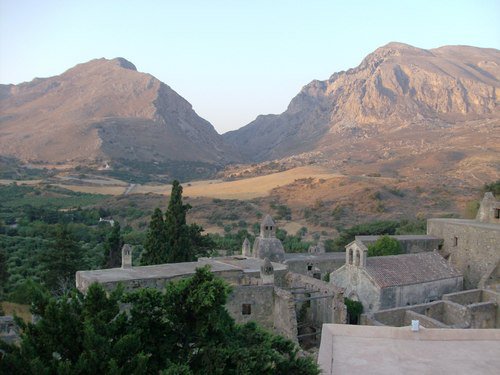
The Kato Moni lies close to the arched stone bridge over the Megalopotamos, which was built in 1850; a second bridge, over the tributary Bourtzoukos, followed two years later. In the period of Ottoman rule and the risings the monastery was destroyed and plundered several times – above all in 1649, 1823 and 1867 – and an earthquake in 1810 did serious damage besides. Its katholikon is a single-aisled church of St John the Baptist; some of the icons and liturgical vessels were later taken to the upper abbey and to the museum. The refectory, monks’ cells, an olive press, workshops, stables and storerooms also survive. Since the life of the brotherhood moved entirely to the upper monastery around 1900, the complex has lain deserted, and in 1941 it suffered once more at German hands; yet its roofless walls still allow the plan of a monastic farmstead to be read quite clearly.
Piso Preveli – the Upper Monastery of St John the Theologian
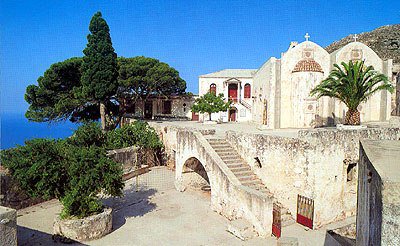
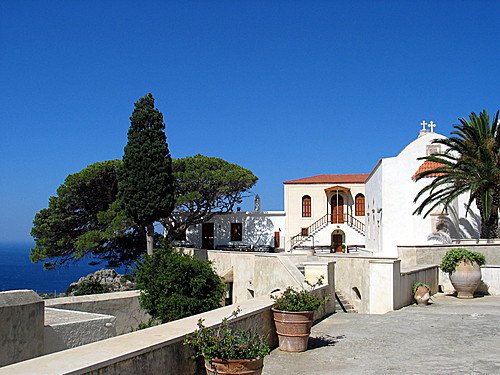
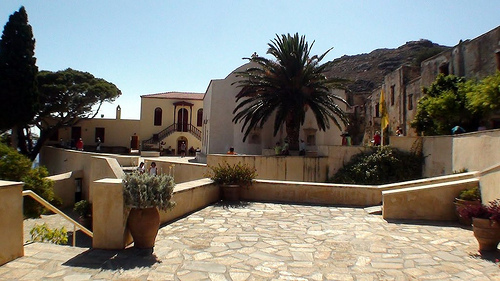
The Piso Moni stands about 170 metres above the sea on a rocky slope and faces the Libyan Sea with buildings stepped in terraces. Its rebuilding was begun in 1823, after the Ottoman sack, by Abbot Nilos Moschovitis. The present two-aisled katholikon was built in the 1830s, probably in 1836, on the site of an older church: the right-hand aisle is dedicated to St John the Theologian, the left to the Annunciation of the Virgin. Inside are a richly carved wooden iconostasis, liturgical vessels and icons. The abbot’s lodging dates from around 1900, part of a campaign of reconstruction that started in 1897 and ended with the renovation of the whole upper monastery in 1911. The principal feasts of the monastery are 8 May, the day of St John the Theologian, and 14 September, the Exaltation of the Cross.
The church museum, a small one, holds portable icons of the 16th to 20th centuries, gathered from both monasteries and from their dependent chapels, among them works of the Cretan School and panels by the 19th-century painter Merkourios Sigalas of Santorini, who was working here in 1841; also manuscripts, liturgical books, documents, crosses and other sacred objects. The collection includes pieces from the inner life of the monastery as well as evidence of the history of the Orthodox community of Crete.
The history of Preveli unfolded gradually. The lower abbey by the Megalopotamos was the economic centre, while the Piso Moni on the hillside became the spiritual and administrative core. Since about a kilometre and a half lies between the two, they are best understood as two connected but distinct architectural spaces. Until well into the 20th century the monastery owned most of the land round about, as far as the fields of Myrthios. It also did much for education: in 1831 Abbot Nikodimos financed one of the first Greek schools of the district, reviving an older school that had lapsed.
Melchisedek Tsouderos and the struggle for the freedom of Crete
From 1803 to 1823 Melchisedek Tsouderos, from nearby Asomatos, was abbot of Preveli. He belonged to the Filiki Eteria, the secret society founded in Odessa in 1814 to prepare the Greek rising, and became one of the first organisers of the revolt of 1821 in Crete: on 24 May of that year he had the flag of the rising hoisted on a height above the monastery – by tradition the first to be raised on the island – equipped a band of his own and supported the armed struggle against Ottoman rule. He died on 5 February 1823 after an engagement in western Crete; a few months later Ottoman troops sacked the monastery. At Preveli he is remembered as a spiritual leader who joined service to the abbey with responsibility for the fate of the island.
Preveli in the war years
During the Battle of Crete in May 1941 and the German occupation that followed, the monastery became a refuge for Greek and Allied soldiers – British, Australians and New Zealanders who were wandering in the south of the island after the defeat. Under the direction of Abbot Agathangelos Lagouvardos the monks supplied those in hiding with food, kept in touch with the local resistance and helped to organise the crossing: in the summer of 1941 British submarines several times took off groups of soldiers in the bay below the monastery and carried them to Egypt.
On 25 August 1941 German troops occupied the monastery. The monks were arrested and taken to the Firka prison in Chania; they were accused of having concealed weapons and a wireless set and of having helped British soldiers. The abbot himself escaped to the Middle East, where he died before the end of the war. When the brothers were released the abbey had been stripped – livestock, stores and equipment had been carried off, and the lower monastery lay wrecked – but the monks and the people of the surrounding villages put it in order again and went on helping those who had to hide from the occupation authorities.
The Cross of Preveli and the memory of its miraculous return
The chief treasure of the upper abbey is a precious silver-mounted cross enclosing a splinter of the wood of the Cross of Christ. According to tradition it came from Constantinople and has been in the monastery since 1769; an inscription on the base names Abbot Ephraim as the donor. In church tradition it is held to work miracles, and the faithful come to it with their prayers and petitions.
Monastic tradition relates that German soldiers carried off the cross in 1941 in order to remove it from Crete. It was taken to the airfield at Maleme, but the aircraft that was to bear it to Germany could not take off in spite of several attempts; the relic was thereupon handed over to the police in Chania and given back to the monastery – whereupon, the story adds, the aeroplane left without difficulty. Most accounts place this in September 1941, shortly before the feast of the Exaltation of the Cross; other tellings move the event to 1944. In the monastery they even speak of two thwarted attempts at theft: the earlier is laid in 1823, when Genoese pirates are said to have seized the cross, only to find their ship held motionless on the water until they returned it. The faithful understand the return as miraculous aid and make the pilgrimage to Preveli every year.