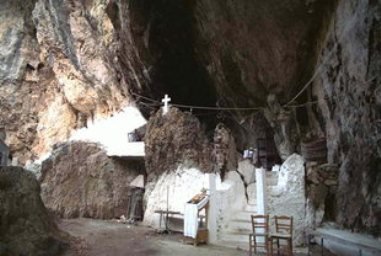
Patsos: the Cave of St Anthony and the Sanctuary of Hermes Kranaios
The most complete guide to Crete: 221 places on the map, 23 routes and 49 articles — with photos, videos and the story behind every place. No sign-up, no trackers.
Routes drawn along real roads
Weather at every stop
Full-text search
“Near me” by geolocation
Create your own printable itinerary
Satellite, terrain, dark mode
Works offline
⌕
Searches 1.7 million characters of descriptions, not just names
—places
4regions
—routes
—with video
Search results
—
Interactive map
Find what is near you
Filters narrow the map and the list at once. Zoom out and pins group together.
Region
Category
Фильтры карты
Landmarks
Featured places
RegionCategory
Routes
Ready-made day trips
Individual places
Articles about landmarks
The Cave of St Anthony in the Patsos Gorge
North of the village of Patsos, in the Amari district of the prefecture of Rethymno – some thirty kilometres south of the town and eight kilometres south-west of Arkadi Monastery – the Cave of St Anthony (Agios Antonios) lies in a green gorge: not a true cavern but a shallow recess beneath an imposing overhang of rock, into which a small chapel has been built. The present church is dedicated to St Anthony, the saint of caves, who in local devotion is regarded as the patron of children. The place itself, however, keeps the memory of a far older sanctuary.
The cave served as a place of worship in Late Minoan, Hellenistic and Roman times – for many centuries, that is, on the archaeologists’ reckoning. Excavation has brought to light pottery, terracotta figurines, animal bones and other votive offerings. The first investigations took place in the late 19th century, when the Italian archaeologist Federico Halbherr worked here in 1885–86 and recovered figurines of people and animals; more objects turned up in 1894 and were sold to Arthur Evans. Later campaigns and rescue excavations carried the work on in the 20th century.
Chapel and pilgrimage
The chapel of St Anthony is set directly into the hollow of the rock. Water seeps from the roof of the cave and is venerated by the faithful as holy water; on the saint’s feast day pilgrims come here from the whole surrounding district. The crevices in the rock around the chapel are stuffed with thousands of tiny slips of paper on which visitors have written their prayers and wishes. The gorge has been laid out for walking by the forestry service: old plane trees grow beside the path, and the riverbed leads on to the Potami dam, whose reservoir, completed in 2008, holds some 23 million cubic metres of water.
The ancient sanctuary and its finds
Material from the Late Minoan period down to the Roman era was discovered in the cave: pottery, terracotta figurines of people and animals, the burnt bones of sacrificed animals and votive gifts. The finds from Patsos are divided between the museums of Rethymno, Heraklion and Oxford – Halbherr’s figurines went to the Archaeological Museum of Heraklion, while the pieces acquired by Evans in 1894 travelled to Oxford. They prove that the cave remained a place of veneration for many centuries – on the usual dating, from the second millennium BC into late antiquity.
The chapel of St Anthony
The present chapel is cut into the rock and dedicated to St Anthony the Great, whom local Orthodox tradition honours as protector of children. Water drips from the roof of the cave; it is caught in a vessel and held to be holy water. Every year on 17 January, the saint’s feast and the anniversary of his death in 356, the inhabitants of Patsos and pilgrims from the surrounding villages come here to celebrate the liturgy.
The Patsos Gorge as a nature walk
The cave lies about four hundred metres from the southern entrance to the gorge, at an altitude of roughly 490 metres. A well-kept path leads to it between old plane trees and rocks; beyond, the riverbed continues to the Potami dam, about three kilometres away. The gorge, in which several springs rise and the water flows for almost the whole year, lies some three kilometres south of the village; the walk through it takes about an hour – nearer two with stops and the return – and is considered easy, with a drop of only a hundred metres or so from end to end. An asphalt road runs to the entrance. Greenery, shade and water make the route a pleasant stroll, but after rain the stones are slippery. Along the way there are resting places on broad terraces with wooden benches and tables for picnics, and a hide for watching birds; tavernas are to be found in the village and in the gorge.
From ancient cult to pilgrimage
Two layers of memory overlie one another in the cave today. Archaeology tells of the ancient gifts to Hermes; Orthodox tradition of prayer before the icon of St Anthony, of the paper petitions tucked into the rock and of the holy water dripping from the roof. For the visitor this is no museum piece detached from life but a living place of worship, where the past remains present in service and pilgrimage. Access is free.