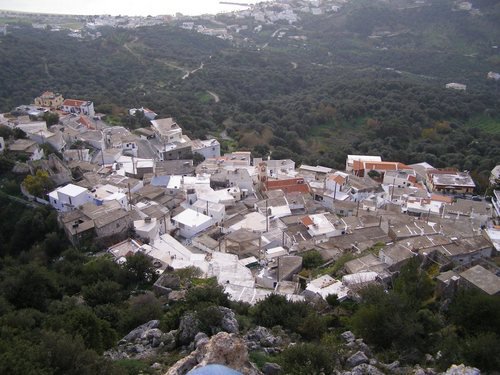
Myrthios – the hill village above the bay of Plakias
The most complete guide to Crete: 221 places on the map, 23 routes and 49 articles — with photos, videos and the story behind every place. Everything is open and free: no sign-up, no paid sections and no advertising, open or hidden. You can install the guide on your smartphone as an app.
Routes drawn along real roads
Weather at every stop
Full-text search
“Near me” by geolocation
Create your own printable itinerary
Satellite, terrain, dark mode
Works offline
⌕
Searches 1.7 million characters of descriptions, not just names
—places
4regions
—routes
—with video
Search results
—
Interactive map
Find what is near you
Filters narrow the map and the list at once. Zoom out and pins group together.
Region
Category
Фильтры карты
Landmarks
Featured places
RegionCategory
Routes
Ready-made day trips
Individual places
Articles about landmarks
Myrthios above the bay of Plakias
Myrthios (Μύρθιος) is set like an amphitheatre on the southern slopes of Kouroupa, the 984-metre mountain that separates the Kotsifou Gorge from that of the Kourtaliotis; it lies some 36 kilometres from Rethymno and about 200 metres above the sea. From the village one looks down on the bay of Plakias, the Libyan Sea and the cleft of the Kotsifou Gorge, and the taverna terraces on the hillside are among the finest viewpoints on the south coast – late afternoon and dusk are the hours to be there. Local people speak with pride of a curious spectacle: on nights of the full moon from September to January the reflection of the moon lies across the sea as a broad path of light. Myrthios is mentioned in written sources from the Venetian period, but its church monuments point to an older, Byzantine settlement, and the recorded history of the village is generally taken back to the 10th century.
The village, which is protected as a traditional settlement, has kept its inherited plan: stone houses, courtyards, flights of steps and narrow passages that follow the lie of the ground. It is a place to be explored on foot, and the lanes are steep. The surroundings preserve traces of ancient cultivation and Roman sherds in the localities of Petres and Agios Theodoros, and on the summit of Vrysinas archaeologists have uncovered a peak sanctuary with an altar and clay figurines of animals.
The written record of Myrthios begins in the Venetian period, when the village formed part of the estate of a Venetian family. According to local tradition it originally stood closer to the sea and was moved further uphill because of frequent pirate raids; the remains of an old aqueduct on the plain are taken as evidence of that earlier site. The inhabitants are of mixed origin – families from Sfakia, from other parts of Crete and from the Greek mainland settled here, and legend even adds former corsairs; Turks are said never to have lived in the village. On the heights round about stand the remains of small fortifications with loopholes, the local koules. Older defences are remembered too: Nikephoros Phokas is credited with building roads and bridges in this district, and fragments of a fortified enclosure survive to the north-east of Plakias.
The church of the Transfiguration: a building from before 961
The church of the Transfiguration of Christ (Metamorfosi tou Sotiros) is a single-aisled chapel and is regarded as one of the oldest monuments of Myrthios. Local tradition places its construction before 961, the year in which the Byzantine general and future emperor Nikephoros Phokas wrested Crete from the Arabs: his fleet had sailed in 960, and after a siege of nine months he entered Chandax, the Arab capital, on 6 March 961. According to legend Phokas found the village already in existence when he was planning the fortification and restoration of the Christian settlements of the island. Wall paintings survive inside, among them scenes of the Last Judgement with the damned – a subject that the village churches of Crete liked to treat with graphic vividness, and one that ties the building to the Byzantine tradition of painting. Frescoes and details of the masonry recall the medieval past of the place.
St Charalambos and the Venetian bell
The second principal church of Myrthios is dedicated to the martyr-bishop St Charalambos. It has two altars: that of St Charalambos and that of the Annunciation of the Virgin. In the belfry hangs a Venetian bell bearing the date 1589 – cast, that is, eighty years before the fall of Candia and a rare survival, linking the parish life of today with the age of Venetian Crete. For the history of the village it is particularly telling, since it bears witness to the continuity of the community through Venetian rule and all the upheavals that followed.
The watermill in the Kotsifou Gorge
Below Myrthios, on the bed of the Kotsifos, a large watermill of the 19th century has survived. The water reached the wheel through a masonry channel and set the millstones turning; the mill served the neighbouring villages and tied the economy of Myrthios to the gorge. Part of the installation was later repaired, and the old aqueduct remains a landmark on the footpath that leads up along the river from Plakias, about a kilometre and a half from the shore. It is one of three mills on the lower course of the stream – another, known as the Mill of the French, has been turned into a house – and an old stone bridge and the cave chapel of St Onoufrios stand in the same stretch. The gorge itself, which opens to the west of Kouroupa, begins at the village of Kanevos as a slot barely ten metres wide and broadens over its 1,800 metres to some 600, between walls that rise almost sheer to a similar height; a tributary, the Boutsinas, joins it over a waterfall of twenty metres. The upper bed is dry in summer, but below the springs the Kotsifos runs all year. The gorge has always been shared by two villages: one half belongs to Myrthios, the other to Sellia. One of its springs is called Mairi Kolymba; village legend has a monstrous eel living there, a hundred okas in weight.
Paligremnos and the memory of the war
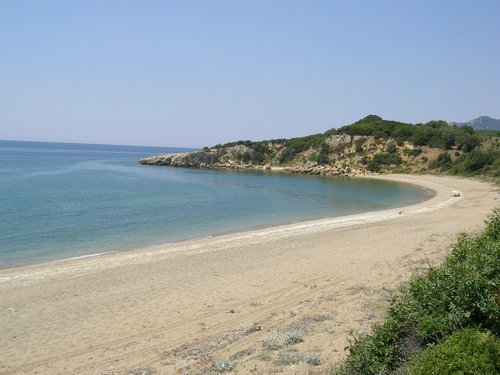
On the coast below Myrthios, in the area of Paligremnos – the rock face also known as Gonates, a smooth limestone fault scarp more than 80 metres high at the eastern end of Plakias beach – there are small caves that served the inhabitants as shelters from bombing during the German occupation. Paligremnos is also known for a natural curiosity: in certain months large squid, called θράψαλα (thrapsala) in Cretan dialect, would come in to the sandy beach, and local people hauled them out with long poles. They connect it with the full moons of autumn and early winter, when the light reflected from the cliff falls on the water and seems to draw the creatures inshore. So in one spot the memory of war, a seasonal catch and the seascape come together – to which the present day has added the ropes of climbers, for whom the wall is one of the best-known crags in Greece.