Prassano Gorge: the Sfakoryako Streambed South-east of Rethymno
The most complete guide to Crete: 221 places on the map, 23 routes and 49 articles — with photos, videos and the story behind every place. Everything is open and free: no sign-up, no paid sections and no advertising, open or hidden. You can install the guide on your smartphone as an app.
Routes drawn along real roads
Weather at every stop
Full-text search
“Near me” by geolocation
Create your own printable itinerary
Satellite, terrain, dark mode
Works offline
⌕
Searches 1.7 million characters of descriptions, not just names
—places
4regions
—routes
—with video
Search results
—
Interactive map
Find what is near you
Filters narrow the map and the list at once. Zoom out and pins group together.
Region
Category
Фильтры карты
Landmarks
Featured places
RegionCategory
Routes
Ready-made day trips
Individual places
Articles about landmarks
Prassano Gorge and the bed of the Sfakoryako
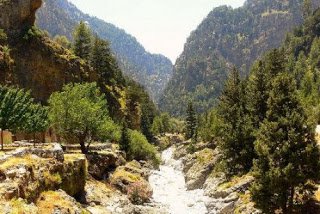
Prassano Gorge – Prassano Farangi in Greek – begins south of the village of Prasies, some ten kilometres south-east of Rethymno, and cuts northwards through the bare limestone hills of Gargana. Prasies itself, which stands at about 250 metres above sea level, is a medieval village that still has Venetian mansions and a few Ottoman buildings, and is reached by an asphalt road. The gorge is a natural corridor of stone walls, centuries-old plane trees and the bed of a mountain torrent, the Sfakoryako. In the dry season the streambed can be walked from end to end; the full descent, about six kilometres, takes around four hours and calls for some experience of pathless ground.
A cave near the village has not yet been explored. The safest time to plan the walk is between the middle of June and the end of October, when the water level drops; even then, the weather and the state of the route should be weighed up before setting out. Water generally lingers in the bed until spring, and the gorge also serves as the overflow channel for the Potami reservoir upstream, which is a further reason to keep to the dry months.
Cretan dittany
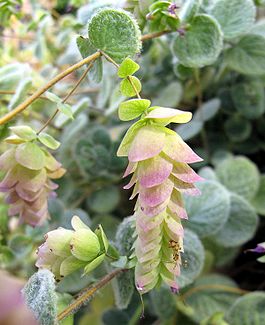
Among the plants of the gorge is dittany of Crete (Origanum dictamnus), also known as Cretan dittany or hop marjoram. It grows wild nowhere but on Crete: a low, tender shrub 20 to 30 centimetres high, with rounded leaves no more than a couple of centimetres across, so thickly covered in white-grey down that they feel like velvet, and rose-pink flowers set among deeper purple-pink bracts that appear in summer and autumn. It holds on by preference in the crevices of cliffs that are hard to reach. Ancient writers credited it with healing power; Virgil mentions the Cretan herb in the “Aeneid”, in the scene in which Venus comes to the aid of the wounded Aeneas.
The caves of the gorge give shelter to rare bats, among them the Cretan race of the greater horseshoe bat. A wide variety of plants and birds has been recorded in the larger protected area; the wetlands and the shore are bound up with the nesting beaches of the loggerhead turtle (Caretta caretta) and with the presence of the Mediterranean monk seal, which uses the sea caves between Skaleta and the mouth of the Geropotamos.
The route down the bed of the Sfakoryako
The route starts south of Prasies, at the northern end of the Potami valley – the valley now partly filled by the Potami reservoir – and gradually drops into the streambed, framed by vertical walls, plane trees and dense growth; in places the huge boulders that choke the bed make for awkward passages. About four hours should be allowed for the whole distance, rather more for a group; the difference in height is small, around a hundred metres, and the difficulty is rated as moderate. Where the going in the bed becomes hard, one takes to the goat tracks on the slopes. Towards the end the gorge narrows to a few metres; the exit is at Missiria and Platanias, east of Rethymno, where an old bridge still stands shortly before the sea, and where the beach is close enough for a swim afterwards. As the walk is linear, transport should be arranged at one end or the other. After rain the streambed is impassable, which is why the descent is made in the dry season.
A protected natural area
The Natura 2000 site GR4330004 also appears in some lists under the abbreviated title “Prassano Gorge – river – stream”. It takes in not only the rock walls but also the streambed, temporary waters, riverside habitats and stretches of the coast, including the small wetland at the mouth of the Geropotamos. The gorge therefore matters as a continuous ecosystem linking the mountains with the sea; for migratory birds it is an important resting place, and its plant life changes perceptibly from south to north. Botanists rank it alongside the Samaria Gorge for the interest of its flora: besides dittany, the cliffs carry other plants of the rock face such as Erysimum candicum, a wallflower confined to Crete, Karpathos and the Cyclades.
Dittany and ancient medicine
Dittany (Origanum dictamnus) is an endemic Cretan marjoram with silvery, rounded leaves and pink flower heads. Antiquity believed it could staunch bleeding; Hippocrates prescribed it for stomach and digestive complaints and for the healing of wounds. In the twelfth book of the “Aeneid” (lines 411–415) Virgil tells how Venus fetches dittany from the Cretan mountains – a stalk clothed in downy leaves and crowned with a purple flower – to heal the wounded Aeneas. Retellings usually name Mount Dikte, from which the plant is supposed to take its name, whereas the poet himself speaks of Cretan Ida. In this way the Cretan herb entered the literary memory of Europe.
Caves, birds and coast
The caves of the gorge serve as a refuge for rare species of bat. Numerous birds live in the woods and on the crags, birds of prey among them: griffon vultures, which have a colony here, wheel above the walls, buzzards are common, and a small population of Bonelli’s eagle is at home in the gorge too. The damp, rocky bed is good ground for reptiles and amphibians – the leopard snake, the stripe-necked terrapin and the Cretan tree frog are all recorded – and kingfishers work the water lower down. Further on, in the coastal zone, the ecosystem is connected with the nesting beaches of the loggerhead turtle and the rare visits of the monk seal. Thus the nature trail continues from the mountain stream to the sandy beaches.
The cave near Prasies
The cave discovered close to the village has so far been neither explored nor opened to visitors, and should not be entered. It is a sign that the natural heritage of the gorge is not exhausted by the familiar walking route: new sites have to be investigated by archaeologists and speleologists before they can be included in anything offered to tourists.