The most complete guide to Crete: 221 places on the map, 23 routes and 49 articles — with photos, videos and the story behind every place. Everything is open and free: no sign-up, no paid sections and no advertising, open or hidden. You can install the guide on your smartphone as an app.
Routes drawn along real roads
Weather at every stop
Full-text search
“Near me” by geolocation
Create your own printable itinerary
Satellite, terrain, dark mode
Works offline
⌕
Searches 1.7 million characters of descriptions, not just names
—places
4regions
—routes
—with video
Search results
—
Interactive map
Find what is near you
Filters narrow the map and the list at once. Zoom out and pins group together.
Region
Category
Фильтры карты
Landmarks
Featured places
RegionCategory
Routes
Ready-made day trips
Individual places
Articles about landmarks
The Monastery of St Irene
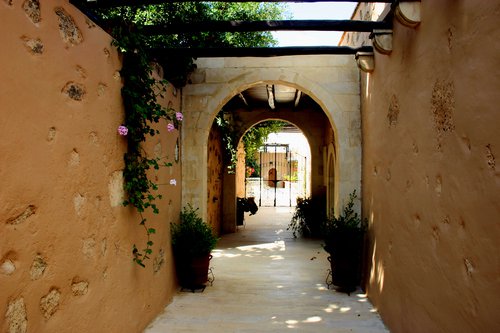
The monastery of St Irene (Ιερά Μονή Αγίας Ειρήνης) rises on a rugged outcrop of rock at the foot of Mount Vrysinas, the 858-metre mountain south of the town, about five kilometres from Rethymno and at a height of some 260 to 280 metres, just before the road reaches the village of Roussospiti. It is attested in writing as early as 1362: a Venetian document of that year names it as an important monastery with considerable landed property. The little settlement of Agia Irini at its foot takes its name from it. From outside, the complex has the look of a fortress – a high enclosing wall surrounds the courtyard, along the edges of which the cells are ranged.
Until the rising of 1821 the monastery was inhabited without a break; a surviving seal bears the date 1751. After that the brotherhood dwindled to one or two monks, and around the middle of the 19th century the property passed into the administration of the local school committee, which spent the income on schools and charitable purposes. The great Cretan revolt of 1866 brought heavy destruction: Turkish troops plundered and laid waste the monastery, in the same year in which they burnt the village of Roussospiti just above it. In the disturbances of 1896–97 it was finally burnt down, and thereafter it lay deserted for almost a century. Only in 1989, under Metropolitan Theodoros of Rethymno, did rebuilding begin, and a community of nuns moved into the renewed walls.
Because the monastery stands high above the town, its courtyard commands a broad view of Rethymno, the Fortezza and the Sea of Crete. In the workshops and in the exhibition the nuns’ work can be seen, made in the tradition of Cretan handicraft: embroideries, weavings and painted icons. The sisters have a name for hospitality and are glad to show visitors round. In the middle of the courtyard stands a more recent church, likewise dedicated to St Irene; a chapel consecrated in 1994 is dedicated to the martyrs Raphael, Nicholas and Irene.
The katholikon and the sacred treasures of the monastery
In 2011 the restoration of the old three-aisled katholikon, the principal church of the monastery, was completed. The central aisle is dedicated to the Great Martyr St Irene, the right-hand aisle to the Great Martyr St Euphemia and the left to the Great Martyr St Catherine. The wooden iconostasis, the Royal Doors and the proskynetarion, the stand on which an icon is set out for veneration, are the work of a craftsman from Chania in the tradition of hand carving; the icons were painted by the sisters of the convent themselves.
In the church is the icon of St Irene, venerated as wonder-working, which was painted in 1930 by the priest-monk Nestor Vassalos. Also kept here is an old copy of the icon of the Virgin Eleousa (“the Merciful”) from Kykkos Monastery in Cyprus, the original of which tradition ascribes to St Luke the Evangelist. From the 19th century come two icons by the painter I. Stathakis, dated 1871: a Dormition of the Virgin and a St Irene. The faithful may venerate relics of St Irene and St Euphemia, together with a fragment of the Life-giving Cross.
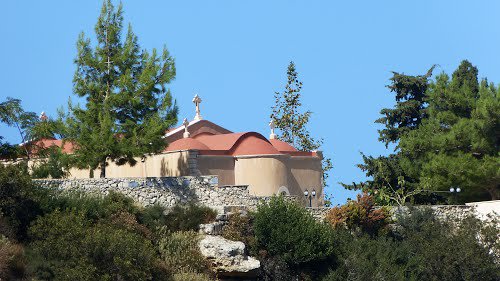
In the architectural details different periods meet. The pointed-arched windows recall the Venetian age, in particular the decades before 1600, and in general the building follows Western models. Above the entrance the date 1702 is carved. The three domes without drums over the sanctuaries, on the other hand, point to a remodelling during Ottoman rule, which is usually placed in the year 1755 – only four years after the date on the monastery’s surviving seal. Local tradition relates that a monk cured the daughter of the pasha of Rethymno and in return received permission to enlarge the single-aisled church into one of three aisles.
The restored katholikon was solemnly reopened on 20 August 2011. The consecration was led by Theodoros II, Pope and Patriarch of Alexandria and All Africa – himself a Cretan, born on the island on 25 November 1954 as Nikolaos Choreftakis, who from 1975 to 1985 served as archdeacon and chancellor of the Cretan diocese of Lampi and Sfakia, later worked as a missionary bishop in Cameroon and Zimbabwe, and was elected Patriarch on 9 October 2004. Since then the monastery has continued as a convent of nuns: a place of prayer and pilgrimage where the ecclesiastical heritage of Crete is kept alive.
Notes for visitors
The monastery lies on the road from Rethymno to Roussospiti, the old Venetian village 300 metres up on the slope of Vrysinas, and combines well with an excursion to the villages around the mountain, for instance to Chromonastiri, with its Byzantine churches and the Venetian Villa Clodio, or into the gorge of the watermills at Myli. The patronal feast of St Irene is celebrated on 5 May. Visitors are welcome, but should respect the sisters’ midday rest. Anyone who buys an embroidery or an icon in the small exhibition is directly supporting the community and the upkeep of the buildings.