Chromonastiri – Byzantine churches and the Villa Clodio
The most complete guide to Crete: 221 places on the map, 23 routes and 49 articles — with photos, videos and the story behind every place. Everything is open and free: no sign-up, no paid sections and no advertising, open or hidden. You can install the guide on your smartphone as an app.
Routes drawn along real roads
Weather at every stop
Full-text search
“Near me” by geolocation
Create your own printable itinerary
Satellite, terrain, dark mode
Works offline
⌕
Searches 1.7 million characters of descriptions, not just names
—places
4regions
—routes
—with video
Search results
—
Interactive map
Find what is near you
Filters narrow the map and the list at once. Zoom out and pins group together.
Region
Category
Фильтры карты
Landmarks
Featured places
RegionCategory
Routes
Ready-made day trips
Individual places
Articles about landmarks
Chromonastiri – Byzantine churches and the Villa Clodio
Chromonastiri (Χρωμοναστήρι) lies on the northern slopes of Mount Vrysinas, eleven or twelve kilometres south-east of Rethymno by road, and has around 360 inhabitants – the figure of the 2021 census for the whole community, which takes in the hamlets of Prinedes, Kapediana and Myli as well; the village proper has just under three hundred, and in 1940 the community still numbered 640. To this day the place feels like a piece of the past: in its lanes stand well-preserved houses of the Renaissance period with Venetian architectural forms, in a settlement that goes back to the 12th or 13th century. In the surrounding countryside two Byzantine churches have outlasted the centuries, Agios Eftychios and Panagia Kera, and in the middle of the village rises the Venetian Villa Clodio, now the Military Museum of Rethymno. A folk collection completes the picture, and the restored Prinari oil mill has been fitted out as a small museum of olive growing and traditional pressing.
The church of St Eutychios (Agios Eftychios)
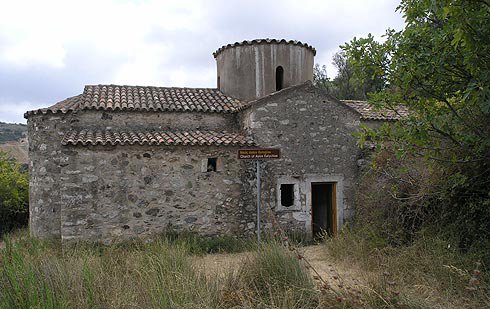
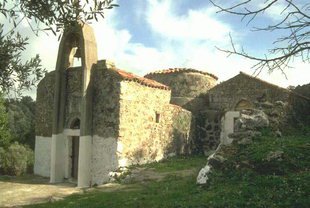
The church of St Eutychios stands about a kilometre and a half from the village on the side of a ravine, in the abandoned settlement of Perdiki Metochi; a side road branches off to it near the entrance to the village. It is one of the oldest churches in Crete and represents a rare building type: a variant of the compact cross-in-square church with an octagonal core, closed on the east by a large semicircular apse. Two deep wall niches flank the apse, the original west entrance is walled up, and both inside and round about parts of a pebble floor survive.
In the apse a fresco cycle of the 11th century has been preserved: in the conch the Deesis, and beneath it, in two registers, Fathers of the Church shown frontally, with further figures of saints. The condition is fragile, but the paintings are remarkable for a direct, almost popular force of expression, such as is characteristic of the provincial art of the Middle Byzantine period; the faces of Christ and the saints, with their large eyes and firm outlines, are what most visitors remember.
The excavations have brought a long earlier history to light. The site was already in use in the 3rd century AD; a first securely identified building, rectangular and without an apse, was put up in the late 6th or early 7th century. Its north and south walls served as foundations for the church that was built at the beginning of the 11th century – the very years in which the Cretan ascetic St John Xenos was founding churches in this district, among them one of St George “Opsaropiastes” near Chromonastiri. The only known written mention occurs in 1637, in a register of the Orthodox churches of the district of Rethymno. In Ottoman times the building was converted into a dwelling and was returned to its proper purpose only in the 20th century. Between 2011 and 2013, under a Greek–Cypriot cooperation programme, it was structurally consolidated, archaeologically investigated and restored; in the course of this work the frescoes were conserved and the surroundings laid out afresh.
Panagia Kera
The church of Panagia Kera lies about two kilometres south-east of Chromonastiri in open country; it was once the centre of the monastery to which the village is said to owe its name. Its wall paintings date from several periods, among which the 11th and the 14th centuries stand out – the cruciform, domed core belongs to the earlier date, most of the surviving painting to the later. The church is valuable not only for its frescoes but also for its many-layered architecture: the central cross-in-square building is adjoined by side chambers and by a narthex added later, so that the history of the building can be read from the masonry.
Villa Clodio and the Military Museum
The Villa Clodio was built around 1610 as the country seat and summer residence of a Venetian family of rank. The Clodio came from Mogliano near Venice; a Matteo Clodio is said to have taken part in the naval battle of Lepanto in 1571, and in Crete the name is attested from 1601. The façade still displays the family’s coat of arms with the winged lion of St Mark, emblem of the Republic of Venice. After the Ottoman capture of Rethymno in 1646 the local aga resided here: the house became a konak, the official seat and dwelling of a representative of the authorities, and remained one until the Ottomans withdrew in 1898.
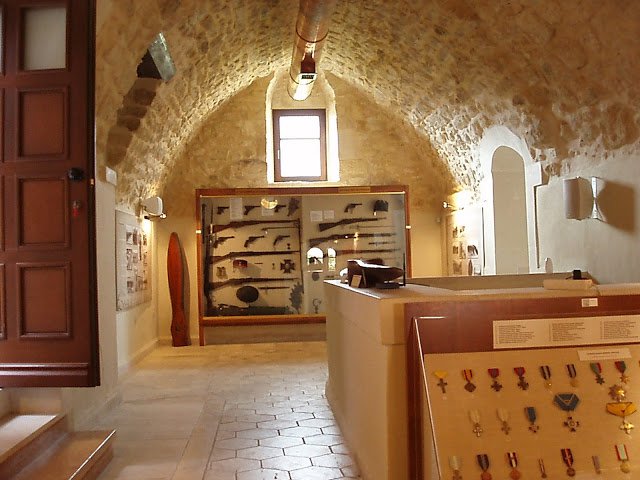
In 1985 the last owner, Alkiviadis Kotzampasis, gave the villa to the community of Chromonastiri, which between 1990 and 1995 carried out the first work of consolidation under the supervision of the Archaeological Service. In 1997–98 the building was handed over to the Greek army, which restored it completely in about five years; the initiative came from the then chief of the general staff, Manousos Paragioudakis. On 21 May 2010 a branch of the War Museum was opened in it. The rooms show weapons and uniforms illustrating the history of Crete and of Greece – from 1821 to the Korean War – together with decorations and medals, costumes and models of fortresses from the Venetian period, a room of its own devoted to the Battle of Crete of 1941 with captured German and Italian weapons, and memorabilia of the Reserve Officers’ School. In the courtyard stand the larger exhibits: guns, vehicles, tanks, a helicopter and a Cessna 172 aircraft. The house also serves as a venue for lectures, concerts and book launches.
Notes for visitors
Chromonastiri combines well with the monastery of St Irene, with Roussospiti and with the gorge of the watermills at Myli to make a round trip on the slopes of Vrysinas; a waymarked footpath also leads up here from Rethymno by way of Agia Irini and Myli. The two Byzantine churches lie outside the village and are not always open – it is best to ask for the key in the village or at the museum. In the village itself the parish church is dedicated to St George, and in the country beyond are the ruins of the abandoned 16th-century monastery of Chalevi.