Rethymno – the town, the Fortezza and the old quarter
The most complete guide to Crete: 221 places on the map, 23 routes and 49 articles — with photos, videos and the story behind every place. No sign-up, no trackers.
Routes drawn along real roads
Weather at every stop
Full-text search
“Near me” by geolocation
Create your own printable itinerary
Satellite, terrain, dark mode
Works offline
⌕
Searches 1.7 million characters of descriptions, not just names
—places
4regions
—routes
—with video
Search results
—
Interactive map
Find what is near you
Filters narrow the map and the list at once. Zoom out and pins group together.
Region
Category
Фильтры карты
Landmarks
Featured places
RegionCategory
Routes
Ready-made day trips
Individual places
Articles about landmarks
Rethymno – fortress town and open-air museum
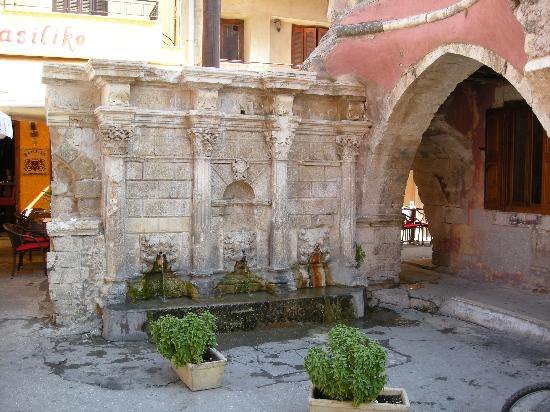
Rethymno (Ρέθυμνο), with a population of around 35,000, is the third town of Crete and one of its most completely preserved historic towns. The Venetian fortress, the Fortezza, rises above the old quarter, and the lanes between fortress and sea form a many-layered urban museum: Venetian houses with their carved stone doorways stand beside Ottoman buildings, Orthodox churches, fountains and the cultural venues of today. The Loggia of the 16th century, the Rimondi fountain, the Guora gate (the Megali Porta, once the main entrance through the Venetian town wall), the Neratze mosque with its tall minaret, now the municipal Odeon, the Venetian mansions along Arkadiou Street and the small Venetian harbour with its lighthouse of the Egyptian period are all within a few minutes’ walk of one another.
From Rithymna to Venetian Rethymno
The history of the settlement reaches back to Late Minoan times, roughly the years 1400 to 1100 BC; tombs of that period, and even Neolithic sherds, have been found on the fortress hill. Here grew the ancient city of Rithymna, which governed itself and struck its own coins; coins and inscriptions of the 4th and 3rd centuries BC attest it, and ancient writers mention a sanctuary of Artemis Rokkaia on the hill. A city named Arsinoe is also recorded on the same site. Towards the end of the Roman period the town declined. Venetian rule reversed its fortunes: the Venetians wanted an intermediate trading station between Candia and Chania, and from about 1250 Rethymno was the seat of a Latin bishop. It became an economic and administrative centre, and educated Cretans returning from Italy brought the ideas of the Renaissance to the island. In 1562, at the instigation of Francesco Barozzi, the Accademia dei Vivi was founded in the town, closely bound up with the intellectual life of Venetian Crete; the Barozzi family had also built the church of St Francis around 1530, which today houses the Archaeological Museum. The dramatist Georgios Chortatzis belonged to this Rethymno of the late 16th century.
The Venetian centuries were nonetheless far from peaceful. Crete lived through revolts, pirate raids and the struggle for the sea lanes. In 1538 the Ottoman corsair Hayreddin Barbarossa sacked the town; on 7 July 1571 the fleet of Uluç Ali fell upon Rethymno and destroyed the old walls and the greater part of the houses. The town wall designed by Michele Sanmicheli and completed around 1570 had proved useless. These raids laid bare the weakness of the existing defences and persuaded Venice to build the Fortezza. After the siege of 1646 – the Ottomans arrived on 29 September and the town capitulated on 13 November – Rethymno passed to the Ottoman Empire, more than twenty years before the fall of Candia.
The Ottoman town and present-day Rethymno
Under the Ottomans Rethymno lost its earlier role as a Venetian administrative and intellectual centre. Some of the Christians left the town, others embraced Islam; at the same time a considerable Muslim population moved in. The change in the inhabitants shaped the townscape: Venetian houses acquired Ottoman additions, wooden projecting balconies, domes and new public functions, and churches were turned into mosques – the Neratze mosque and the mosque of Kara Musa Pasha both belong to this period. The result is a townscape in which two layers of history complement rather than cancel each other. The Ottoman statesman and diplomat Ahmed Resmi Efendi, active in the 18th century, was born in this Rethymno.
After the liberation of Crete and union with Greece Rethymno became the centre of a district with a well-developed agriculture and stock-raising. Its position on the north coast favoured tourism. The University of Crete was founded in 1973 and began teaching in the academic year 1977–78; its School of Philosophy, with the departments of philology, history and archaeology and philosophy, opened in Rethymno in 1977, followed by the School of Social Sciences in 1987 and the School of Education in 1995, all on the Gallos campus above the town. The students they attracted made Rethymno one of the intellectual centres of the island, and the town, which had 8,648 inhabitants in 1940, has grown fourfold since.
A town beside long beaches
Rethymno stretches out along the north coast. East of the town extends one of the largest sandy beaches of Crete – about twelve kilometres long, beginning barely a kilometre from the Venetian harbour; in the west the rocky shore gives way to a further sandy stretch some ten kilometres long. The town remains to this day the administrative, transport and commercial centre of the regional unit of Rethymno, and the municipal unit counted 38,759 inhabitants at the census of 2021.
The Archaeological Museum and the memory of the region
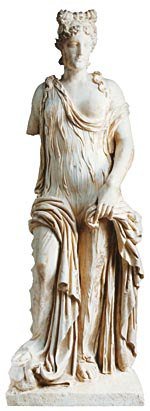
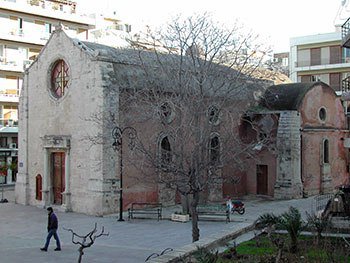
From 1991 to 2015 the Archaeological Museum of Rethymno was housed opposite the entrance to the Fortezza, in the pentagonal Ottoman ravelin that later served as a prison; since then the collection has been shown in the former Venetian church of St Francis (Agios Frangiskos) in the old town, built by the Barozzi family around 1530. Its holdings span the history of the district from prehistory to Roman times: Late Minoan and Hellenistic terracotta figurines, dedicated to deities or deposited as votive offerings, Minoan larnakes (clay burial chests) from the Prepalatial and Neopalatial periods, among them one painted in the Marine style, pottery, inscriptions and coins, including gold issues of Knossos. An archaic inscription from Eleutherna, written boustrophedon – alternately left to right and right to left – and dated between 600 and 450 BC, records a law against excessive drinking. Finds from the caves of the district are shown here too, such as those from the Gerontospilios of Melidoni and a violin-shaped marble idol from the cave of Gerani. Among the sculptures the Roman copy of the Large Herculaneum Woman stands out – a type traced back to a work of Praxiteles; the Cretan example comes from Eleutherna – together with a statue of Aphrodite Rhithymnia of the Roman period. The museum also preserves a marble sarcophagus of the 1st to 3rd century AD with reliefs of mythological subjects.
The Fortezza – fortress on the cape of Paliokastro
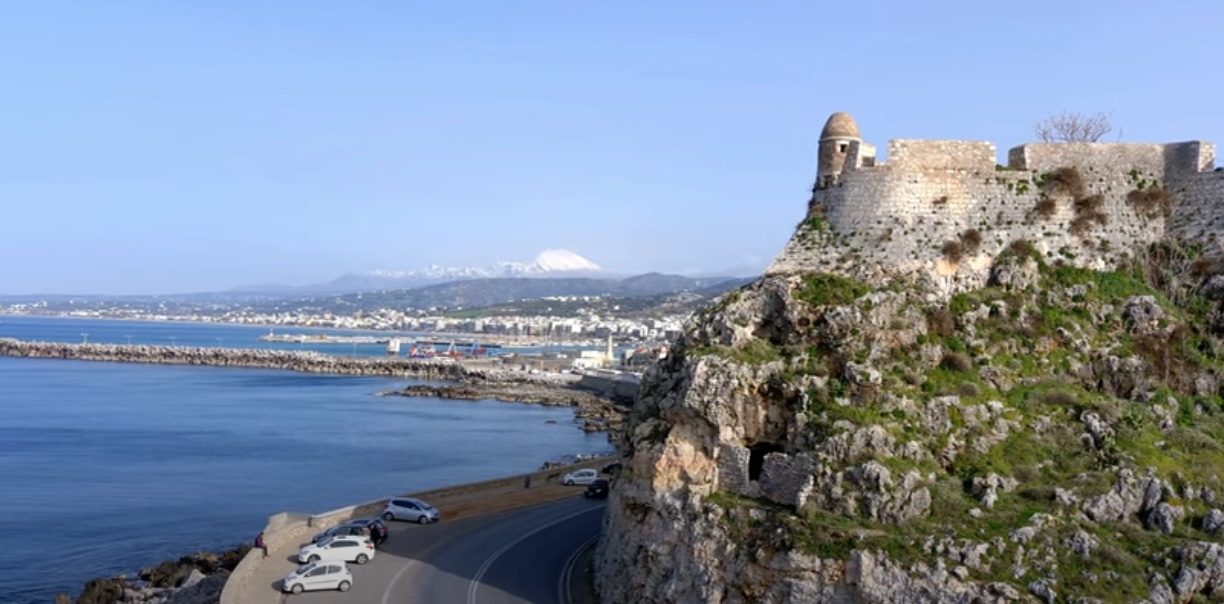
The Fortezza, also called the Kastro, was built by the Republic of Venice between 1573 and 1580, in the years after the naval battle of Lepanto of 1571. The foundation stone was laid on 13 September 1573 under the Rettore Alvise Lando; the design came from the military engineer Sforza Pallavicini, the work was supervised by the engineer Gian Paolo Ferrari, and the master builder was the Cretan Giannis Skordilis. The site chosen was the semicircular cape of Paliokastro jutting into the Sea of Crete. Fortress and town walls were meant to protect Rethymno from pirate raids like those of Barbarossa and Uluç Ali and from the Ottoman fleet. The original idea was to move the whole town up on to the hill; the space proved insufficient, however, and most of the citizens rebuilt their houses below. Inside the walls, therefore, stood only the administration, the cathedral and the garrison, while the fortress was to serve the population as a refuge in time of need – and a place of refuge for a whole town needs cisterns even more than it needs walls, which is why so many were dug here. In 1646 the Ottoman troops landed on the neighbouring coast and took the fortress from the landward side, helped by the absence of a proper ditch and by an outbreak of disease among the defenders – and so showed how vulnerable the work was to an attack from the mainland.
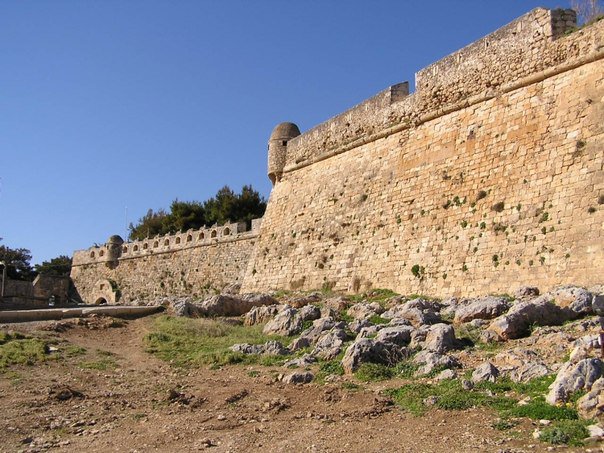
The Fortezza has kept the characteristic features of Italian military architecture: massive polygonal walls of local limestone with a perimeter of 1,307 metres, upper walks with embrasures, where the stone platforms for the cannon-balls still survive, four corner bastions and three gates. Three of the bastions secure the south side, one the east side; on the rocky flanks to the west and north weaker works sufficed. Small inner forts with loopholes probably served to train the garrison. Chapels beside the bastions gave the individual sections their names – St Nicholas at the eastern end, St Theodore (to the Venetians also St Paul or Santa Maria, today the Panagia bastion) in the south-east, St Luke in the south-west, St Elias in the south and others. The main entrance on the east, a vaulted gate between the bastions of St Nicholas and St Paul, is built into the donjon and forms a long gallery wide enough for carts and guns; above it projects a watch-tower that allowed close defence, and a semicircular gun platform covers the approach. Two smaller gates open on the west and north sides. Inside stood the palace of the Rettore (1575–1582, of which only the cells of the prison survive), the two-storey house of the Councillors with its Renaissance character, the bishop’s residence, storehouses along the north wall, the two-storey artillery depot with its arched interior, now used for exhibitions, cisterns and – moved to the edge for safety’s sake – the two powder magazines. Today the Fortezza is at once a museum and a living cultural venue. On the bastion of St Elias lies the open-air theatre “Erofili”, opened in 1993; it is the main stage of the Renaissance Festival, which the municipality has organised since 1987, with theatre, early music, commedia dell’arte and dance from late May to August.
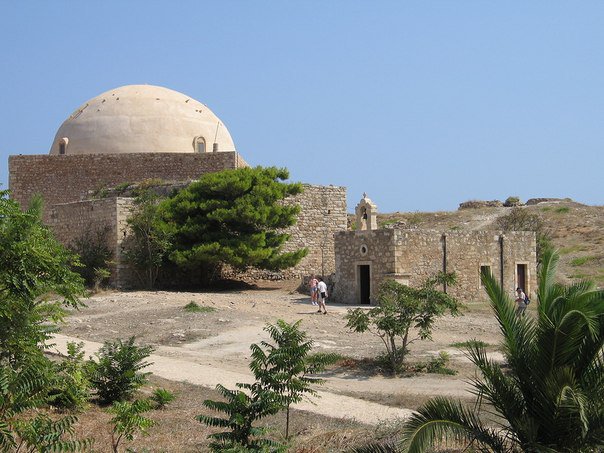
The best-known building inside the fortress is the mosque of Sultan Ibrahim Han. Originally the Venetian cathedral of San Nicolò stood here, built from the end of the 16th century and completed in 1583 – in 1585, in fact, Bishop Carrara still refused to hold services in it, complaining that it was too small and poorly furnished. After the conquest of the town the Ottomans turned the church into a mosque in 1648: pointed arcades were added, a great hemispherical dome eleven metres across resting on eight arches, a minaret, of which only the base remains since its collapse in the early 20th century, and the mihrab – the niche that marks the direction of Mecca. The building passed to the municipality in 1971 and was restored by the Ephorate of Byzantine Antiquities in 2002–04; today it is used for exhibitions, concerts and other cultural events, and its acoustics are famous. The Ottomans also added a pentagonal fort, the ravelin outside the main gate, and built dwellings inside, so that the fortress remained an inhabited quarter of the town into the 20th century; during the German occupation it served as a prison for members of the Cretan resistance, and systematic restoration has been under way since the early 1990s.
The chapels of St Catherine and St Theodore Trichinas
Beside the former mosque stands the small church of St Catherine with its low barrel vault; it was fitted out in a converted water store in the late 19th century, using stone from the fortress itself, and its belfry was added in 1985. By the eastern walls of the fortress lies the church of St Theodore Trichinas, likewise made out of a cistern. Its present building dates from 1899: at that time, under the Cretan State of 1898–1913, Russian troops administered Rethymno, and their commander, Theodore de Chiostak, had the church dedicated to his patron saint. In both chapels single-tier iconostases with four icons, carved stalls and icon shrines have survived, with small bell-cotes outside.
Rethymno demonstrates particularly clearly how a town changes without wholly erasing its earlier plan. Venetian palazzi, the Loggia, fountains and churches stand beside Ottoman wooden oriels (sachnisia), mosques, minarets and baths. After the exchange of populations of 1923 thousands of Greeks from Asia Minor settled in the town and its surroundings, taking over the houses of the departing Muslims; this changed the social and cultural life of Rethymno without blurring the older layers of building. The novelist Pandelis Prevelakis, a native of the town, belongs to the same Rethymno of the early 20th century.
The last public buildings of the Fortezza were completed around 1590, and to this day it is more than an archaeological site. In its halls and courtyards theatre performances, concerts, exhibitions and festival programmes take place. The fortress remains the emblem of the town and links military history, archaeology and the cultural life of present-day Rethymno. A full circuit of the walls and buildings takes about two hours, a brisk visit three-quarters of an hour; whoever climbs up in the late afternoon sees from the ramparts the old town, the harbour and the White Mountains against the light.