Atsipopoulo – a village rich in history above Rethymno
The most complete guide to Crete: 221 places on the map, 23 routes and 49 articles — with photos, videos and the story behind every place. Everything is open and free: no sign-up, no paid sections and no advertising, open or hidden. You can install the guide on your smartphone as an app.
Routes drawn along real roads
Weather at every stop
Full-text search
“Near me” by geolocation
Create your own printable itinerary
Satellite, terrain, dark mode
Works offline
⌕
Searches 1.7 million characters of descriptions, not just names
—places
4regions
—routes
—with video
Search results
—
Interactive map
Find what is near you
Filters narrow the map and the list at once. Zoom out and pins group together.
Region
Category
Фильтры карты
Landmarks
Featured places
RegionCategory
Routes
Ready-made day trips
Individual places
Articles about landmarks
Atsipopoulo – a village rich in history above Rethymno
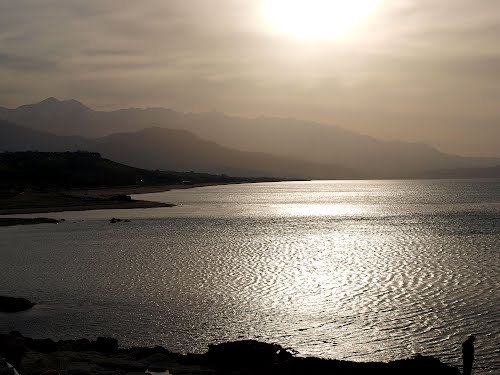
Atsipopoulo lies on a rise from which the view extends over Rethymno, the bay and the north coast. The surrounding country is covered with olive groves, carob trees and valonia oaks; the meltemi, the north wind off the sea, brings coolness and not infrequently stirs up the coast below. The village is officially recognised as a traditional settlement, and its old core preserves stone houses, arched doorways and narrow lanes in which the Venetian element in the architecture is still strongly felt. New building has gone up mainly on the edges, for its closeness to the town has made Atsipopoulo a sought-after place to live.
From the Byzantine charter to the poet of the Renaissance
The first written mention falls in the year 1182: in a Byzantine document on the partition of Crete – an imperial chrysobull, in which the place appears as “Aktzipopoulo” – the settlement was awarded to the distinguished house of Chortatzis. The origin of the name is debated to this day. The local historian Eleftherios Skandalis derives it from Latin, from acer, “sharp”, and populus, “people”; he points out that numerous surnames of Latin and Byzantine origin occur in the village. Another interpretation thinks of the “Atsipades”, Ethiopian guards and doorkeepers in the service of Byzantine lords.
Later the village took part in Crete’s movements for freedom. The Venetian and Ottoman periods have left their mark on the architecture; some houses and details of their interiors still date from the 17th and 18th centuries. Anyone walking through the lanes of the old core will discover dressed-stone door frames, vaulted passageways and courtyards hidden behind high walls.
Atsipopoulo is regarded as the home of Georgios Chortatsis, the poet of the Cretan Renaissance, who around 1600 wrote the tragedy “Erofili”; local tradition also ascribes to him the “Sacrifice of Abraham”. The economy of the place rested on pottery, lime-burning and the processing of acorns, or more precisely of their tannin-rich cups, which were used in tanning and in the household and exported in large quantities. Around the village there still extends an oak wood of some 25 square kilometres – the largest forest of valonia oaks (Quercus macrolepis) on Crete, which stretches across the neighbouring villages of Prines and Gonia. It is not a wild wood in the strict sense but a forest of tended trees, kept for generations for the sake of their crop, and as such it has no counterpart elsewhere on the island; it is protected today, and a signed cycling route of some 27 kilometres from Rethymno makes the circuit through it by way of Gonia, Prines and Atsipopoulo.
Churches and the spiritual memory of Atsipopoulo
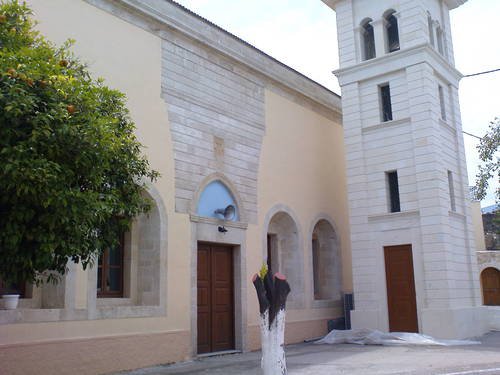
Bound up with the church life of Atsipopoulo are the church of St Eleftherios and St Charalambos, the Byzantine church of St John Chrysostom, of the 12th century, the Panagia Mesochoriani and the cave chapel of St Antony. When in 1885 a plague threatened the oak woods – caterpillars were stripping the trees bare – the inhabitants went in solemn procession through the fields with the relic of the Girdle of the All-Holy Mother of God; according to local tradition the blight ended after the prayers. The story belongs to the spiritual memory of the village and explains the particular veneration of the Agia Zoni, the “Holy Girdle”.
Atsipopoulo today
Today Atsipopoulo combines closeness to Rethymno with the character of an old Cretan settlement. On the village square kafenia and tavernas invite a pause; a walk through the old core is at its best in the late afternoon, when the light softens on the stone façades. From here the journey can easily be continued to Prines, whose houses likewise show Venetian and Ottoman work, to Gerani on the coast with its Neolithic cave, to Arkadi Monastery and to other places in the country round Rethymno.