The most complete guide to Crete: 221 places on the map, 23 routes and 49 articles — with photos, videos and the story behind every place. No sign-up, no trackers.
Routes drawn along real roads
Weather at every stop
Full-text search
“Near me” by geolocation
Create your own printable itinerary
Satellite, terrain, dark mode
Works offline
⌕
Searches 1.7 million characters of descriptions, not just names
—places
4regions
—routes
—with video
Search results
—
Interactive map
Find what is near you
Filters narrow the map and the list at once. Zoom out and pins group together.
Region
Category
Фильтры карты
Landmarks
Featured places
RegionCategory
Routes
Ready-made day trips
Individual places
Articles about landmarks
Armeni and the memory of a Byzantine settlement
Armeni (Αρμένοι) is a village south of Rethymno, at the foot of Mount Vrysinas, on the old route between the north and south coasts. Local tradition traces its name to Armenian warriors whom the Byzantine general and later emperor Nikephoros Phokas settled in Crete after wresting the island from the Arabs in 961. The chief sight of the district, however, is far older: one of the largest excavated Late Minoan cemeteries on the island, laid out within view of Vrysinas, whose summit carried a Minoan peak sanctuary.
The Late Minoan cemetery
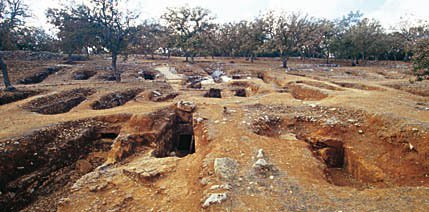
The cemetery lies at a spot called Prinokefalo, on a low hill in the middle of an open oak wood, some nine to ten kilometres south of Rethymno on the road to Spili and Agia Galini – a quarter of an hour by car. It was discovered by chance: in 1969 two schoolboys from the neighbouring village of Somatas brought pottery they had found here to the Archaeological Museum of Rethymno. Systematic excavation began in the same year under the archaeologist Giannis Tzedakis and went on for decades. The burial ground covers roughly 35 acres, about 14 hectares, and is divided by the excavators into three zones.
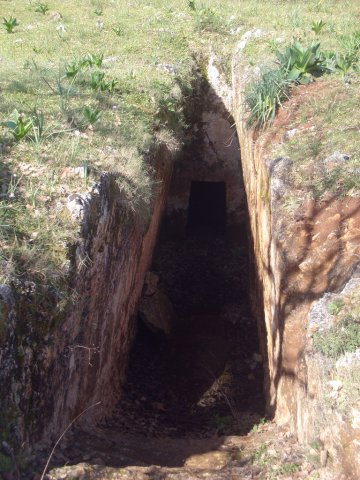
The cemetery belongs essentially to the Late Minoan III A–B period, that is, to the 14th to 12th centuries BC, with its centre of gravity in the 13th and 12th; individual burials may be older. The dead were laid in family tombs hewn with bronze tools out of the soft marly limestone. Each chamber is reached by a long open passage, the dromos, made either as a ramp or as a flight of steps; the entrance was sealed with a stone slab or a dry-stone wall. The approaches are uniformly aligned towards the east, most of them more exactly north-east, in the direction of the peak of Vrysinas. A typical dromos is between one and a half and two and a half metres wide and three and a half to seven metres long, and the chambers are round, semicircular or rectangular. The richer tombs have benches, a supporting pillar in the chamber or a grave stele – at least eleven such stelae are attested – while others were left unfinished and consist of no more than the dromos that had been started. The grandest is Tomb 159, whose passage runs for 15.5 metres and descends by a staircase of 25 steps to a doorway two metres high; inside, a pillar props the east wall. More than 220 tombs have been investigated so far: 231 chamber tombs, together with a single built tholos tomb, a small one with a chamber 2.45 metres across.
The tombs were opened again and again: a single family chamber might hold the remains of many people, earlier burials being pushed aside when a new body was brought in. The deceased lay on the chamber floor or in painted larnakes, clay coffins in the form of a chest or a bathtub. With them were vases – stirrup jars, cups, beaked jugs, kraters, incense burners – jewellery including gold beads and silver rings, sealstones, weapons and implements of bronze – swords, daggers, knives, spearheads, razors – figurines, and objects of daily life such as spindle whorls, bone pins and an ivory comb. Smashed drinking bowls, cups and cooking pots at particular points in the cemetery point to funeral meals and libations. Remarkably, only four of the tombs had been robbed in antiquity, so that most were found as their last users left them. Finds of this kind make it possible to study not only the burial rite but the social order, the crafts and the trading connections of the community.
The visit is worthwhile for the place itself: beneath the oaks one goes down the steps of individual dromoi right into the burial chambers, several of the larger of which have been fitted with lighting that comes on automatically. The rock-cut steps are worn and uneven. The fenced site is as a rule open only in the morning and until early afternoon and closed on one weekday; the visit combines well with the museum in Rethymno.