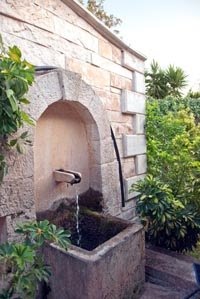
Prines – a traditional village and its church of St Nicholas
The most complete guide to Crete: 221 places on the map, 23 routes and 49 articles — with photos, videos and the story behind every place. No sign-up, no trackers.
Routes drawn along real roads
Weather at every stop
Full-text search
“Near me” by geolocation
Create your own printable itinerary
Satellite, terrain, dark mode
Works offline
⌕
Searches 1.7 million characters of descriptions, not just names
—places
4regions
—routes
—with video
Search results
—
Interactive map
Find what is near you
Filters narrow the map and the list at once. Zoom out and pins group together.
Region
Category
Фильтры карты
Landmarks
Featured places
RegionCategory
Routes
Ready-made day trips
Individual places
Articles about landmarks
Prines – a traditional village and its church of St Nicholas
Prines stands at 200 metres above sea level, about seven kilometres west of Rethymno and two kilometres from Atsipopoulo, on a slope that rises like the tiers of a theatre and looks out to the sea, towards Rethymno and the Akrotiri peninsula, and inland to the White Mountains. The village is half submerged in the green of walnut and plane trees, oaks and olives; some of the olive trees are said to have been planted under the Venetians – the old grove north of the village is known as Venerata – and the wood of valonia oaks runs from here all the way to Atsipopoulo. The old residential core preserves arched houses, stone staircases, domed rooms, courtyards and doorways that recall both the Venetian and the Ottoman eras. The nearness of the town has drawn many newcomers, and the census of 2021 counted 895 people in Prines itself. Until the 1930s the community also took in Gerani on the coast. The main crops are olives, vines and carob, and stock-breeding still plays its part.
Traditions of the founding
Local tradition ties the origins of the settlement to the Byzantine period that followed the recovery of Crete from the Arabs by Nikephoros Phokas in 961, when noble families were sent from Constantinople to resettle the island. In one version a man of rank named Michael, taken with the landscape, made his home here, and around his estate grew up neighbourhoods and watch-posts that guarded the bay of Gerani against pirates; the name “Prines” is explained as a corrupted form of the Latin princeps. A more prosaic derivation looks instead to the prinos or prinari, the kermes oak that covers the hillsides hereabouts. Another story holds that the village was founded by the inhabitants of three neighbouring hamlets – Stinganevo, Klotziana and Kanetha – who abandoned their houses because of an epidemic; Klotziana is said to have existed before the 10th century, and its successors to have been known for their potters’ workshops. In the written record the place first appears in Venetian registers of the 16th century as “Prinea et suo metochi”; 430 inhabitants are recorded for 1583. Venetian inscriptions, one of them in the main church, bear out that age. By 1834 the village had 40 Christian and 90 Muslim families, and in 1881 440 Christians and 74 Muslims.
Close by lies Vederi (Βεδέροι), which local tradition calls the sentinel of Prines. The name probably goes back to the Italian vedere, “to see”: from the rise, approaching ships could be made out in good time. The little settlement, 1.3 kilometres west of Prines and now home to about thirty people – it had 99 in 1881 – ranks in heritage law as a place of the very highest cultural and historical importance, and it has kept its Venetian character more completely than its larger neighbour. Its church of St John, with a bell tower in the Renaissance manner and an iconostasis of unusually rich imagery, keeps its feast on 24 June. A small oak wood adjoins the square and the churchyard, and a footpath leads on from Prines through Vederi into the gorge that bears its name.
Mill, olive press and churches
Among the sights of the village are the old mill, the Mylos tou Vevogianni, and the press in which the olives were worked. The church of St Nicholas is held to be the oldest place of worship in Prines, dating from the 10th or 11th century. Also in the centre stand the two-aisled church of St Anthony and the Annunciation, built in 1800; the church of St Panteleimon, patron of the village, whose feast on 27 July is the occasion of its principal festival; and the chapel of St Paraskevi, once a well-peopled monastery and a dependency of Arsani Monastery, which was plundered and abandoned under Ottoman rule and whose lands were sold in 1866 to fund the Cretan rising of that year. There is a church of St George as well.
The legend of the wonder-working icon of St Nicholas
Attached to the church of St Nicholas is the legend of a wonder-working icon. When the church was threatened with desecration, the villagers relate, the icon betook itself of its own accord to Myra in Lycia – the home of the holy bishop Nicholas – and came back to Prines once the danger had passed. A fuller telling sets the event around 1700, during the procession on the saint’s day: at a spring the icon slipped from the hands of one of the two young men carrying it and made for the sea with the other, vanishing on the horizon in a blaze of light. The icon was back in its place three days later; the youth was found by his mother after forty days, lying on a stone bench, and died without saying anything of his journey to Myra. For the village community the story is a witness to the heavenly protection of the saint, whose feast is kept on 6 December.
School, war and the present day
From the 19th century Prines had a properly organised mutual school – it is recorded from 1834, meeting at first in private houses – and from 1870 it was lodged in a stone building beside the church of St Nicholas, which now serves as the parish centre. A night school for adults followed in 1887. Markos Kaloudis, a villager who had fought in the War of Independence of 1821, left money in his will of 1876 for scholarships to train teachers from Prines. More recent history has left its marks as well: almost the whole village took part in the Battle of Crete in May 1941, and one inhabitant was killed. During the occupation a resistance group was active here under the kapetan Christos Tzifakis (1888–1962), a colonel and veteran of the Balkan Wars and the Asia Minor campaign, who went on to be governor of Rethymno in 1946 and whose bust stands in the square; twice the Germans meant to burn the village down, and twice they desisted after Greek intercession.
Today Prines leads a quiet rural life and makes a pleasant halt on a drive through the country west of Rethymno. A walk through the lanes of the old core, past archways and courtyards, and a coffee in the shade of the plane trees on one of the paved squares are enough to feel the difference from the coastal strip only a few minutes away. There are a couple of tavernas, and a signed cycling circuit of about ten kilometres starts from the village. Atsipopoulo, Gerani and Gonia are none of them far from here.