The most complete guide to Crete: 221 places on the map, 23 routes and 49 articles — with photos, videos and the story behind every place. No sign-up, no trackers.
Routes drawn along real roads
Weather at every stop
Full-text search
“Near me” by geolocation
Create your own printable itinerary
Satellite, terrain, dark mode
Works offline
⌕
Searches 1.7 million characters of descriptions, not just names
—places
4regions
—routes
—with video
Search results
—
Interactive map
Find what is near you
Filters narrow the map and the list at once. Zoom out and pins group together.
Region
Category
Фильтры карты
Landmarks
Featured places
RegionCategory
Routes
Ready-made day trips
Individual places
Articles about landmarks
Ano Valsamonero and the castle of Monopari
Ano Valsamonero (Άνω Βαλσαμόνερο), the “upper” of the two Valsamonero villages, is a hill settlement 14 kilometres south-west of Rethymno, about 380 metres above the sea. The houses stand on an open hill from which one looks across both the northern and the southern slopes of the Rethymno hinterland and over the wide bay. Until about 1910 it was a Muslim village; the first Greek families to move in after the departure of its former inhabitants were Sfakians, and several of the surnames still found here go back to them. The chief historical sight of the neighbourhood is the castle of Monopari on the steep rock of Kastellos.
Monopari after the conquest of Crete
The story of the castle leads back to the upheavals that followed the Fourth Crusade and the fall of Constantinople in 1204. Crete fell at first to Boniface of Montferrat, who sold the island to Venice. Before the Venetians were ready to make good their claim, the Genoese seafarer and corsair Enrico Pescatore, Count of Malta, seized large parts of the island in 1206. He had key points in the east and centre of Crete fortified; tradition speaks of fourteen or fifteen castles. Monopari, together with the fortresses of Sitia, Chandax – the present Heraklion – and Rethymno, belonged to this network of strongholds. Venice answered by sending troops, and by 1211 Pescatore had been bought off and had left the island for good, leaving his castles to the Republic.
The name Monopari is usually traced to the Italian Bonriparo – “good refuge”, “reliable defence” or “strong enclosure”; in the Venetian sources the place is called Castel Bonriparo, and the hamlet below has simply inherited the worn-down name of the fortress. Who actually founded it cannot be said with complete certainty: one reading ascribes its building or rebuilding to Pescatore, the other sees here an older Byzantine post that was later absorbed into the defensive system of the 13th century. Between 1217 and 1236 the castle was caught up in the rising of the “two Syvritos”, the struggle of the Skordilis and Melissinos clans against Venetian rule. According to tradition it was kindled when the castellan of Monopari – remembered as Pietro Filicanevo – stole cattle and horses from the Skordilis and the Duke of Crete dismissed their complaint; in the end Venice had to concede fiefs and privileges to the rebel archons. The castle then remained in Venetian hands until the Ottoman conquest that began in 1645.
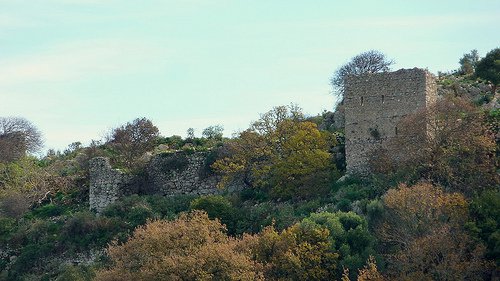
The castle rock is a detached plateau, standing some 150 metres above the land around it, that falls away on three sides in almost vertical walls; only the western flank had to be secured with masonry. Stretches of the outer wall survive, as do the watch-towers of the inner line of defence. On the summit the remains of living quarters, storerooms and a large cistern that collected rainwater can be made out. Greek and Roman graves have come to light in the vicinity – a sign that the area was inhabited long before the Middle Ages. Even in ruin Monopari gives a sense of the scale of the medieval fortress, and from the hill the eye ranges far over the country, as far as Georgioupoli and the headland of Chania.
The church memory of Valsamonero
In the history of Cretan art the name Valsamonero is associated above all with the memory of the former monastery of Valsamonero and its church of St Phanourios. This church is famous for its frescoes of the late Byzantine and Venetian periods, whose programme of images is connected with the flowering of the Cretan school of painting. The paintings are more than ornament: they show how the Byzantine tradition lived on in Crete under Venetian rule. This monastery of Agios Fanourios, however, does not stand in the hills behind Rethymno but near Vorizia, on the southern slope of Psiloritis; it merely shares its name with the two villages near Rethymno. The churches of Ano Valsamonero itself are more modest: the parish church of the Dormition of the Virgin, a church of St George and a small chapel of St Anthony.
Ano Valsamonero has remained to this day a small farming village that lives from olive growing and stock-raising. In the old censuses its name also occurs as Varsamonero; the commonest explanation links it with the fragrant balsam plant (Greek βάρσαμος) – in Crete the word is used of the mint that grows thickly here, as a geography of the island published in 1890 already noted – and with the waters of the district (νερό), for a spring of good water irrigates the land below the village. Here too the former monastic site of Valsamonero, with its church of St Phanourios and its frescoes of the late Byzantine and Venetian periods, is called to mind – paintings that testify to the tenacity with which the Byzantine tradition lived on under the Venetians. Village life reaches its high point on 15 August, when the patronal festival is held for the Dormition of the Virgin; a cultural association founded in 1977 looks after the keeping of local customs. From the village the road runs on to Monopari and thence to the villages of the Rethymno interior.