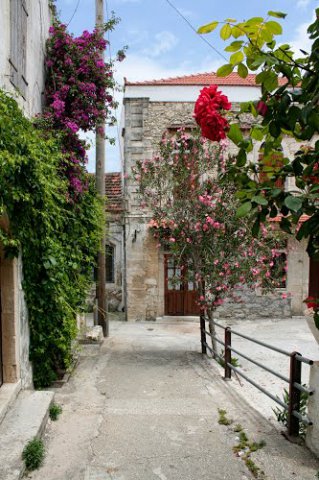
Agios Konstantinos – Venetian heritage and ancient layers
The most complete guide to Crete: 221 places on the map, 23 routes and 49 articles — with photos, videos and the story behind every place. Everything is open and free: no sign-up, no paid sections and no advertising, open or hidden. You can install the guide on your smartphone as an app.
Routes drawn along real roads
Weather at every stop
Full-text search
“Near me” by geolocation
Create your own printable itinerary
Satellite, terrain, dark mode
Works offline
⌕
Searches 1.7 million characters of descriptions, not just names
—places
4regions
—routes
—with video
Search results
—
Interactive map
Find what is near you
Filters narrow the map and the list at once. Zoom out and pins group together.
Region
Category
Фильтры карты
Landmarks
Featured places
RegionCategory
Routes
Ready-made day trips
Individual places
Articles about landmarks
Agios Konstantinos: the church and the layers of history
Agios Konstantinos is a small village in a rocky landscape, about 250 metres above sea level and roughly eighteen kilometres from Rethymno, immediately next to Roustika. Its traditional buildings have kept features of the Venetian period, and the place itself took its name from the church of St Constantine and St Helen, Equals of the Apostles, built in 1315. A century later the Florentine traveller Cristoforo Buondelmonti, who was in Crete in 1415, described a festival here with wrestling and archery contests and women crowned with garlands of flowers. The Venetian census of 1583 records 179 inhabitants; numbers rose to 345 in 1900 and then fell away steadily, and today a little over two hundred people live here, chiefly from olive oil, carob and stock-raising.
The church of St Constantine and St Helen
The two-aisled church, a basilica in plan, preserves Byzantine wall paintings and icons. The icons are generally dated to the years 1730 to 1770, whereas the foundation of the building goes back to the beginning of the 14th century; on several panels appears the name of the Vlastos family, an old Byzantine-Cretan noble house – the same family that stood behind the monastery of the Prophet Elijah at neighbouring Roustika. The stone bell tower was added only in 1863. This coexistence of older architecture and younger images shows how the church was renewed without forfeiting its historical continuity.
In the Venetian period Agios Konstantinos was among the possessions of the Barozzi family, whose name also occurs as Borozi or Barocci. Their villa was described and photographed by the Italian scholar Giuseppe Gerola at the beginning of the 20th century; its ruins stood until 1941–42, when the German occupiers made the villagers build barracks out of the stone of their own houses and of what was left of the mansion. On the village square lie the remains of a building which local tradition identifies as a Venetian mint. In the northern part of the village buildings of the Byzantine era can be seen, among them small churches of the Saviour, one of which had notable frescoes that are now badly decayed; and further west archaeologists came upon traces of settlement reaching from the Late Minoan to the Roman period.
The archaeological setting of the village
The surroundings form a many-layered archaeological landscape: Minoan, Roman, Byzantine and Venetian settlements succeeded one another here. Agios Konstantinos is worth seeing, then, not for any single monument but because in one small place it is possible to read how different ages of Cretan history left their mark. Among the quieter witnesses are the church of the Dormition of the Virgin, a basilica of the Venetian period, and two cave chapels dedicated to St Anthony and St Nicholas and known in the village as “Spilites”, the saints of the cave; a third rock chapel, of St Titus, lies at Manglava, and a Byzantine church of St George marks the site of the old settlement of Artos.
In the countryside near the village the Venetian Barozzi fountain survives, at the place called Vitsiles to the east. Cut into the stone slab set above it is a Latin inscription of the year 1509 that connects the structure with Francesco Barozzi, a member of that noble house which owned land in this part of the Rethymno district. A later namesake, the scholar Francesco Barozzi, wrote in 1577 a description of Crete that is still valued as a source. Against the outer wall of the parish church lie the graves of three former village priests.
The village in modern times
Under Ottoman rule Agios Konstantinos remained a Christian village – in 1834 it had fifty Christian families and ten Muslim ones – and it later became one of the places associated with the organisation of the struggle for freedom: during the rising of 1821, according to local accounts, a revolutionary committee sat here for a time before it was moved to Margarites, the insurgents beat off an Ottoman force nearby, and several men of the village, among them Georgios Sakorafos, an early member of the Philiki Etaireia, fought in the Cretan revolts. A later figure was the priest Vasilis Papadakis (1851–1931), a member of the revolutionary assembly of 1896 and an associate of Eleftherios Venizelos. The archaeological finds that came to light here around the middle of the 20th century – among them a gold ring connected with the Vlastos family, found about 1950 – are now kept in the Historical Museum of Heraklion and fill out the picture of the long history of the district. The youngest church in the village, Agia Kyriaki, was built in 1940.