Ancient Lappa – city, necropolis and early Christian memory at Argyroupoli
The most complete guide to Crete: 221 places on the map, 23 routes and 49 articles — with photos, videos and the story behind every place. No sign-up, no trackers.
Routes drawn along real roads
Weather at every stop
Full-text search
“Near me” by geolocation
Create your own printable itinerary
Satellite, terrain, dark mode
Works offline
⌕
Searches 1.7 million characters of descriptions, not just names
—places
4regions
—routes
—with video
Search results
—
Interactive map
Find what is near you
Filters narrow the map and the list at once. Zoom out and pins group together.
Region
Category
Фильтры карты
Landmarks
Featured places
RegionCategory
Routes
Ready-made day trips
Individual places
Articles about landmarks
Ancient Lappa: city, necropolis and the memory of Crete
Ancient Lappa ranks among the most important historical centres of western Crete. The city commanded an extensive territory between the valleys of the Petre and the Mousela, kept up sea connections by way of both the north and the south coast, and struck its own coins, which always give the name as Lappa, although ancient writers also use the forms Lampa and Lampe. Traces of its development – from the late Geometric and Classical periods through Hellenistic and Roman times and on into the early Byzantine age – have been found all around the modern village of Argyroupoli, 27 kilometres south-west of Rethymno. In the Hellenistic period Lappa was a power to be reckoned with: Polybius relates that it gave shelter to the people of Lyttos when Knossos destroyed their city in 220 BC, and treaties bound it to Teos in 193 BC and to Pergamon in 183 BC. After its destruction by the Romans under Quintus Caecilius Metellus in 68 BC, Lappa was restored by Octavian, because its inhabitants had supported him in the struggle against Mark Antony; the episode is recorded by Dio Cassius.
Octavian, the future emperor Augustus, rewarded the city with special privileges. Its citizens were granted their freedom, Lappa kept the right to mint coins – the issues of the Roman period bear the emperor’s head – and the city went on developing under Roman rule; local estimates put its population at around ten thousand. That it lay in a spot so rich in water must have done much to secure its survival down the centuries: fertile land, springs and river courses offered everything a settlement needed in antiquity. The karst springs below the village, which still pour out some 20,000 cubic metres a day, are the same that served the ancient city.
The necropolis and the early Christians
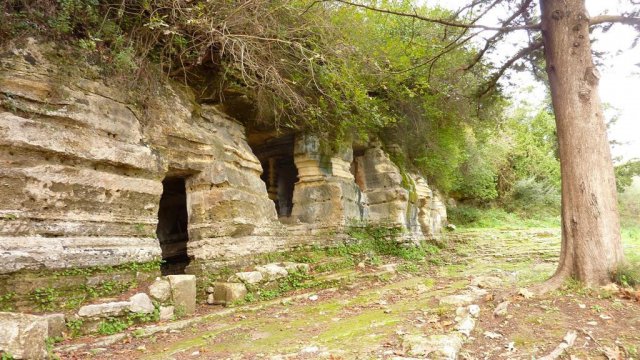
The necropolis of Lappa consists of family burial chambers and vaults cut into the rock, set in a green, wooded hollow. In early Christian times some of them were converted into small churches and chapels; one of these sanctuaries is in the cave of Agia Eleousa. Lappa became the seat of a bishop – tradition names St Titus as founder of the diocese – and its bishops are recorded at the Council of Ephesus in 431 and at Chalcedon in 451.
Lappa decayed gradually; the ancient city suffered from earthquakes and later destructions – the Arab conquest of Crete brought both town and bishopric to an end – and its ruins passed into the present landscape of Argyroupoli. From here the road runs on south to Myriokefala, about eight kilometres away, and to Asi Gonia, about nine; both villages lie in the upper country of the Mousela among groves centuries old. Myriokefala stands at about 500 metres on the north-western slopes of Mount Kryoneritis and has a monastery of the Panagia that goes back to the 10th century; Asi Gonia, at 400 metres on the eastern edge of the White Mountains, already belongs to the Chania regional unit and was the home of George Psychoundakis, the wartime resistance runner who wrote “The Cretan Runner”. The drive shows how thickly the hinterland of Rethymno is strewn with the evidence of every age.
In the Lamagnana area a Graeco-Roman tomb cut into the rock has been preserved. According to local tradition five young women rest here who died for their loyalty to the Christian faith. Next to it grows an enormous plane tree, protected as a natural monument, which tradition holds to be a thousand years old. A visit to Argyroupoli is especially rewarding at Easter, when the candlelit procession is accompanied by local customs and the lanes of the village lie in the glow of the candles.
Visiting Lappa today
Ancient Lappa takes time to explore. The remains lie scattered among olive trees, gardens and houses on the edge of the village; much can now be grasped only as a stretch of wall, a burial chamber in the rock or an object in a museum. The site is not fenced or ticketed, and one wanders through it freely. In the 19th century the English traveller Robert Pashley could still describe considerably more: a massive brick building with projecting buttresses, a circular structure some 18 metres in diameter with niches round its walls, and a cistern about 23 metres long by 6 wide. It is worth walking through the village with the thought that beneath today’s gardens and lanes lay a city with access to harbours, a mint and Roman baths; a Roman mosaic floor can still be seen among the houses. Finds from the area are kept in the Archaeological Museum of Rethymno, among other places.