Agia Irini (St Irene) and Episkopi – a river plain and its church history
The most complete guide to Crete: 221 places on the map, 23 routes and 49 articles — with photos, videos and the story behind every place. Everything is open and free: no sign-up, no paid sections and no advertising, open or hidden. You can install the guide on your smartphone as an app.
Routes drawn along real roads
Weather at every stop
Full-text search
“Near me” by geolocation
Create your own printable itinerary
Satellite, terrain, dark mode
Works offline
⌕
Searches 1.7 million characters of descriptions, not just names
—places
4regions
—routes
—with video
Search results
—
Interactive map
Find what is near you
Filters narrow the map and the list at once. Zoom out and pins group together.
Region
Category
Фильтры карты
Landmarks
Featured places
RegionCategory
Routes
Ready-made day trips
Individual places
Articles about landmarks
Agia Irini and Episkopi: a river plain and its church history
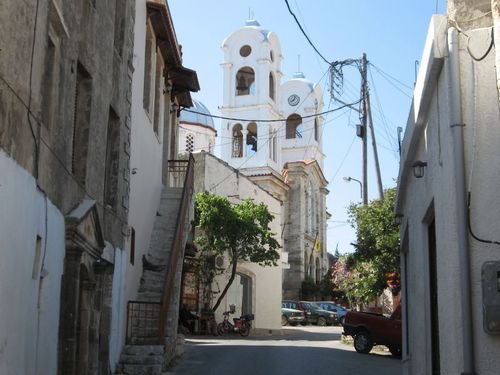
Agia Irini is an administrative centre in the fertile plain between the rivers Mousela and Petre. The settlement arose in the first centuries of the Byzantine era, and archaeological finds confirm the great age of the place. In Venetian sources it goes by the name of Kalamon. In the older quarter houses with arched openings and family coats of arms have survived, recalling the medieval and Venetian history of the district. The plain, with its orchards and olive groves and the water of the two rivers, makes it easy to see why people settled here early and why an ecclesiastical centre was later established. Anyone who takes the time to walk the lanes of the old core will find, on lintels and walls, many a detail that points back to earlier centuries.
Agia Irini is associated with the Vardinogiannis family, the well-known Greek entrepreneurs. They regard this countryside as their particular homeland and trace their descent to St John of Sfakia. This is a family tradition rather than a documented line of descent.
The monastery of St Irene
Not far away, at the foot of Mount Vrysinas, some five kilometres south of Rethymno and 260 metres above the town, lies the monastery of St Irene, one of the old monasteries of the Rethymno region. The first written mention dates from 1362, in a Venetian document. It is said to go back to ascetics who lived in the caves of the neighbourhood, perhaps as early as the second Byzantine period between 961 and 1204; under Venetian rule it owned extensive lands, and it continued to exist in Ottoman times, though it went into decline after the revolution of 1821. During the rising of 1866 the monastery was destroyed, and it lay long in ruins; it was formally dissolved in 1900. In 1989 its restoration began and nuns moved in again. In 1895 a seminary for future priests functioned briefly at the monastery; today there is an ecclesiastical museum with liturgical vestments, church plate and mementoes of Metropolitan Theodoros Tzedakis, as well as icons painted by the sisters themselves. The complex rises on a spur of rock within an enclosing wall and from a distance looks like an old fortress.
The revival of the monastery was the work of a handful of women: in 1989 three nuns, under the direction of Metropolitan Theodoros, set about the task, and they took care to preserve the architectural character of the place. A chapel dedicated to St Raphael, St Nicholas and St Irene now stands on the remains of the old olive mill, and the community, which has grown to some eight sisters, supports itself by icon painting, weaving, embroidery and the sewing of vestments, and by making soap, candles and herbal extracts that are sold in a small shop. Visiting times are liable to change, and it is as well to enquire beforehand.
The beach of Episkopi
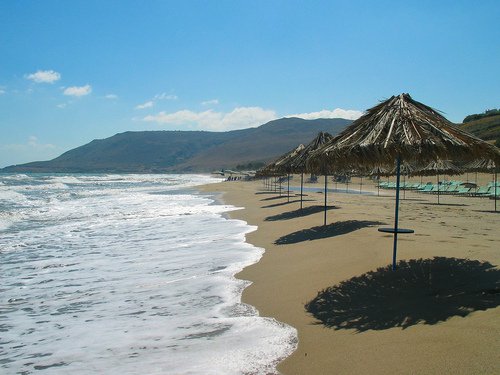
The beach of Episkopi is a broad stretch of coast with fine golden sand and well-developed facilities for bathers. It lies about three kilometres from the village. The shore is bound up with the mouths of the Mousela and the Petre and with the old geography of the district, which in Byzantine times was an important ecclesiastical centre. To combine the monastery and the beach is to experience mountainside, river plain and sea within a short distance. The gently shelving shore suits families with children too; sunbeds and umbrellas, tavernas and cafés are close at hand, so that a visit goes well with a walk through the plain.
Sacred objects and the tradition of the healing
In the monastery church is the venerated icon of St Irene painted in 1930 by the hieromonk Nestor Vassalos, together with an old copy of the miracle-working image of the Mother of God Eleousa of Kykkos. Part of the church is cut into the rock on which the monastery stands, and beside the enclosure an older three-aisled church, dedicated to St Irene, St Catherine and St Euphemia, still awaits restoration. With the monastery goes the custom of calling upon St Irene, whose feast falls on 5 May, for help and healing. Local tradition tells that a monk cured the daughter of the pasha of Rethymno; in gratitude he was allowed to enlarge the small single-aisled church into one of three aisles. Such stories are typical of the monasteries of Crete: they show how the Christian community gained room for manoeuvre under Ottoman rule, and how the intercession of the saints lived on in popular memory.