Lake Kournas – Crete’s only natural freshwater lake
The most complete guide to Crete: 221 places on the map, 23 routes and 49 articles — with photos, videos and the story behind every place. No sign-up, no trackers.
Routes drawn along real roads
Weather at every stop
Full-text search
“Near me” by geolocation
Create your own printable itinerary
Satellite, terrain, dark mode
Works offline
⌕
Searches 1.7 million characters of descriptions, not just names
—places
4regions
—routes
—with video
Search results
—
Interactive map
Find what is near you
Filters narrow the map and the list at once. Zoom out and pins group together.
Region
Category
Фильтры карты
Landmarks
Featured places
RegionCategory
Routes
Ready-made day trips
Individual places
Articles about landmarks
Lake Kournas – the only natural freshwater lake on Crete
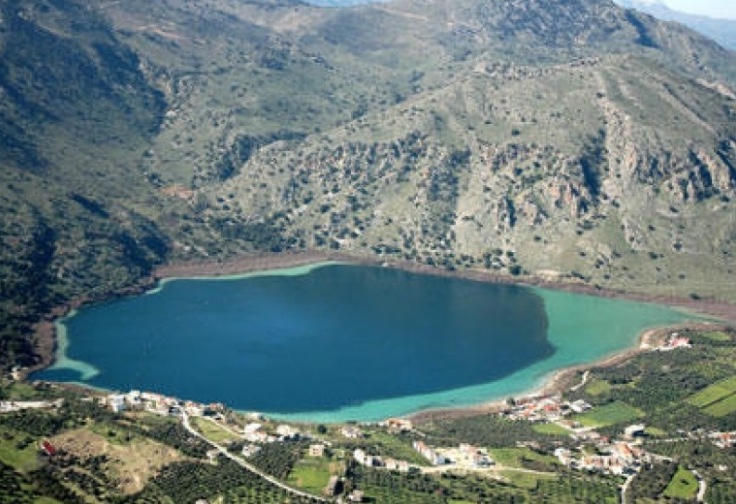
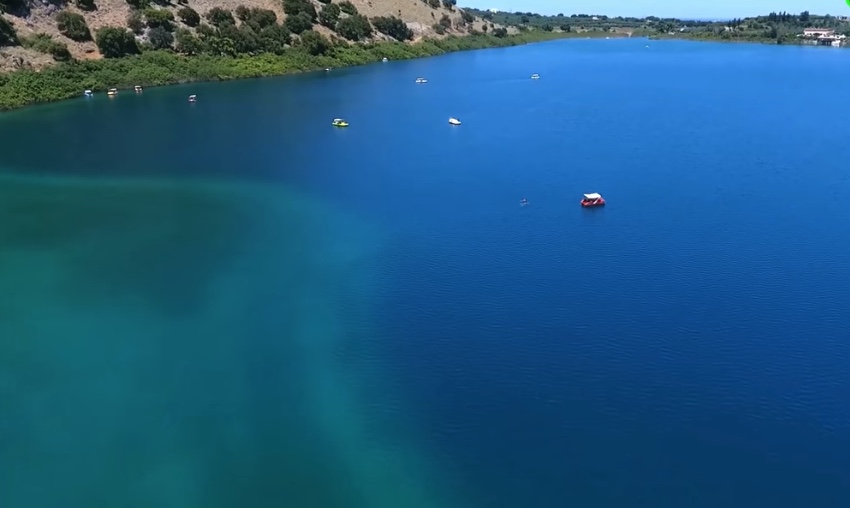
Lake Kournas (Limni Kourna) lies in a hollow among the hills of Apokoronas, at the northern foot of the White Mountains, about four kilometres south of Georgioupoli and two and a half kilometres from the village of Kournas; Chania is some 43 kilometres to the west, Rethymno 20 kilometres to the east. It is the only natural freshwater lake on Crete, and its still surface, enclosed by olive groves and low slopes with the bare limestone of the mountains rising behind, forms a wetland landscape rare on this dry island. With the light and the depth the water changes from the pale turquoise of the shoreline to a dark blue in the middle, a colour deepened by the algae that carpet the lake bed; on a calm morning the mountains stand reflected in it, and in the afternoon the breeze off the sea ruffles the surface.
The lake is relatively small and shaped like a pear, or on some maps almost circular: its greatest length is 1,087 metres, its width 880 metres, and its area about 579 stremmata, that is roughly 57.9 hectares or 0.58 square kilometres – a perimeter of some three and a half kilometres. The middle part is shallow, but the greatest depth reaches 22.5 metres. The surface stands about 20 metres above sea level. Because the dark blue zones of deep water show as concentric rings, the local people used to call the lake “bottomless”. The level varies markedly with the seasons: in winter and spring the water rises as far as the steps that lead down from the road, while by late summer it has fallen enough to uncover a broad margin of white sand.
Karst basin and underground waters
The lake came into being in a karst depression: water seeps through the limestone of the White Mountains and emerges in the basin of the lake from underground springs. In the south-east lies the spring Mati or Amati – “the eye”; at the end of a dry summer, when the level falls, its outlet is sometimes visible on the shore, while in winter it is drowned again. The second spring remains permanently hidden beneath the surface. Besides these two underground sources the lake receives surface run-off from the surrounding hills; in summer it still holds about 7.5 million cubic metres of water, and the lake is in effect a natural reservoir for the plain of Georgioupoli below.
When the level is high, the Delfinas flows out of the lake; in its lower course it is also called the Almyros. After about five kilometres it reaches Georgioupoli and empties into Almyros Bay and the Sea of Crete, passing on its way the dunes of Kavros beach. Since 1962 a small weir at the outlet has regulated the flow. Lake Kournas is thus part of a larger wetland system which includes the river, the springs near the coast, areas that flood from time to time, and the mouths of the Delfinas, the Kavros and the Mouselas.
From Korisia to Kournas: the history of the name
In ancient geography the lake is linked with the name Korisia (Koresia). Stephanos of Byzantium, the lexicographer of the 6th century AD, mentions it; nearby, according to tradition and later interpretations of place names, stood a sanctuary of Athena Korisia, and the city of Korion is thought to have lain in the same district, although its site has never been identified. The names Hippos and Kore are also associated with Korisia, and from this group of names derives the old regional name Hippokorona, which in time became Apokoronas – the name of the whole district between Souda Bay and Georgioupoli.
The present name “Kournas” took hold in the period of Arab rule over Crete, in the 9th and 10th centuries. It is usually explained by an Arabic word for “lake”, “basin” or “bath”; another interpretation connects it with the Greek word κρουνός – “spring”, “jet of water”. Both explanations name the essential quality of the place: the constant presence of fresh water.
The wildlife of the lake
Eels, sand smelt and the freshwater goby live in the water; the eels, which once reached the lake from the sea by way of the Delfinas, are still present in considerable numbers. In recent years goldfish released by visitors have been noticed in the closed ecosystem, as well as the mosquito fish, introduced long ago to control the mosquitoes. Such introductions alter the composition of the native fauna and can upset the balance of the lake, since the newcomers compete with the native species for food and prey on their young.
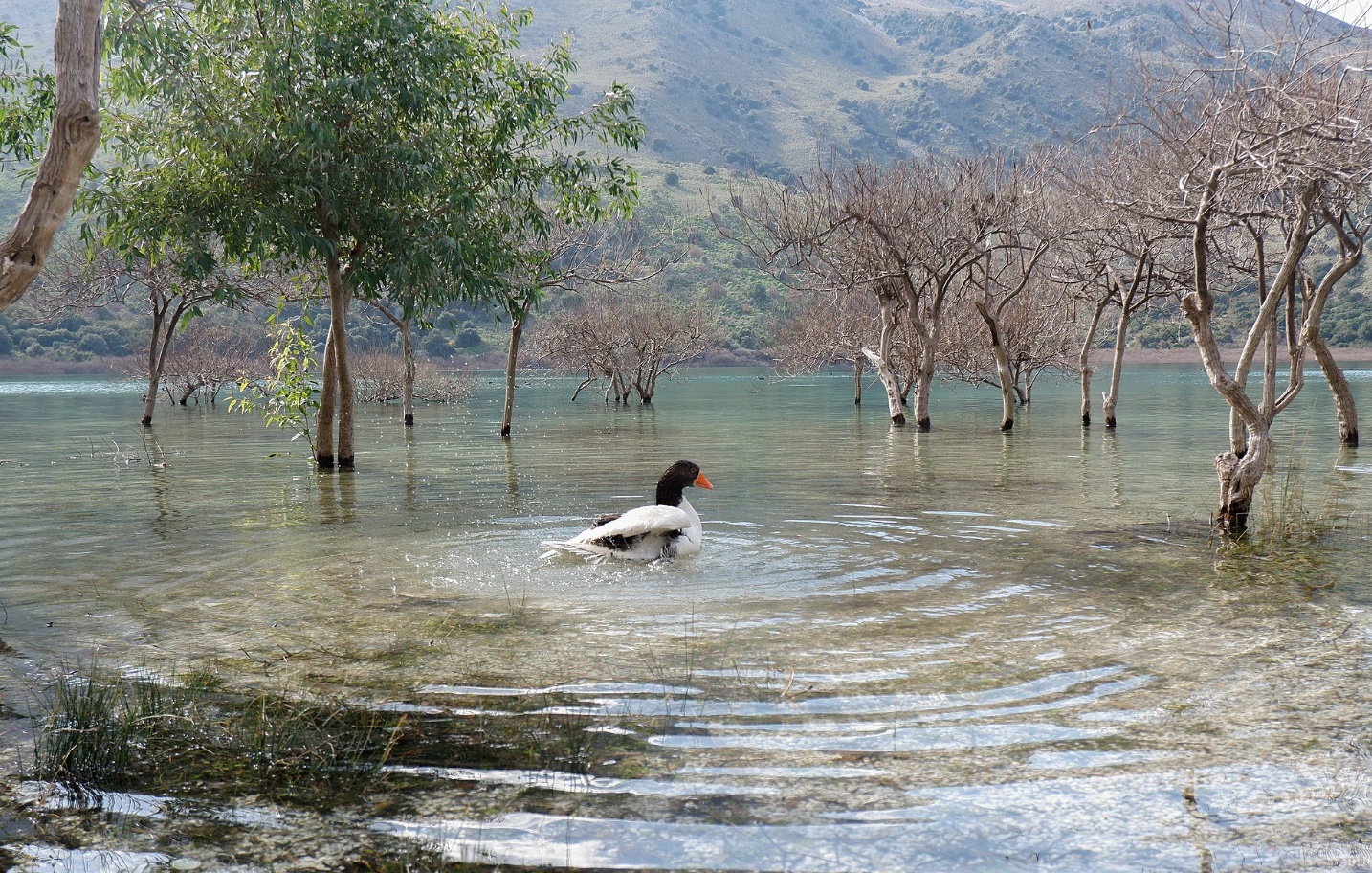
On the banks and in the surrounding hills live the Balkan green lizard, the agama and a rare two-coloured terrapin which can be watched in the shallows on calm days: this is the Balkan terrapin (Mauremys rivulata), with an olive to blackish shell and yellowish stripes along the neck and legs, which grows to about 15 centimetres and basks on half-submerged stones and fallen branches. Grass snakes and dice snakes hunt in the reeds. Among the birds, mallard and ferruginous duck, purple and grey herons, little egret, pochard, ibis, moorhen and cormorant have been recorded; herons and cormorants are most often seen in the winter months, when the lake is quiet. The waterside vegetation includes species characteristic of Crete and the eastern Mediterranean – reeds, rushes and plane trees at the inflows – and the slopes are covered with kermes oak scrub and maquis.
A protected wetland
Lake Kournas is a resting place for migrating birds and belongs to the Natura 2000 network under the code GR4340022; it is also designated a Special Protection Area for birds. The protected complex also takes in the adjoining wet meadows and the coastal stretches at Georgioupoli. The status does not mean that human presence is forbidden, but it imposes a regime in which farming and tourism must preserve the habitats and the diversity of species. Causes for concern are litter and waste water from tourism and building, and the abstraction of water for irrigation, which lowers the level of the lake in the very months when it is most visited.
In summer the lake is busy with day-trippers: on the north-western shore are tavernas, with pedal boats and canoes for hire, and when the level drops pale margins of sand appear and a path becomes visible that circles the water – the full circuit, about three and a half kilometres, takes under an hour on easy ground, though the far shore is rough and reedy in spring. From Georgioupoli a country road passes under the national highway to reach the lake, and in season a little road train runs from the resort; there is parking above the tavernas. The water is clearest and warmest for swimming on summer afternoons, when the sun has been on the shallows all day. Those who want quiet come in the early morning or outside high season. A visit shows not merely a picturesque landscape but a coherent natural system in which underground waters, the river, wooded slopes and the flyways of the birds all interlock.