Myriokefala: the Monastery of Panagia Antifonitria, the Virgin “who answers”
The most complete guide to Crete: 221 places on the map, 23 routes and 49 articles — with photos, videos and the story behind every place. No sign-up, no trackers.
Routes drawn along real roads
Weather at every stop
Full-text search
“Near me” by geolocation
Create your own printable itinerary
Satellite, terrain, dark mode
Works offline
⌕
Searches 1.7 million characters of descriptions, not just names
—places
4regions
—routes
—with video
Search results
—
Interactive map
Find what is near you
Filters narrow the map and the list at once. Zoom out and pins group together.
Region
Category
Фильтры карты
Landmarks
Featured places
RegionCategory
Routes
Ready-made day trips
Individual places
Articles about landmarks
The Monastery of Panagia Antifonitria at Myriokefala
A good thirty kilometres south-west of Rethymno – 33 by road – in the mountains on the border with the Chania regional unit, lies the village of Myriokefala (Μυριοκέφαλα). It stands at about 500 metres on the north-western slopes of Mount Kryoneritis and has fewer than three hundred inhabitants. At its centre is one of the oldest monastic foundations in Crete: the monastery of Panagia Antifonitria. According to Church tradition it was founded around 1020, in the second decade of the 11th century, by St John Xenos, the great Cretan ascetic and missionary. Of the former monastic precinct it is essentially the katholikon that survives, the main church, dedicated to the Nativity of the Virgin; the remains of the other monastery buildings that surround it date from the 18th and 19th centuries. The present village grew up around the old monastery; it first appears in the Venetian records in 1577, when Francesco Barozzi lists it as “Myrio Chiefala”, and a census of 1583 gives it 99 inhabitants.
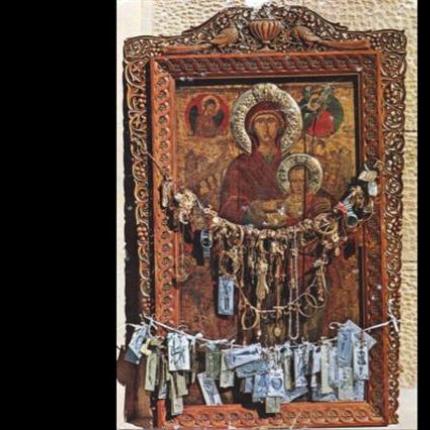
The foundation legend tells how John Xenos, wandering through the district, came upon a vast, overgrown thicket of thorns that barred his way. He set fire to it, and as the brushwood burned he heard a voice – in the local version the Virgin calling out, “Here I am.” When the flames had died down, an icon of the Mother of God came to light beneath the charred branches. The saint took this as an instruction from above, founded a monastery on the spot and named it Antifonitria, because the image had answered to his presence. The icon venerated to this day is held by the faithful to be that same miraculously discovered treasure.
The monastery came into being in the 11th century, in the second Byzantine period of Crete, which lasted from the reconquest of 961 until the arrival of the Venetians in the early 13th century. Under early Venetian rule it flourished; under the Ottomans, by contrast, like many Orthodox buildings on the island, it was exposed to raids and was partly destroyed. In the courtyard there still stands the katholikon, dedicated to the Nativity of the Virgin. The patronal feast is kept on 8 September, and a further local feast day falls on 12 September.
Architecture and frescoes
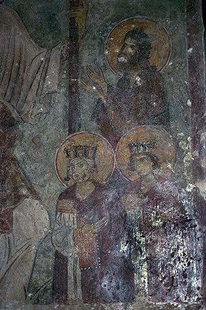
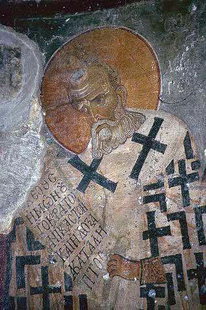
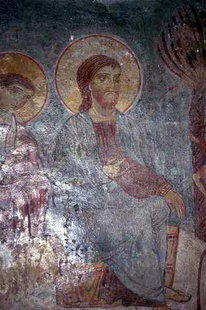
The original building is small: a domed church on the plan of a free cross, as built at the beginning of the 11th century – a square core beneath the dome, later extended westwards by a two-bay arm, so that the plan now resembles a Latin cross; the fabric was repeatedly altered down to the 20th century. It is regarded as a document of Middle Byzantine monumental art and of the influence that Constantinople exerted on Cretan church architecture after the reconquest of the island. The walls carry frescoes of the 11th, the early 13th and the 14th centuries. To the oldest layer belong the Christ Pantokrator in the dome, surrounded by angels and prophets, the Virgin, the Evangelists – Matthew and Mark survive in the south arm – hierarchs in the apse, and St Nicholas and St George in the side niches. The second layer, of the early 13th century, shows the Fathers of the Church concelebrating in the apse and, in the western arm of the cross, scenes from the Gospels: the Entry into Jerusalem, the Betrayal of Judas, the Entombment with the Lamentation, and the Descent into Hell. In the narthex the Dormition of the Virgin is depicted.
On entering, one should give the eyes time to grow used to the half-light. Only then do the figures emerge from the plaster: the austere saints of the founding period, ranged frontally in rows and still wholly indebted to the formal language of the capital, and beside them the livelier, narrative pictures of the later layers, in which the Passion scenes already hint at the direction Cretan painting was to take. It is this juxtaposition that makes the little church one of the most instructive monuments of Byzantine painting in western Crete – here, in a single place, one can follow how the wall painting of the island changed over three centuries. The paintings of the first layer are among the few on the island that can be tied to a named founder and to the very decades of his activity.
The venerated icon of the Panagia Antifonitria, which in its present form is attributed to the early 18th century, is held to work miracles. The church also preserves other treasures: a Gospel book of 1818, a silver chalice of 1829, a censer of 1854, three carved wooden crosses, and various documents of the 19th century that bear witness to the life of the monastery in its late period and after the end of Turkish rule.
Today Panagia Antifonitria is no longer a working monastery: the katholikon serves the people of Myriokefala as their parish church. The preserved and restored walls, the frescoes and the sacred objects live on in the liturgy and keep the memory of one of the oldest monastic communities in Crete, whose spiritual and cultural legacy reaches back a thousand years.
St John Xenos and his mission in Crete
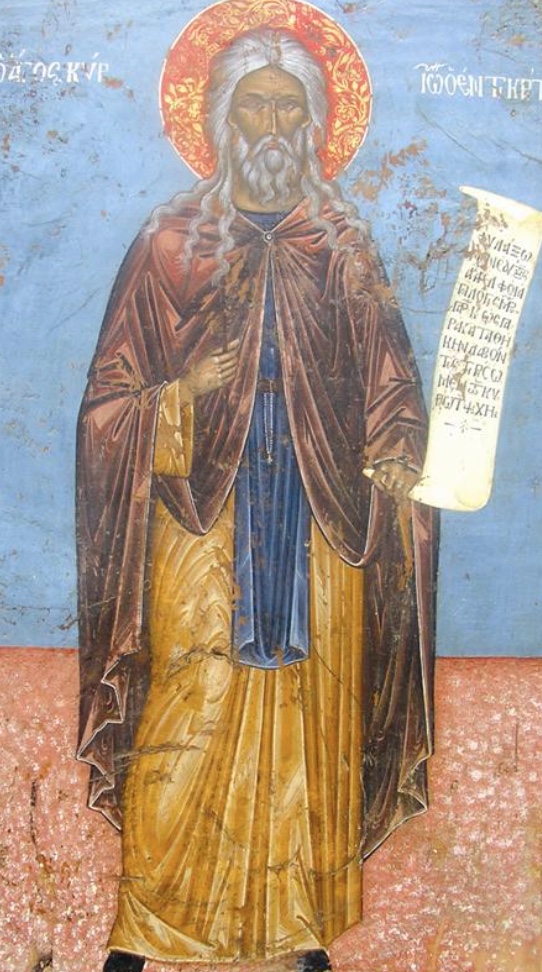
St John, called Xenos (“the Stranger”) or the Hermit, and known popularly as Kyr-Giannis, was born according to tradition around 970 in the village of Makra Siva – Siba in the sources, probably the modern Sivas – in the district of Pyrgiotissa on the Messara Plain, a decade after the liberation of Crete from Saracen rule. He came of a devout and wealthy family, felt drawn to Christ from his youth and chose the life of a monk and ascetic. For some fifty years, from the close of the 10th century into the first half of the 11th, he travelled the island preaching, moving, in his own phrase, from mountain to mountain; he founded churches and monasteries and helped to restore Orthodox life in Crete.
John Xenos was not only a missionary and a founder of monasteries but also a learned theologian, well versed in Christian philosophy. Commentaries on the Gospel of St Matthew are attributed to him, and possibly also hymnographic verse and translations of writings by Aristotle. The hymnographers therefore praise him as a sage, a great luminary of learning, a devout man and a connoisseur of philosophy, a teacher of ascetics, the glory of the saints and the pride of Crete.
The centre of his work was the monastery of the Panagia of Myriokefala, which he founded at the divine bidding of the Virgin Mary. His testament and his Life name nine foundations that he placed under the monastery, spread across what are now the regional units of Rethymno and Chania: the church of Sts Eutychios and Eutychianos, his first; the monastery of the Mother of God at Myriokefala; the church of St George Douvrikas at Melikas, near Roustika; the church of St George Psaropiastis (“the fisherman”), near Chromonastiri; the monastery of St Patapios; the church of the Zoodochos Pigi (“Life-giving Spring”) at Koufos, known as Agios Kyr-Giannis of Koufos; the church of St Paul in Sfakia; the church of St George at Azogires; and the church of St Eustathios on the coast of Kissamos. In law he treated them all as his own property, united under the authority of Myriokefala. They testify to his tireless missionary labour.
This testament is also the most important source for the saint’s life: in it he himself tells, in the first person, of his wanderings, his visions and his foundations – a piece of self-witness quite exceptional for medieval Crete. The text survives in a 15th-century manuscript in the Bodleian Library at Oxford and in the so-called Codex Cisamensis, copied in Crete in 1703. The list reads like a map of his journey, which led from the Messara in the south across the mountains of Rethymno to the west coast and down into Sfakia. Several of the churches named are still standing and are linked with his name to this day, among them the chapel of St Paul on the beach of Agios Pavlos near Agia Roumeli.
The story of this foundation is rich in miraculous images. Wandering from place to place, the saint came into the “turma” of Kalamonas – the Byzantine administrative district – and to the mountain of Myriokefalos. There, tradition relates, he spent seven days praying and fasting in a cave. He lost his sight and regained it when he saw a heavenly light and a voice commanded him to build a church on that spot. Later, around 1030, John travelled to Constantinople and there obtained imperial and patriarchal privileges: the emperor Romanos III Argyros (1028–1034) issued a chrysobull granting his churches an annual subsidy and vestments, and the patriarch Alexios Stoudites (1025–1043) gave the monastery the rank of a stauropegion, so that it was subject directly to the patriarch and exempt from the dues of the local bishop. It was on his return that he drew up his testament. This, too, marks him out as an outstanding spiritual leader and a tenacious defender of the Orthodox faith.
The veneration of St John Xenos continues to this day – in the church of St John in the Kissamos district, where his relics are kept, and in the katholikon of the monastery of Myriokefala, now the parish church.
Notes for visitors
Myriokefala is reached from the north coast by way of Episkopi and Argyroupoli, the village on the site of ancient Lappa some eight kilometres below; from there the road winds up into the mountains through stands of chestnut and oak. The hamlet of Maroulou is passed about a kilometre and a half before the village. The church stands in the middle of Myriokefala, surrounded by the low ranges of the old monastery, and serves as the parish church – outside the hours of service it is not always open, but in the village someone generally knows who keeps the key. The frescoes should not be photographed with flash. Those who seek the stillness of the place should come on an ordinary weekday; those who want to see what this shrine means to the Cretans should choose the night of 7 to 8 September, when the walkers arrive, the candles before the icon are never allowed to go out and the village stays awake until morning.