The most complete guide to Crete: 221 places on the map, 23 routes and 49 articles — with photos, videos and the story behind every place. Everything is open and free: no sign-up, no paid sections and no advertising, open or hidden. You can install the guide on your smartphone as an app.
Routes drawn along real roads
Weather at every stop
Full-text search
“Near me” by geolocation
Create your own printable itinerary
Satellite, terrain, dark mode
Works offline
⌕
Searches 1.7 million characters of descriptions, not just names
—places
4regions
—routes
—with video
Search results
—
Interactive map
Find what is near you
Filters narrow the map and the list at once. Zoom out and pins group together.
Region
Category
Фильтры карты
Landmarks
Featured places
RegionCategory
Routes
Ready-made day trips
Individual places
Articles about landmarks
Vamos and the Monastery of St George
About two kilometres east of Vamos, in the locality of Karydi, lies the Monastery of St George (Moni Agiou Georgiou) – a small foundation, but an important one for the history of the Apokoronas, and the only monastery of this district. A surfaced road leads to it. The name, which means “walnut”, belonged to a hamlet that once stood here and is mentioned in documents of around 1600; a church of St George on the spot was already recorded in 1577 by the Venetian scholar Francesco Barozzi. From its slightly raised position the view runs over olive groves and orange orchards to the White Mountains, often capped with snow. The precinct brings together church, monks’ cells and farm buildings; the most striking witness to the monastery’s working life on the land is the great olive mill. The ensemble has been called the most interesting complex of rural utilitarian architecture in the Chania district.
The olive mill of the thirteen arches
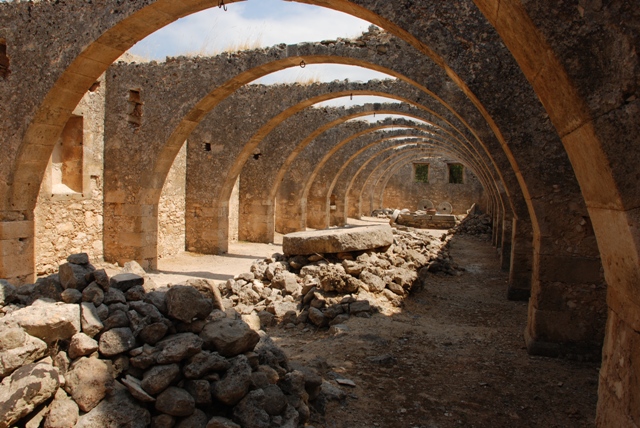
The mill is famous for its row of thirteen arches, which once carried the roof. They are not ornament but the structural frame of a large production hall in which olives were processed and oil was stored. The Ottoman authorities had licensed the monks to produce oil in 1829, and by 1863 the harvest from the estate had grown so large that this building was put up to handle it. The roof fell in long ago, so that the arches now stand open to the sky and offer a different play of light and perspective at every hour of the day. Four grinding mills stood here side by side – a unique case among Cretan olive mills, and one that betrays an extraordinary volume of production; only the masonry substructures survive, the millstones having been removed. The mill shows what part the monastery played in the economic life of the village and the surrounding lands.
The transfer to Agia Triada
Karydi was originally a small settlement in its own right and in Venetian times the fief of a nobleman. After the Ottoman conquest of the Apokoronas in 1646 some of the inhabitants of Vamos adopted Islam; in Karydi itself four families are said to have converted, while the rest faced the choice of leaving the place or changing their faith. In the 18th century the village priest handed the church of St George to the monastery of Agia Triada Tzagarolon as a metochi – as a property and dependent farm. According to local tradition this was done so that the church should not be turned into a mosque. The transfer gave the sanctuary the protection of the Church and preserved its Orthodox purpose, and the place became a refuge of the Christian faith under Ottoman rule. Monks from Agia Triada settled at Karydi, and the estate grew quickly: Christians gave land, and even Muslim neighbours signed plots over to the monastery, for they too held St George in honour.
The rebuilding of the 19th century
In the 19th century the complex was enlarged: the great olive mill was built, and a new and larger church, which went up between 1850 and 1880, when the monastery had grown prosperous through donations. Later the complex fell into decay and stood empty for a long time. The last monk left in 1900; by 1905 the house was deserted and its land was shared out among the farmers of the area, and in 1922 what remained went to veterans of the Balkan Wars and the Asia Minor campaign. In 1989 restoration began under the supervision of the archaeological service of Chania, on the initiative of Bishop Irenaeus Galanakis; the main phase was complete by 1996, when the monk Dorotheos arrived, and since then the monastery has been inhabited again. It is no longer a dependency but an independent monastery within the Metropolis of Kydonia and Apokoronas. Its present appearance has thus grown by degrees, joining an older ecclesiastical memory to the working architecture of the late Ottoman period.
On the veneration of St George
St George, great martyr of the 4th century and a soldier, is among the most widely venerated saints of the Orthodox world; his feast falls on 23 April and, when Easter comes later, is moved to Easter Monday. On Crete his churches often stand for the protection of the community and for the world of the farmer. At Vamos this veneration lives on in the church, which is still in use, and in the memory of the monastery as a place the inhabitants sought to save from ruin.
Vamos, the old chief town
A visit to the monastery is easily combined with a walk through Vamos and the neighbouring villages of the Apokoronas. The village lies about 25 kilometres from Chania in the foothills of the White Mountains; a Venetian census of 1573 lists it as Vamou, with 271 inhabitants. In the late Ottoman period Vamos was the administrative seat of the district of Sfakia, to which three provinces were subordinate – a role it was given in 1863 by Savvas Pasha; stately dwelling houses, the “konakia”, and neoclassical public buildings bear witness to it, alongside the plain one-room arched houses, the kamarospita, of poorer families. In the risings of 1866 and 1896 there was fierce fighting here: in 1896 some 4,000 insurgents besieged the place until the Ottoman troops withdrew. Many old wine stores, olive mills and farmhouses of the 18th to 20th centuries have since been carefully converted into guesthouses.