The most complete guide to Crete: 221 places on the map, 23 routes and 49 articles — with photos, videos and the story behind every place. Everything is open and free: no sign-up, no paid sections and no advertising, open or hidden. You can install the guide on your smartphone as an app.
Routes drawn along real roads
Weather at every stop
Full-text search
“Near me” by geolocation
Create your own printable itinerary
Satellite, terrain, dark mode
Works offline
⌕
Searches 1.7 million characters of descriptions, not just names
—places
4regions
—routes
—with video
Search results
—
Interactive map
Find what is near you
Filters narrow the map and the list at once. Zoom out and pins group together.
Region
Category
Фильтры карты
Landmarks
Featured places
RegionCategory
Routes
Ready-made day trips
Individual places
Articles about landmarks
Aptera – the ancient city above Souda Bay
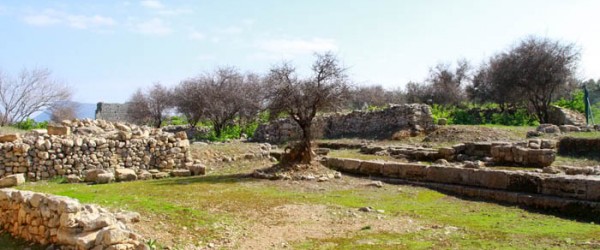
Aptera occupies the plateau of Paleokastro, about 15 kilometres east of Chania and roughly a kilometre inland from the southern shore of Souda Bay, on a hilltop more than 200 metres above the water. The view runs far out to sea, down to the islets at the mouth of the bay and across to the White Mountains. The ruins are better preserved than those of many other ancient cities in Crete: there are city walls, a theatre, sanctuaries, Roman cisterns, baths and houses – and in the middle of it all an abandoned monastery that helped itself freely to the ancient masonry. The plateau had been visited and described by travellers since Cristoforo Buondelmonti came up here in 1415, but it was the Englishman Robert Pashley, in 1834, who first correctly recognised the remains as those of Aptera.
Why Aptera is called the city of the Sirens
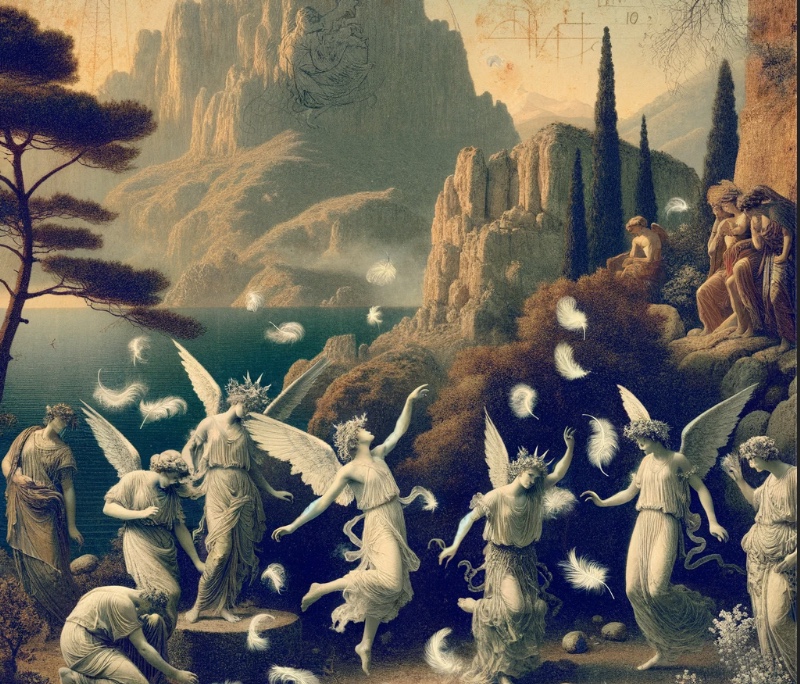
The name Ἄπτερα is usually taken to mean “the wingless one”. According to the myth, it was on the hill of Aptera that the Muses defeated the Sirens in a singing contest. The losers tore out their wings, turned white and threw themselves into the sea; from their white feathers, as Stephanus of Byzantium tells it, arose the islets of Lefkes (the ancient Leukai, “the white ones”) in Souda Bay. Another ancient version derives the name from the hero Pteras of Delphi.
Several distinct stories cluster around the Sirens. In some they were companions of Persephone, who were given wings after her abduction so that they might search for her; in others Demeter punished them for failing to come to her daughter’s aid, or Aphrodite turned them into creatures half woman, half bird because they scorned marriage. All this belongs to mythological tradition and is no historical account of how the city came into being.
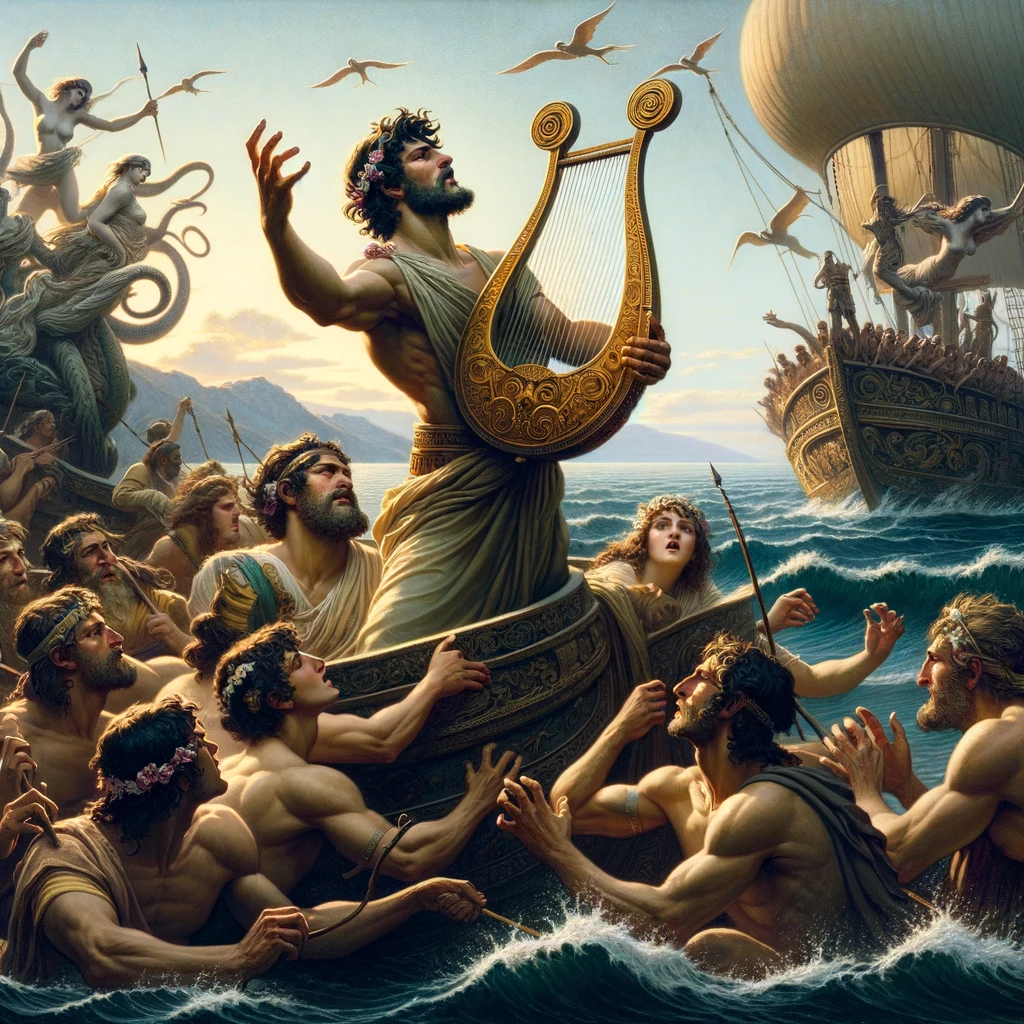
In ancient literature the Sirens are beautiful beings with a bewitching voice who lure travellers to their destruction. In Homer’s “Odyssey”, Odysseus has his companions stop their ears with wax and himself lashed to the mast, so that he may hear the song and still live. In the legend of the Argonauts it is Orpheus who overcomes the danger: he drowns out the Sirens’ song with the music of his lyre.
City, harbours and the islands of Souda Bay
Aptera was one of the leading centres of western Crete and, as Strabo and Pliny report, had two harbours: Minoa, the present-day Marathi, and Kisamos, in the area between Kalami and Kalyves. This position allowed the city to take part in seaborne trade and to command the shipping lanes around Souda Bay. Its men were known abroad as well, chiefly as archers who hired themselves out as mercenaries: bowmen from Aptera are said to have fought beside the Spartans in the Second Messenian War, and in 273 BC a certain Oryssos of Aptera, defending Sparta, killed Ptolemy, the son of King Pyrrhus.
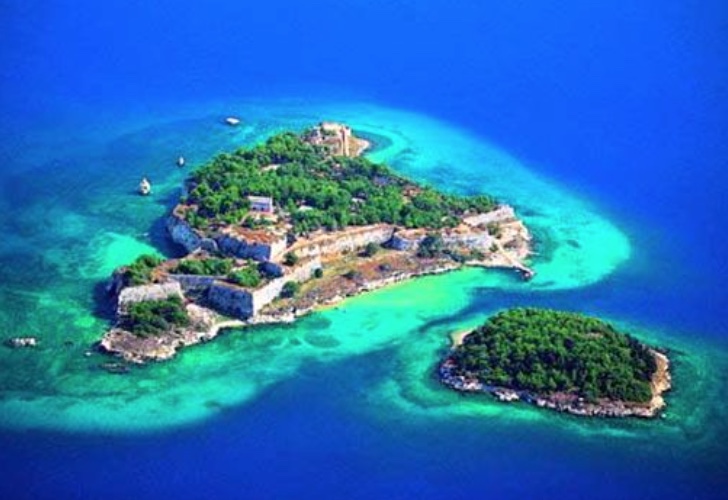
At the mouth of the bay lie the islands of Souda and Lefkes – Souda itself with a smaller companion islet named Leon; the island is said to have borne the name Minoa in antiquity. Later legends make Minoa the home of the Sirens, but that is a mythical image and not a documented history of settlement on the island.
The Venetian fortress on the island of Souda
On the island of Souda the Venetians began building a fortress in 1573, to secure the entrance to one of the best natural harbours in the Mediterranean against the Ottoman fleet. In 1646, with the works still unfinished, an Ottoman attack exposed their weak points; the defence was led by Girolamo Donà. After the fall of Crete in 1669 the island remained in Venetian hands for decades more, serving among other things as a refuge for Cretan insurgents, and capitulated only in 1715 after a siege of 72 days.
Under the Ottomans the fortress became a naval station and supply depot. At the end of the 19th century, in the time of the autonomous Cretan State, the bay drew the attention of the European powers. After the union of Crete with Greece, the Greek flag was raised over the fortress in 1913. The present naval base in Souda Bay is used by Greece and by NATO; the islet itself is uninhabited.
The Allied war cemetery on Souda Bay
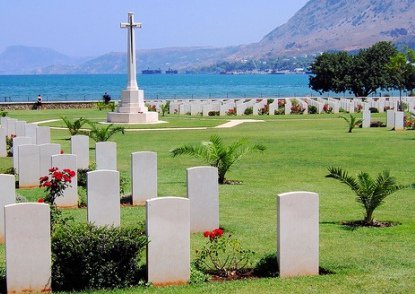
On the shore of the bay lies the Souda Bay War Cemetery. Here rest soldiers of the Commonwealth and of allied armies who fell in Crete during the Second World War – more than 1,500 graves on a lawn sloping down to the water. The cemetery, designed by the architect Louis de Soissons and cared for by the Commonwealth War Graves Commission, holds 1,564 burials in all: 19 from the First World War and the rest from the Second, of which 776 – men lost in the Battle of Crete – could not be identified. Among those buried here are the archaeologist John Pendlebury, who was wounded and killed in May 1941 as the Germans took Heraklion, and the New Zealander Staff Sergeant Dudley Perkins, who fought with the Cretan resistance and died in February 1944. With its rows of white headstones and the great bronze sword on the Cross of Sacrifice, the place recalls the fighting of May 1941 and the occupation of the island that followed.
The archaeological city of Aptera
Aptera arose in the Geometric period, around the 9th century BC, and survived into the 7th century AD; the final decline of the city is associated with earthquakes and Arab raids. The archaeological evidence shows that its great periods of prosperity fell in Hellenistic and Roman times, when the city struck its own coins and maintained relations with the major centres of the Hellenistic world. It took the side of Athens, Sparta and the Ptolemies against Macedon in the Chremonidean War of 266–263 BC, concluded treaties with Eleutherna and Hierapytna, and in 183 BC was one of 31 Cretan cities to sign an agreement with Eumenes II of Pergamon.
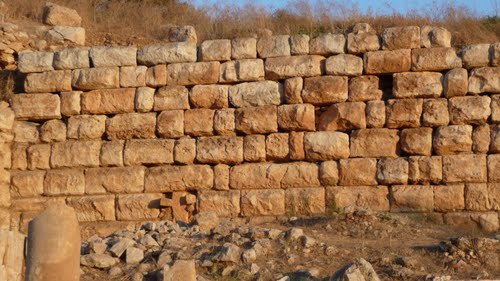
Stretches of the city walls survive, traditionally assigned to the 3rd century BC, though trial trenches at the foundations now point to a date before the middle of the 4th; so do a sacred precinct associated with Apollo and Artemis and a sanctuary of Demeter and Persephone. The little two-roomed temple of the 5th century BC, only 6.32 metres long and 3.96 deep, is built of carefully dressed blocks of uniform size held together with iron clamps and dowels; each chamber has its own door on the east side, and Artemis and Apollo were probably worshipped here together. It stands on a spot that had been sacred since Geometric times and has only one known parallel in Crete, at Lenika in Lasithi. The mythological explanations of the city’s name thus stand here beside the archaeological evidence of its religious life.
Impossible to miss, too, is the monastery of St John the Theologian in the centre of the site. It is mentioned as early as 1182, was a dependency of the monastery of St John on Patmos, and remained inhabited into the 1960s; the buildings that stand today – a square enclosure with a chapel and two-storeyed cells – date from the Venetian period, the 16th and 17th centuries, and squared blocks from the ancient public buildings are embedded in their walls.
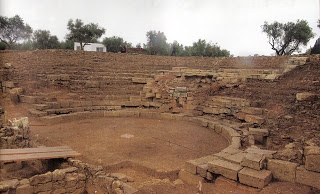
The ancient theatre lies in a natural hollow south of the city plateau, near the south-east gate, facing the White Mountains, and is built of the local limestone. Its main building phases belong to the Hellenistic period – the first half of the 3rd century BC – and to two Roman remodellings; during the Roman heyday of Aptera, in the second half of the 1st century AD, it was thoroughly renewed, with a new stage building and a lowered orchestra. The auditorium is 54.68 metres across, with at least 26 rows of seats divided into four wedges by five flights of steps, while the orchestra, with a radius of only 5.45 metres, is one of the smallest known in any ancient theatre. In the 19th and 20th centuries some of the stone seating disappeared into a lime kiln that was operated in the very middle of the theatre, but the substructure of the auditorium, the walls of the entrance passages and parts of the stage building survived. A paved Hellenistic street, some 55 metres of it traced, leads to the theatre from the temple area. Since its restoration the theatre has been open to visitors and is used for cultural events.
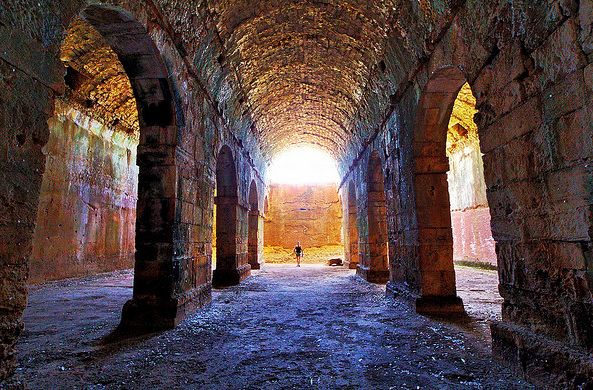
The most impressive structures at Aptera are the Roman cisterns: an enormous three-aisled vaulted hall carried on rows of piers, measuring 17 by 25 metres inside and holding some 2,900 cubic metres, and a second, L-shaped reservoir with arms 55.80 and 34.20 metres long and a capacity of about 3,050 cubic metres. Both are built of Roman concrete and lined with waterproof hydraulic mortar; the vault of the first is of rough-hewn stone, that of the second of brick. As there was no natural spring on the height – the nearest, at Stylos and Kalami, rise about 150 metres lower down – the inhabitants collected rainwater in small domestic tanks and in large public cisterns linked by a network of channels. Close by lay the Roman baths that these reservoirs supplied, two separate complexes with underfloor heating, attributed to the generosity of an Athenian benefactor; a house of the 1st century AD with a colonnaded court of five columns by seven, in which a bronze and marble group of Artemis and Apollo was found; and administrative buildings. Baths and house alike were brought down by the earthquake of AD 365.
The Koules fortress at Aptera
On the north-eastern edge of the ancient city stands the Ottoman fortress of Koules, sometimes also called Paleokastro after the hill, or the Soubashi fort. It was built after the uprising of 1866, in 1867 and 1868, under the supervision of Hüseyin Avni Pasha, as one of a chain of more than twenty watchtowers with which the Ottomans sought to control the rebellious countryside; from here the garrison could watch both the Apokoronas valley and the anchorage of Souda. The plan is almost square, with ancillary buildings ranged around a courtyard: two massive towers cover the south and south-west sides, a bastion protects the north-east, and semicircular towers secure the remaining sides. After the end of Ottoman rule the building served for a time as the village school. A little lower down the slope, above the village of Kalami, lies the larger fortress of Itzedin, completed in 1875, whose name means “Glory of the Faith”. It long served as a prison – Eleftherios Venizelos was held there in 1903, the deposed dictator Theodoros Pangalos from 1926 to 1928, and later many Greek communists – and was closed only in 1971; it has been a protected monument since 1986.
The Koules is not to be confused with the Venetian fortress on the island of Souda: these are two different fortifications from different ages, the one built by Venice in the 16th century to keep the Ottomans out of the bay, the other by the Ottomans three centuries later to hold down the Cretans. From the height of the Ottoman fort one looks over the bay, the White Mountains and the ancient city, which is why its viewpoint has long been part of the walk round Aptera.