Agia Triada Monastery: the Tzagarolos Foundation on Akrotiri
The most complete guide to Crete: 221 places on the map, 23 routes and 49 articles — with photos, videos and the story behind every place. Everything is open and free: no sign-up, no paid sections and no advertising, open or hidden. You can install the guide on your smartphone as an app.
Routes drawn along real roads
Weather at every stop
Full-text search
“Near me” by geolocation
Create your own printable itinerary
Satellite, terrain, dark mode
Works offline
⌕
Searches 1.7 million characters of descriptions, not just names
—places
4regions
—routes
—with video
Search results
—
Interactive map
Find what is near you
Filters narrow the map and the list at once. Zoom out and pins group together.
Region
Category
Фильтры карты
Landmarks
Featured places
RegionCategory
Routes
Ready-made day trips
Individual places
Articles about landmarks
The Patriarchal and Stavropegial Monastery of Akrotiri
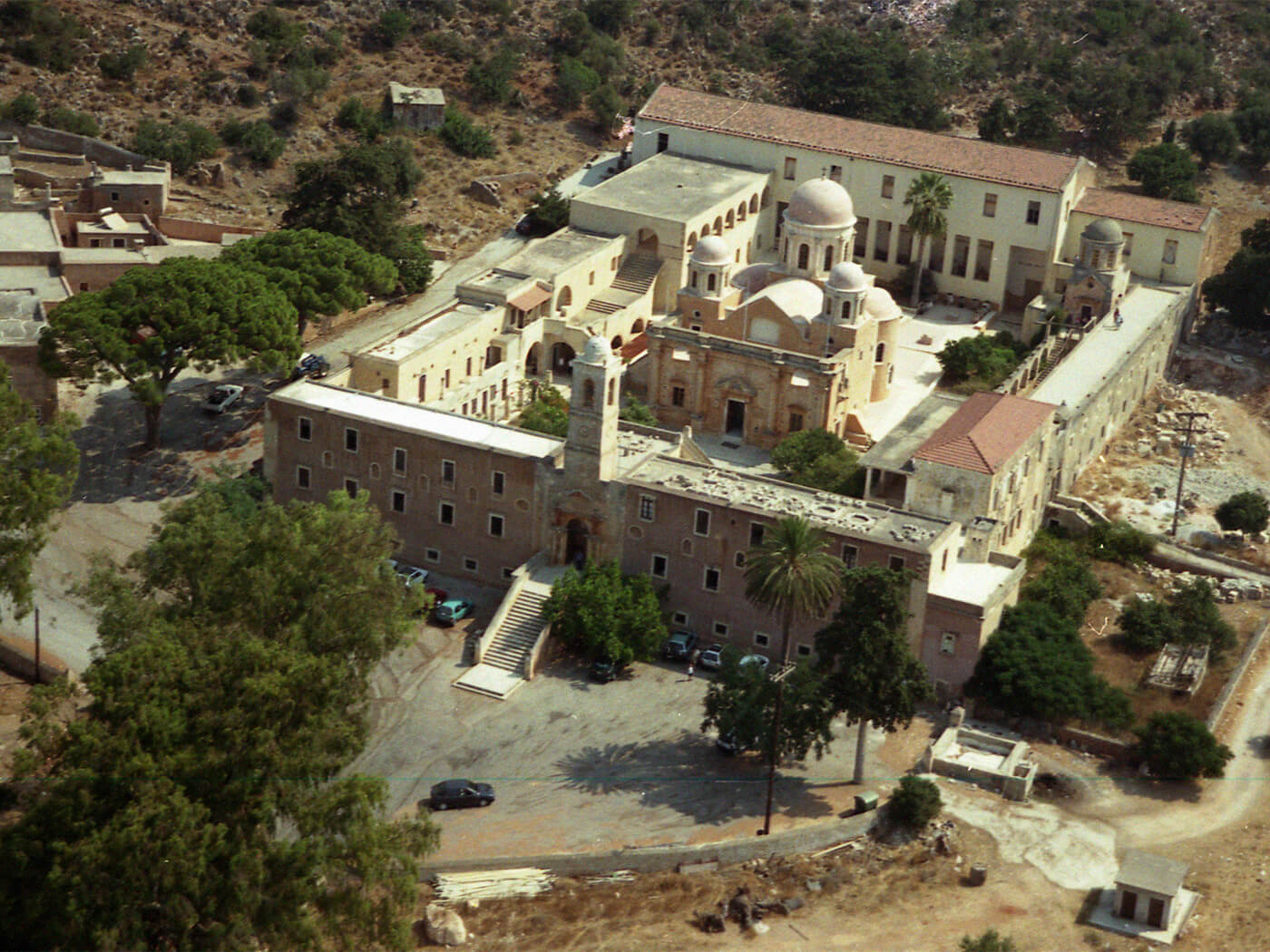
The Monastery of the Holy Trinity of the Tzagaroli (Moni Agias Triadas Tzagarolon) lies at the foot of Mount Stavros on the Akrotiri peninsula, in the district known as Tzobomylos, about fifteen kilometres from Chania and only a few minutes from the airport. A long avenue of cypresses leads towards the ochre-coloured façade. The enclosed complex, surrounded by olive groves and vineyards, combines the severe architecture of the late Venetian period with centuries of Orthodox tradition and a living monastic community; together with Arkadi Monastery it is regarded as the most important monument of the Cretan Renaissance, that brief flowering of the 16th and early 17th centuries when Venetian forms and Greek faith met on the island.
What “Stavropegial and Patriarchal” Means
The word “stauropegial” comes from the Greek stavropigion, “the planting of the cross”. A stauropegial monastery answers directly to the highest ecclesiastical authority and not to the local bishop; at its foundation a cross sent by the Patriarch was symbolically planted on the site. The patriarchal rank denotes the particular bond with the Ecumenical Patriarchate of Constantinople, which still governs the house today, as it does the other stauropegial monasteries of Crete. The term has nothing to do with a “monastery of the Crusaders”, as is sometimes misunderstood; it describes a canonical status within the Orthodox world, one that gave the community a measure of independence from local pressures under both Venetian and Ottoman rule.
The Foundation by the Tzagarolos Brothers
A small monastery stood on the site before the present buildings. In 1612 the brothers Ieremias and Lavrentios Tzagarolos began to raise the great complex. They came from a Venetian noble family but had grown up in the Orthodox milieu of Crete, a not uncommon pattern among the Veneto-Cretan gentry of the period. Ieremias, educated in both Greek and Latin, was a scholar of some fame, a friend of Meletios Pigas, Patriarch of Alexandria, and was himself spoken of as a candidate for the patriarchal throne of Constantinople. He understood a great deal about architecture, drew his design from the treatises of the Italian master Sebastiano Serlio of Verona, and is said to have had in mind the nearby monastery of Gouverneto and the houses of Mount Athos, which the brothers had visited; the triconch plan of the church, with three semicircular apses, is itself an Athonite form. After the death of Ieremias in 1634 Lavrentios carried the work forward.
Work broke off in 1645, when the Ottomans took Chania – the church had just reached the springing of the dome, and the decoration was never finished as planned. In Ottoman times the monastery was called Selvili Manastir, the “monastery of the cypresses”. The name reflected its surroundings and was in use alongside the Christian one; the cypress avenue that still greets the visitor is its living explanation.
Destruction, Rebuilding and the School
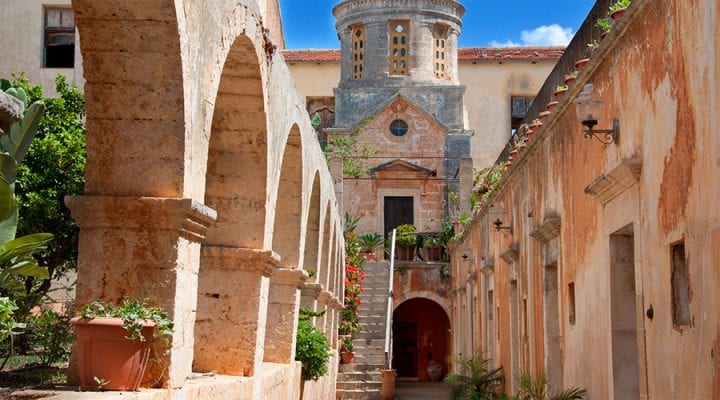
In 1821, the year of the Greek Revolution, Ottoman troops plundered and burned the monastery; many relics and manuscripts were lost, although the monks had hidden the most precious objects beforehand. The brotherhood withdrew into the mountains and the buildings stood empty until monks returned in the autumn of 1827. In 1830 the monks Kalliopios and Grigorios obtained permission from the Turkish authorities to complete the church, dome included; a boarding school opened in 1833, and the bell tower was built in 1864. From 1892 to 1905 the monastery housed a Hierodidaskaleion, a seminary for priests and teachers; in the 1930s the tradition was revived as an ecclesiastical school, which over the decades trained hundreds of pupils. The monastery’s income also helped to support the Greek schools of Chania, a role it still plays. During the rising of 1896–97 it served as a field hospital, a refuge for displaced families and headquarters of the insurgents, and it lost much of its landed property in the expropriations of 1925 and 1952.
In the Second World War the monastery rooms were first used as a munitions store; after the German capture of Crete a naval school and barracks moved in, and in 1944 the occupiers ran an anti-aircraft artillery school here with 150 to 200 troops quartered in the cells. After the war the monastery became once more an active spiritual centre and a place of learning.
The Architecture of the Monastery Court
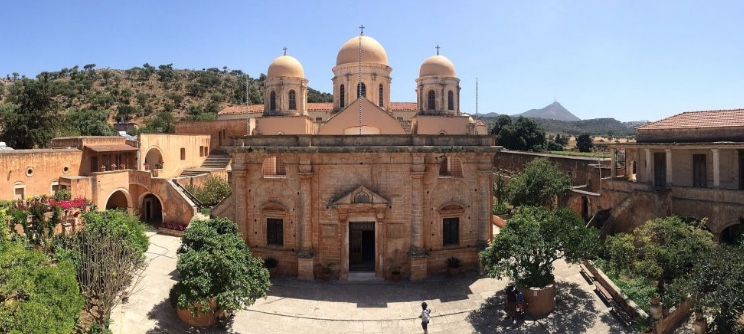
The complex forms a closed quadrangle around an inner court, almost fortress-like in its outer walls. The main entrance on the west side is treated as a show front: a broad flight of steps, paired Doric columns below and Ionic and Corinthian orders above, a round arch and a pediment bearing a Greek inscription that records the founders. In the composition of portal and west range the influence of Serlio’s treatises is unmistakable; the builders adapted the ideas of the Renaissance to the sloping ground of Akrotiri, so that the court sits a storey higher than the road, and later alterations have softened but not erased the original geometry.
The west range held the cells, the wine cellars and the old olive press; on the north side lay the library, on the south the two-storey ossuary with its chapel and the abbot’s lodging, on the east the rooms of the school. The refectory, the stables, the vaulted stores for the harvest, a wine press and a great cistern for rainwater also survive, so that the whole economy of a self-sufficient monastic estate can still be read in its buildings.
Katholikon and Chapels
Through a vaulted passage the visitor enters the court, in which the katholikon stands – a three-aisled church of triconch plan with a dome and carved stone ornament. Beside it are the chapels of the Life-giving Spring (Zoodochos Pigi) and of St John the Theologian, with further chapels on the upper floor, and in the court the small church of Christ the Saviour attached to the ossuary. The forms and decoration marry the Orthodox plan with western influences of the Renaissance and a touch of the Baroque; orange trees and tubs of flowers soften the severity of the stone.
The carved and gilded iconostasis, Cretan in tradition with Baroque detail, was made in 1836. Most of the icons of the mid-19th century are attributed to the painter Merkourios of Santorini, who worked in the post-Byzantine manner. The monastery also preserves vestments, manuscripts and other church furnishings, among them the epitrachelion of the founder, the epigonation of Gennadios, a 12th-century altar cloth and a Russian epitaphios of the 19th century. The small museum in the former cellars shows older icons as well: a St John the Theologian of the 16th century and a St Nicholas of the 17th, and panels of around 1635 to 1645 attributed to the Cretan painter Skordilis, showing Christ enthroned, the Life-giving Spring and the Last Judgement, together with wood carvings and liturgical objects.
Wine, Oil and Practical Notes for a Visit
Agia Triada has remained a working monastery. Its ten or so monks farm the olive groves and vineyards and sell their produce in the monastery shop, fitted out in the old cellar: organically grown olive oil – some twenty tonnes a year – wine from Cabernet Sauvignon, Merlot, Muscat and the local Romeiko among other grapes, tsikoudia, honey, vinegar and olive-oil soap; part of the output is exported. In summer several hundred visitors arrive each day, so the early morning is the quiet time. A small admission charge is made, the gates are usually shut over midday, and wraps are lent at the entrance. From here the road continues a few kilometres further to Gouverneto Monastery and the gorge of Katholiko, so the three sites make a natural half-day from Chania by car; the airport is close enough for Agia Triada to be the first or last stop of a Cretan journey.
Memory and Pilgrimage
Agia Triada Tzagarolon unites history, learning, husbandry and prayer. Vineyards, olive trees, library, icons and architecture tell of an independent spiritual centre of Crete, one that has survived fire, occupation and expropriation and is still inhabited – and not merely of a monument of the Venetian age.