The most complete guide to Crete: 221 places on the map, 23 routes and 49 articles — with photos, videos and the story behind every place. Everything is open and free: no sign-up, no paid sections and no advertising, open or hidden. You can install the guide on your smartphone as an app.
Routes drawn along real roads
Weather at every stop
Full-text search
“Near me” by geolocation
Create your own printable itinerary
Satellite, terrain, dark mode
Works offline
⌕
Searches 1.7 million characters of descriptions, not just names
—places
4regions
—routes
—with video
Search results
—
Interactive map
Find what is near you
Filters narrow the map and the list at once. Zoom out and pins group together.
Region
Category
Фильтры карты
Landmarks
Featured places
RegionCategory
Routes
Ready-made day trips
Individual places
Articles about landmarks
Gavalochori: a traditional village of the Apokoronas
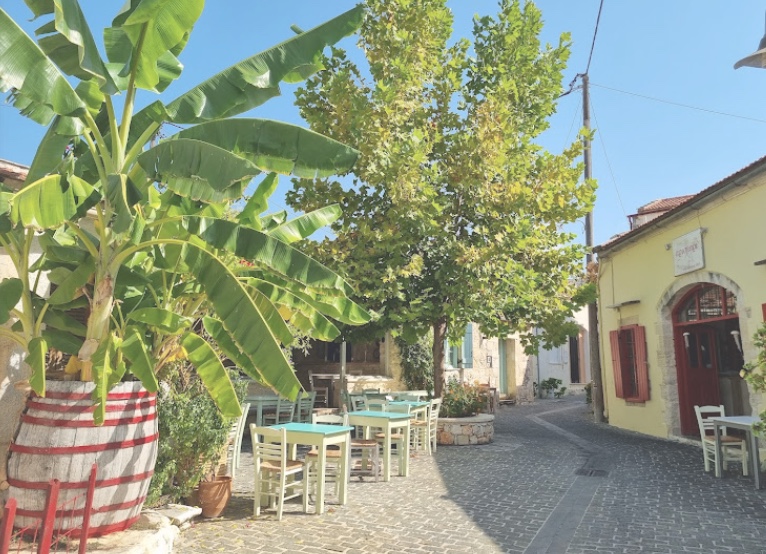
Gavalochori (Γαβαλοχώρι) is among the most characterful of the traditional settlements of the Apokoronas. It lies some 26 kilometres east of Chania in the hill country behind the coast, three or four kilometres inland from the beach at Almyrida, and at the 2021 census had 612 inhabitants. Stone houses with arches and colour-washed fronts, narrow lanes, terraced gardens and old workshops have drawn not only Cretans but other Europeans too, who have bought houses here and restored them with care. Yet the village has not turned into an open-air museum: it has kept its rural routine along with its historic fabric, and it is best explored on foot. A circuit of the main sights – the square, the museum, the principal churches, the olive mill and the wells – is about two kilometres long and takes roughly two hours with stops.
The Museum of Folk Art
The Historical and Folklore Museum of Gavalochori occupies a historic dwelling house and a former olive mill, both recognised as monuments of traditional architecture. It stands a few steps beyond Platanaki Square, the heart of the old Turkish quarter. The ground floor of the house, with its inner courtyard and arched living room, still dates from Venetian times; a mezzanine, the ontas, was added under Ottoman rule. A start was made in 1965 by the head of the community, Vasilios Fronimakis: at his suggestion the inhabitants handed over archaeological, historical and folk objects, and this became the first folklore museum in the Chania district. In its present arrangement it was officially opened in September 1993. Seven rooms are devoted to the stone-built Cretan arched house (kamarospito), silk, pottery, bobbin lace, stone and wood carving, church life and the history of the area. On show are household goods and furniture, a loom and kitchen equipment, locally made silk costumes, a masonry wine press that doubled as a sleeping platform, icons and carved parts of iconostases – among them a 19th-century screen of cypress wood – coins from Roman to modern times, and weapons, medals and lithographs from the risings against the Ottomans. The museum is generally open from April to October.
The Wells of the Gavalians
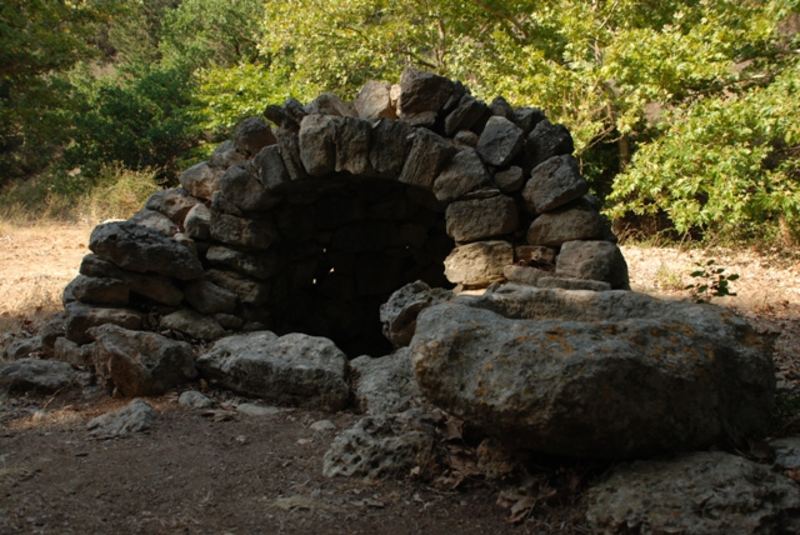
East of the village, about 600 metres from the main square, lie the Gavaliana Pigadia: several dozen water collectors cut into the rock and lined with masonry, ringed with stone and roofed with arched vaults. Tradition speaks of thirty wells; some twenty-four survive. They are usually attributed to the Venetian period of the 15th and 16th centuries, though some accounts hold them to be Byzantine. Here rainwater was gathered and stored for the whole neighbourhood – in a dry limestone hill country, a matter of survival. Several still hold water, two old plane trees shade the spot, and a small Venetian bridge can be seen across the road.
The wells were a place of community: here people drew water and did the washing, and here the women of the surrounding houses met. They kept that role until 1969, when a piped municipal supply reached the village. Their position shows how closely water supply, daily work and social life were bound together in the traditional village.
The Church of St Paul
On the edge of Gavalochori stands the small church of St Paul (Agios Pavlos), which local tradition dates to the 6th or 7th century. Its nearness to the wells makes plain how, in a Cretan settlement, the natural watering place, the working life of the farm and the Christian precinct formed a single landscape.
The story of the name and the memory of Nikephoros Phokas
The ground has long been settled: from the surrounding area come Minoan vessels, axes and lamps, house foundations, coins and cisterns of later ages, and Roman tombs and pottery. Tradition derives the place name from the Gavalas family and from resettlements in Byzantine times. In the 10th century Nikephoros Phokas, the future emperor, restored Byzantine rule over Crete after driving out the Saracens in 961; local tradition connects the growth of the settlement and its waterworks with that era. According to a widespread story the Gavalades were among the twelve noble houses of Constantinople whom the emperor Alexios Komnenos sent to the island in 1082; a Philippos Gavalas is regarded as the founder of the “village of the Gavalas”. Scholars consider the document on which the tale rests a later forgery, but the family’s presence is real enough: the church of St Catherine, which goes back at least to about 1200, was theirs, and until 1700 every one of its priests was a Gavalas. Later centuries were harder. Plague struck in 1770, 1797 and 1810, and in 1906 alone some two hundred men left for America. In the rising of 1821 the Cretan Council had its seat here for a time, and on the main square a memorial honours two later fighters, Konstantinos Malinos (1832–1913) and Charalambos Papadakis. Such accounts link the history that can be documented with the memory the inhabitants hand down from generation to generation.
Gavalochori combines well with Vamos, Douliana and other villages of the Apokoronas. It is not only the museum but also the wells, the old lanes and the small churches that give the village its coherent historic appearance.