Profitis Ilias Hill: the Venizelos Graves and the Flag of 1897
The most complete guide to Crete: 221 places on the map, 23 routes and 49 articles — with photos, videos and the story behind every place. No sign-up, no trackers.
Routes drawn along real roads
Weather at every stop
Full-text search
“Near me” by geolocation
Create your own printable itinerary
Satellite, terrain, dark mode
Works offline
⌕
Searches 1.7 million characters of descriptions, not just names
—places
4regions
—routes
—with video
Search results
—
Interactive map
Find what is near you
Filters narrow the map and the list at once. Zoom out and pins group together.
Region
Category
Фильтры карты
Landmarks
Featured places
RegionCategory
Routes
Ready-made day trips
Individual places
Articles about landmarks
The Hill of the Prophet Elijah and the Story of Akrotiri
On the eastern edge of Chania, where the Akrotiri peninsula begins to rise from the plain, stands the hill of the Prophet Elijah – Profitis Ilias, once known from the old field name as Froudia. It is a few kilometres from the centre on the road to Akrotiri and the airport, and it holds three things in one place: the chapel of the prophet, the monument to Spyros Kagiales, and the graves of Eleftherios and Sofoklis Venizelos, all set within a well-kept park of pines, cypresses and flower beds. From the top the eye travels over the city and its Venetian harbour, across the bay to the green plain beyond, and up to the White Mountains, whose summits often keep their snow until late spring. The hill is at once a place of prayer, of national remembrance and of simple pleasure in the view; for the people of Chania it is a favourite spot to watch the sun go down, and it is still surprisingly little visited by foreign travellers.
The Church of the Prophet Elijah
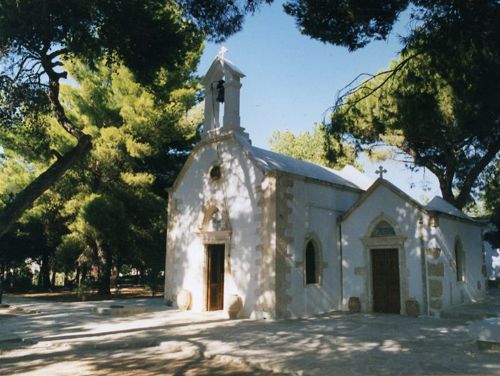
The small church of the Prophet Elijah is one of the older sanctuaries of Akrotiri and belongs to the Venetian period; its origins lie in the 15th century. According to tradition it was first dedicated to the prophet Elisha, and in the 16th century a second aisle was added for the prophet Elijah – hence its double dedication. During the bombardment of the insurgents’ camp in 1897 it was struck by shells from the international squadron and the bell tower collapsed. It was later rebuilt with money to which the Russian imperial court contributed. Local tradition explains the gift as an attempt to make peace with the prophet: shortly after the bombardment an explosion occurred aboard a Russian warship, and this was read as punishment for the damage done to the shrine. The feast of the patron falls on 20 July, when the chapel on the hill is the focus of a service and a small panigyri.
The Cretan Revolt and the Camp at Akrotiri
Between 1890 and 1895 the Christian population of Crete suffered under heavy fiscal and administrative pressure, and under violence. After the arson and killings in Chania on 23 and 24 January 1897, when the Christian quarter went up in flames, about a hundred insurgents gathered on Akrotiri. They demanded an end to Ottoman rule and the union of the island with Greece; a revolutionary camp grew up on the peninsula, from which Chania and the sea approaches could be kept under observation. Among its leading figures was a young lawyer from Chania, Eleftherios Venizelos, then in his early thirties, whose house in the suburb of Chalepa lay directly below the hill. The camp was the last of the great Cretan risings of the 19th century, following those of 1866–69, 1878 and 1889, and it was the one that finally forced the island’s question onto the agenda of the European chancelleries.
The Great Powers – Italy, France, Austria-Hungary, Germany, Great Britain and Russia – were not prepared to allow an immediate union of Crete with Greece. Their squadrons, anchored off the north coast, established international control over Chania, Rethymno and Heraklion; they wished to contain the fighting, which threatened to draw Greece and the Ottoman Empire into open war, and to make sure that the question of the island would not be settled without them. Within weeks a Greek expeditionary force had in fact landed on Crete, and the Greco-Turkish War of 1897 broke out on the mainland that spring; the Powers kept the island itself under their own hand.
The Deed of Spyros Kagiales
On 9 February 1897 – by the old calendar then in use in Greece – the Italian admiral Felice Napoleone Canevaro, senior officer of the allied fleet, had the insurgent positions on Profitis Ilias shelled after a clash between Christians and Turks on the hill; some hundred shells are said to have fallen there. The shots smashed the flagstaff, and twice the Greek flag fell to the ground. When a third shot splintered the pole, the insurgent Spyros Kagiales (Kagialedakis), a man of twenty-five from a family with roots in Gramvousa and Sfakia, picked up the cloth and made his own body the flagstaff, standing upright with the flag held high while the ships continued firing.
The squadron commanders saw the flag flying again over the camp and ordered the guns to cease; from the decks of the ships, it is said, applause could be heard. Canevaro himself later wrote that the raising of the flag in such a heroic manner was a moment in his life he would never forget, and he is said to have confessed to Eleftherios Venizelos that the act of Kagiales had “literally defeated European diplomacy”. Kagiales went on to fight in the later Cretan risings and, at the age of forty, at the battle of Driskos in Epirus during the First Balkan War, where his son Georgios was killed; he was decorated for bravery but lived afterwards in modest circumstances in Chania. He is said to have refused a pension with the words that he had acted for the nation, not for payment. He died in Chalepa on 5 September 1929 and lies in the cemetery of Agia Fotini. His bronze statue on the hill – a man holding the flag aloft with outstretched arm – was unveiled on 21 July 1997, a century after the event, at the very spot where the shells fell; each year on 9 February the municipality lays wreaths there, and the figure has become the emblem of self-sacrifice in the Cretan struggle for freedom.
From Autonomy to Union
After the rising of 1897 Crete was granted autonomy under an international protectorate and freed from direct Ottoman administration; in November 1898 the last Turkish troops left the island, and the following month Prince George landed at Souda as High Commissioner. The autonomous years became the transition to Enosis, the union with Greece on 1 December 1913, which the Treaty of London had conceded after the First Balkan War. The flag on the hill therefore recalls not a single episode of war but the long political road travelled by the island, from the camp of 1897 to the ceremony on the Firkas sixteen years later.
Eleftherios Venizelos and the Family Graves
Eleftherios Venizelos was born on 23 August 1864 in Mournies, a village just south of Chania, in what was then the Ottoman Empire. His first name means “the free one”, and he grew into one of the most important politicians in modern Greek history, a man whose name is inseparable from the liberation and union of Crete. After the risings he helped to build the Cretan State, then placed himself at the head of the movement for Enosis – in 1905 with the Therisso revolt, launched from a village in the foothills behind Chania – and from 1910 served, by the usual count, five times as Prime Minister of Greece, or seven or eight times if every short-lived ministry is reckoned separately, more than twelve years in office in all. Under him the country enlarged its territory considerably in the Balkan Wars of 1912–13, gaining Macedonia, Epirus, Crete and the eastern Aegean islands, and underwent far-reaching reforms of administration, army and education.
Venizelos died in exile in Paris on 18 March 1936, aged seventy-one; his coffin was brought back to Chania by sea and buried on the hill amid enormous public mourning, deliberately bypassing Athens, where feeling against him still ran high. Beside him rests his son Sofoklis (died 1964), likewise a politician and Prime Minister of Greece in several governments between 1943 and 1952; his tomb was built in 1965. The burial place was not chosen by chance: Venizelos himself had wished for it, within sight of his family house at Chalepa, because it was on this hill that the Greek national flag had been raised under fire in 1897.
The Inscription on the Grave of Venizelos
Carved into the plain stone slab of Eleftherios Venizelos’s grave are words from his speech to Parliament in 1932, four years before his death – a kind of obituary written by himself. In it he speaks of the possible errors of his life, but stresses that he devoted all his powers of mind and body to the struggle to free his people from oppression, and describes himself as a man of courage, with confidence both in himself and in the people he served. The inscription makes the grave a place of civic and political remembrance; on the anniversaries of his birth and death delegations from all over Greece lay wreaths here, and the site is a regular stop for school parties and official visitors to Chania.
Practical Notes for a Visit
The hill lies about five kilometres from the centre of Chania on the road to the airport and Akrotiri, just above the suburb of Chalepa; city buses stop nearby, and there is parking at the top. The park is open at all times and free to enter, and several cafés and patisseries on the edge of the grounds share the view – the Koukouvagia (“the owl”) and the Nymphes are the best known, and a coffee or a dessert on their terraces is part of the ritual for locals. The light is loveliest in the late afternoon, when the sun sinks behind the Rodopou peninsula and the city below turns gold; on a clear winter day the snow on the White Mountains makes the panorama complete.
Today the hill of the Prophet Elijah brings together the church, the Kagiales monument, the Venizelos graves and the panorama of Chania. A visit makes the history of Crete visible in a single place: in religious tradition, in the rising of 1897, in the manoeuvres of international diplomacy and in the island’s road to union with Greece.