Agia Marina – beaches, Thodorou island and the coast west of Chania
The most complete guide to Crete: 221 places on the map, 23 routes and 49 articles — with photos, videos and the story behind every place. Everything is open and free: no sign-up, no paid sections and no advertising, open or hidden. You can install the guide on your smartphone as an app.
Routes drawn along real roads
Weather at every stop
Full-text search
“Near me” by geolocation
Create your own printable itinerary
Satellite, terrain, dark mode
Works offline
⌕
Searches 1.7 million characters of descriptions, not just names
—places
4regions
—routes
—with video
Search results
—
Interactive map
Find what is near you
Filters narrow the map and the list at once. Zoom out and pins group together.
Region
Category
Фильтры карты
Landmarks
Featured places
RegionCategory
Routes
Ready-made day trips
Individual places
Articles about landmarks
Agia Marina and the west coast of Chania
Off the coast, half a mile out from the beach, lies the small island of Thodorou, officially Agii Theodori, with a still smaller companion, Mikros Agios Theodoros, beside it; in antiquity it was known as Akytos, and the Stadiasmus, the ancient coastal itinerary, records that it had drinking water. The island covers about seventy hectares. The Venetians fortified it in the late 16th century with two forts, one called Turluru on the summit and a second lower down by the shore, at a cost of some 21,500 ducats, to protect the shore and the approach to Chania from raids by sea; in June 1645, at the opening of the Cretan War, the island was one of the first points to fall to the Ottomans, and tradition tells that the Venetian commander, Biagio Giuliani, chose to blow up the magazine with his small garrison rather than surrender. On the island once stood an early Christian three-aisled church of St Theodore the Commander, of which only ruins remain. Today Thodorou is protected as a nature reserve and is known for its herd of Cretan wild goats, the kri-kri, which have been kept here undisturbed since 1935, when the first male and two females were released on the island; it is also an important breeding site of Eleonora’s falcon. Landing is as a rule forbidden, with the exception of the feast of the Saints Theodore, when boats bring the faithful across from Platanias; but the island is plain to see from the beach of Agia Marina – with the great cave mouth in its flank, in which folk legend recognises the gaping jaws of a petrified sea monster that was rising to devour Platanias when the prayers of the people to the Virgin and St George turned it to stone.
Agia Marina (Αγία Μαρίνα) is a resort about nine kilometres west of Chania, between Stalos and Platanias. Here two different characters of the coast meet: Stalos has kept quieter stretches of shore, while Agia Marina is known for its sandy beach of some two kilometres with organised sections, for beach volleyball, tavernas, bars and its nightlife; its visitors, like those of Platanias, come in large part from Scandinavia during a season that runs from April to October. Behind the strip of hotels begin the hills and the old paths that lead to the villages of the hinterland and on towards the plain of Kissamos. The community numbers a few hundred permanent residents and, before the visitors came, lived from olives, citrus fruit, melons and livestock, together with small workshops and trades.
The history of the village went on into the 20th century. Four men from the place took part in the Macedonian Struggle; during the Battle of Crete in May 1941 there was fighting in the district. In the years of the German occupation soldiers requisitioned many houses in Agia Marina, and two inhabitants were killed immediately after weapons had been found in their homes. These events are a reminder that the present resort grew up on the ground of a living village community and not on an empty shore.
The name of the settlement goes back in all probability to the small church of Agia Marina, which stands outside the old village centre by the old cemetery. When it was built is not settled; a local conjecture carries it back as far as the time of Nikephoros Phokas, that is to the 10th century, when Crete was recovered from the Arabs. In the surroundings traces of a Venetian fortification and of later Ottoman building survive, and scattered coins, potsherds and dressed stones from older buildings suggest that the district was already inhabited in antiquity. These remains do not make up a castle of their own, but they recall that the shore belonged to the historical territory of Chania, in which landlords, roads and patterns of settlement changed with the centuries.
Nerospilia – a cave of Minoan date
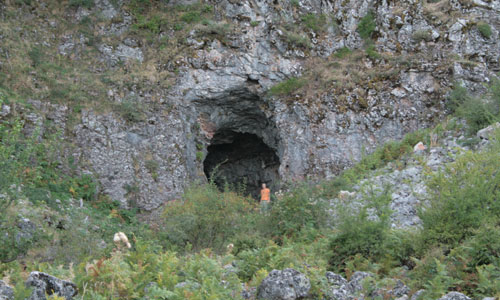
In the district of Stalos lies Nerospilia, the “water cave”, with stalactites and stalagmites. Archaeologists connect it with religious practices of the Minoan period. Water and underground space may have given the cave a sacred significance; what rites were performed here, and to which deity they were addressed, is unknown. It is more accurate, therefore, to speak of a place of cult use than of a fully reconstructed sanctuary. The cave lies in the hills above the coast and is not developed for visitors; a torch and sure footing are needed, and it is best found with someone from the village.
Platanias and the Bay of Chania
West of Agia Marina lies Platanias, a large coastal settlement at the mouth of the river of the same name, which owes its name to the plane trees along its banks. The village proper has a little under a thousand inhabitants, but since the local-government reform of 2011 it has given its name to a municipality of some fifteen thousand people that stretches westwards as far as the border of Kissamos, with its seat at Gerani. From the hill of the old village above the coast a panorama opens over the Gulf of Chania as far as the island of Thodorou, and the fertile plain on either side of the river is planted with citrus orchards and olive groves. Today Platanias is one of the most important tourist centres in the western part of the gulf, yet its landscape remains tied to agriculture.
Ancient Pergamos (Πέργαμος) is associated with Platanias. According to a local view it was exactly here that the city named in ancient tradition stood – a foundation, the ancients said, of Agamemnon or of the Trojan exiles under Aeneas; other scholars look for it on the hill of Grimbiliana or near Vryses. The location remains a hypothesis.
Gerani and the family holiday
Further west lies Gerani, a coastal village with beaches, hotels and a quiet atmosphere, and since 2011 the administrative seat of the municipality of Platanias. Families with children come here, and all who prefer water sports without the constant noise of the big resorts. The hinterland has kept its gardens, olive trees and small rural settlements; so Gerani complements the bustle of Agia Marina with a different and more measured rhythm.
Together Agia Marina, Stalos, Platanias and Gerani form a continuous strip of the west coast of Chania. Beaches and tourist facilities lie here side by side with the cave of Nerospilia, the remains of old settlements and the Orthodox church of Agia Marina. For a stay it is worth choosing the stretch of shore in advance: between the organised beaches and the quiet spots the distance is small, but the impression is wholly different. The beaches face north and feel the summer wind, so the sea is often choppier in the afternoon than in the morning. From Chania the public buses run along the coast road at frequent intervals.