The most complete guide to Crete: 221 places on the map, 23 routes and 49 articles — with photos, videos and the story behind every place. No sign-up, no trackers.
Routes drawn along real roads
Weather at every stop
Full-text search
“Near me” by geolocation
Create your own printable itinerary
Satellite, terrain, dark mode
Works offline
⌕
Searches 1.7 million characters of descriptions, not just names
—places
4regions
—routes
—with video
Search results
—
Interactive map
Find what is near you
Filters narrow the map and the list at once. Zoom out and pins group together.
Region
Category
Фильтры карты
Landmarks
Featured places
RegionCategory
Routes
Ready-made day trips
Individual places
Articles about landmarks
Voukolies – a market town in the Tavronitis valley
Voukolies (Βουκολιές) is a historic place on the west bank of the Tavronitis, in the foothills behind Chania and on the old road that runs from the north coast by way of Kandanos to Paleochora. Its various quarters lie at heights between roughly 200 and 300 metres. Olive groves, orange orchards and vineyards shape the landscape, and the valley itself links the north coast with the mountain villages of the municipality of Platanias, to which Voukolies has belonged as a municipal unit since 2011. Before that it was a municipality in its own right, in the eastern part of the old province of Kissamos, and its territory – some 75 square kilometres, reaching from Tavronitis on the coast to the first slopes of the White Mountains – takes in Kakopetros and Palea Roumata among other villages; the community of Voukolies itself numbered 939 inhabitants at the 2021 census. The name is of ancient Greek origin: “voukolia” means cattle pastures and stock enclosures, and the district did indeed once serve as summer grazing. The place is first recorded in a notarial deed of 1256.
Voukolies is known for its weekly λαϊκή αγορά, the open market of local producers, held every Saturday morning on the village square. It has existed for more than a century and a half and owes its fame above all to the Easter bazaar of Good Friday, when the square fills with food, cheese, honey, oil, craftwork and the goods of the season. The bazaar once mattered to the social fabric of the district in another way too: it was the recognised occasion on which families from scattered villages met and marriages were arranged. This trading tradition was already alive in Ottoman times, when Voukolies – then largely a Muslim village – was an important local exchange: the market for central and eastern Kissamos and for parts of Selino, at which sheep, goats and cattle above all changed hands. The market reaches a second peak each year on 14 and 15 August, for the feast of the Dormition of the Virgin.
The church of St Constantine
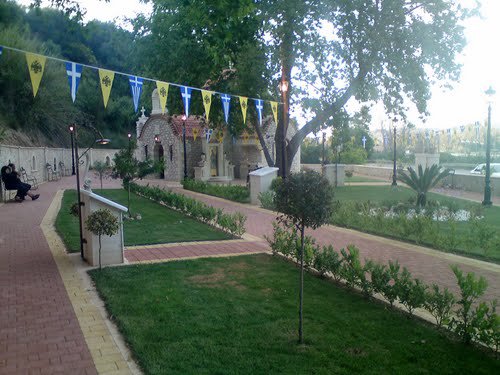
In the old part of the town, in the quarter of Nembros on its northern side, the church of St Constantine survives among fields of olive and orange trees. It is commonly dated to the 15th century – the years 1452 to 1462 for the building, 1645 for the bell-cote – though its core may go back to the 13th. The church is best regarded as a monument of many layers, in which a medieval core stands beside later additions – and one that belongs wholly to the Venetian period of the island, whatever date is preferred. Most of the wall paintings have faded; the Baptism of Christ is comparatively well preserved, and there is an inscription at the south door. Two more Byzantine churches lie nearby: the half-ruined Agios Athanasios, with frescoes of the 14th and 15th centuries, and the small Agios Andreas not far from the square. The parish church of the town is that of the Transfiguration of Christ.
The tower of Voukolies and the fighting of 1866 to 1897
About six hundred metres south-west of the town, at the 27th kilometre of the road from Chania to Kandanos and Paleochora, lie the remains of the Pyrgos of Voukolies – an Ottoman fortification built in the last decades of Turkish rule in Crete. It dates from about 1866 and belonged to the network of defensive and observation posts created during the period of the uprisings, and it guarded the village through the revolt of 1866–1869. Its position made it possible to watch the road and the approaches to the Tavronitis valley, and to protect what was then a Muslim settlement against the Christian insurgents of the hills. In 1999 the tower was rebuilt on a reduced scale; the original key is kept in the Benaki Museum in Athens. The site can be reached by a surfaced road.
From 5 to 7 February 1897 one of the decisive engagements of the late Cretan uprising took place at the tower. The Greek expeditionary corps under Colonel Timoleon Vassos, an Athenian officer then about sixty who was later to rise to major general, joined Cretan insurgents in surrounding the Ottoman garrison of some 400 men and took the fortification; on the spot a mixed detachment with artillery and engineers led the attack. The defenders tried to break out under cover of darkness and a storm and lost more than a hundred men; on the Greek side fifteen Cretans and one officer of the regular army fell. It was the first action fought by regular Greek troops for the liberation of the island – and a link in the chain of events that led to the intervention of the Powers, to the Greco-Turkish War of the same year, which the dispatch of Vassos’s force did much to precipitate, and to the later autonomy of Crete.
Voukolies today
Today Voukolies keeps the character of a lively rural centre: beside the historic buildings there are shops, tavernas and the market, and roads lead to Tavronitis, to Palea Roumata and into the hill country. A visit here takes in everyday Cretan life, a medieval church and the more recent history of the island – from the Ottoman period to the union of Crete with Greece. An hour or two is enough for the square, the church at Nembros and the tower, and Voukolies makes a natural first halt on the drive from Chania to the south-west coast.
The Good Friday market has existed for more than 160 years and is still one of the best-known village markets in the Chania region. Dozens of itinerant traders and producers offer food, cheese, honey, plants, craft goods and everyday articles, and the tavernas on the square serve the Lenten dishes of Holy Week. On the bank of the Tavronitis a restored watermill survives: its stone grinding gear shows how the water of the river was put to work milling grain for the economy of the village.