The most complete guide to Crete: 221 places on the map, 23 routes and 49 articles — with photos, videos and the story behind every place. Everything is open and free: no sign-up, no paid sections and no advertising, open or hidden. You can install the guide on your smartphone as an app.
Routes drawn along real roads
Weather at every stop
Full-text search
“Near me” by geolocation
Create your own printable itinerary
Satellite, terrain, dark mode
Works offline
⌕
Searches 1.7 million characters of descriptions, not just names
—places
4regions
—routes
—with video
Search results
—
Interactive map
Find what is near you
Filters narrow the map and the list at once. Zoom out and pins group together.
Region
Category
Фильтры карты
Landmarks
Featured places
RegionCategory
Routes
Ready-made day trips
Individual places
Articles about landmarks
The olive tree of Vouves
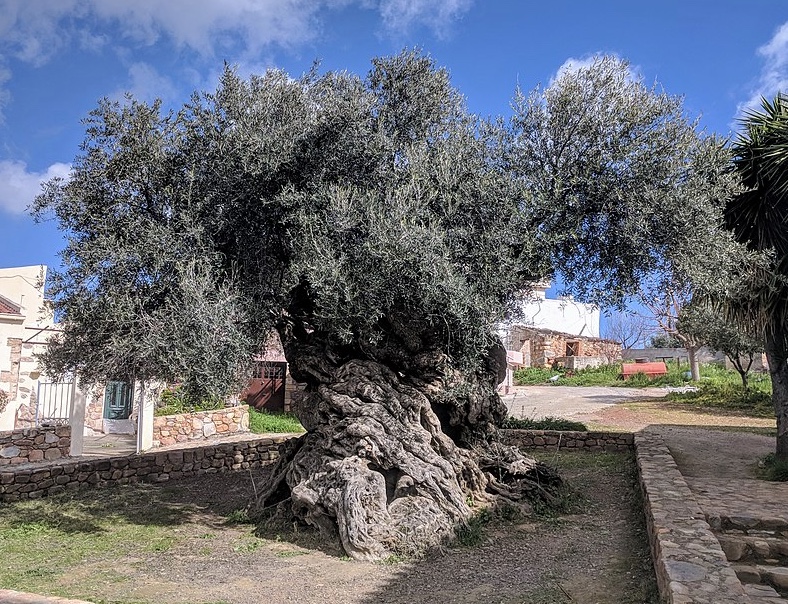
At Spilia, in the hills behind Kolymvari, a narrow road turns off to the village of Ano Vouves (Άνω Βούβες), home to one of the most celebrated old olive trees in Crete. It is counted among the oldest recorded olive trees in the world, and the village likes to call it the oldest of all – a claim not everyone on the island accepts, since the great olive at Azorias, above Kavousi in the east, has its own supporters. The trunk has long been hollow: the heartwood has rotted away, yet the tree lives on through its outer tissue, puts out new growth every spring and still fruits each year. Standing before it, you see less a trunk than a piece of sculpture – twisted, fissured, full of cavities and swellings in which visitors like to make out faces and figures.
Local accounts put the age of the tree at somewhere between three and five thousand years. A precise date is all but impossible to establish, and the hollow trunk is the reason: the inner growth rings are missing, and radiocarbon dating has failed too, because the oldest wood was destroyed over the centuries and there is nothing left to sample. The rings that survive are said to prove an age of at least two thousand years; scientists at the University of Crete consider about four thousand possible; more recent work urges caution with all such estimates for olive trees, and allows that this one could be younger or older than the figures usually quoted. Specialists therefore speak of an approximation, not of an age established beyond doubt. None of this diminishes the monument. What stands here is a living tree that links the present-day olive culture of Crete with a very deep past. Two cemeteries of the Geometric period have been found close by – an indication of how long this hillside has been lived on and worked.
Natural monument and olive museum
The olive of Vouves was declared a natural monument by Decision No. 603 of the Secretary General of the Region of Crete, dated 17 February 1997; the Association of Cretan Olive Municipalities (SEDIK) also lists it among the island’s monumental olive trees. At ground level the trunk measures some 12.5 metres in circumference, with a diameter of a little over four and a half metres; at 0.9 metres above the ground the girth is still 8.10 metres and the diameter 3.70 metres. Botanically it is a wild olive on to which, long ago, the cultivar Mastoidis was grafted, the variety known in Crete as Tsounati. The tree belonged to the Karapatakis family; Panagis Karapatakis presented it to what was then the municipality of Kolymvari.
Right beside it is the Olive Museum of Vouves, inaugurated in October 2009 in a restored farmhouse of the 19th century and now spread over two small buildings. It displays tools for tending the trees, implements for harvesting and pressing, vessels for storing and carrying the oil – among them large ceramic jars – and objects from everyday farming life, covering the long span from antiquity to the middle of the 20th century, before machines took over. Old photographs hang on the walls, and one case holds fossilised olive leaves from Santorini, tens of thousands of years old. Admission is free; the museum is open daily from April to October from about 10 am to 7 pm, and in winter by arrangement. Next to the museum a small kafenion with a view of the tree, and of an old press and millstones set out below, is a pleasant place to pause. A second venerable olive stands nearer the road, and between the two the Olympic rings have been laid out in low clipped bushes.
The olive branch in the Olympic tradition
Branches from this tree were woven into wreaths of honour for victors at the 2004 Olympic Games in Athens – among them the wreath for the winner of the men’s marathon; the same honour was extended to the 2008 Games in Beijing, and branches from Vouves have been carried at Olympic ceremonies since. The wreath of olive twigs, the kotinos, goes back to the ancient Greek custom of rewarding the victor with a sacred branch. In this way the tree of Vouves has become an emblem of Crete’s unbroken connection with its ancient inheritance; the cutting of the branches is celebrated in the village as a small festival.
What kotinos means
The kotinos (κότινος) is no mere ornamental garland but a token of victory and honour, woven from branches of the wild olive, which was sacred to the Greeks. At Olympia it was the only prize, and it was precisely its lack of material worth that gave it its standing. In today’s Olympic ceremony it recalls the ancient games, and is a reminder that in Crete the olive belongs not only to the economy but to cultural memory as well.
In the surrounding area
About two kilometres from Vouves stands the church of St Stephen (Agios Stefanos), dating from the 14th century. The drive to the tree, only a few kilometres from Kolymvari through dense olive groves, can thus be extended into a short circuit through the rural hinterland of Chania, on which natural monument, museum and medieval church complement one another. The tree draws tens of thousands of visitors a year, so the place is at its most impressive in the early morning or the late afternoon, when the slanting light throws the relief of the trunk into sharp definition and the coaches have not yet arrived on the little village square, or have already left. The tree should not be touched, still less climbed into.