The most complete guide to Crete: 221 places on the map, 23 routes and 49 articles — with photos, videos and the story behind every place. No sign-up, no trackers.
Routes drawn along real roads
Weather at every stop
Full-text search
“Near me” by geolocation
Create your own printable itinerary
Satellite, terrain, dark mode
Works offline
⌕
Searches 1.7 million characters of descriptions, not just names
—places
4regions
—routes
—with video
Search results
—
Interactive map
Find what is near you
Filters narrow the map and the list at once. Zoom out and pins group together.
Region
Category
Фильтры карты
Landmarks
Featured places
RegionCategory
Routes
Ready-made day trips
Individual places
Articles about landmarks
Nopigia and ancient Mithymna
Nopigia (Νωπήγεια) lies at the eastern edge of the Gulf of Kissamos, six kilometres east of Kissamos town and some thirty west of Chania, at the point where the long arc of beach meets the steep flank of the Rodopou peninsula. The present settlement has grown up beside a site identified with ancient Mithymna – more precisely, with the coastal part of a community that existed here from the Minoan age into Roman times. The sea determined its position and its economic life: Nopigia was the ancient town’s natural outlet to the sea routes of western Crete. The ruins lie a short walk inland, south of the beach along the lane towards Koleni, scattered among olive groves.
What the excavations have preserved
The excavated area has yielded dwellings and defensive works, pottery, sections of a water conduit and Roman buildings. To the Roman period belong an aqueduct, baths and enclosure walls, and further Roman remains lie to the west of the village. The history of the place is thus not confined to the Minoan age: the settlement changed and lived on through Classical, Hellenistic and Roman times.
Particularly revealing were the rescue excavations directed by the archaeologist Maria Andreadaki-Vlazaki during the building of the new national road. They recorded settlement remains from the Prepalatial period, that is, the 3rd millennium BC, down to the close of the Late Minoan age c. 1100 BC. Thousands of conical cups and potsherds came to light, interpreted as votive offerings to the deity of a sanctuary, along with cult vessels and an incense burner. These finds are displayed in the first room of the Archaeological Museum of Kissamos. Further afield there are Hellenistic fortifications, ancient landing places and harbour works of the Classical period.
The tradition of Agamemnon
Nopigia is associated with the legend of Agamemnon’s return from Troy. According to the local story, the king of Mycenae landed here to sacrifice to the gods in thanks for the victory and the freeing of Helen. The Trojan captives, however, tried to set fire to the ships, and Agamemnon had to leave the coast in haste. In this legend the shoreline of Nopigia is joined to the memory of the Mycenaean world and of the old routes across the Aegean, on which Crete was always a staging post for ships between the Peloponnese and the East.
The church of St George
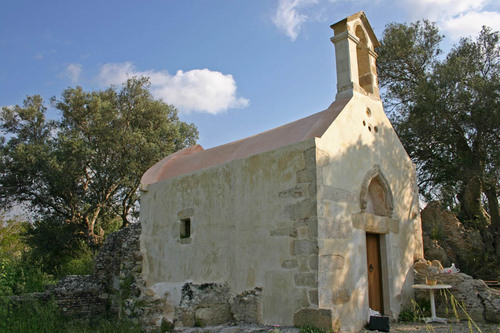
Beside the excavated area stands the church of St George (Agios Georgios). It is built on the walls of the Roman baths and is usually dated to the 15th century, while local church tradition assumes a far older core; its wall paintings include a depiction of the Holy Trinity and of St Pachomios. Its axis is unusual, running north–south instead of towards the east, a consequence of the ancient structure it reuses. The building continues the sacred history of this landscape: a place that in antiquity was bound up with cult and with the sea routes became part of the Orthodox ecclesiastical setting. Near Nopigia there are other churches, including that of St Panteleimon, a cruciform building on a rectangular plan with a cylindrical drum beneath its dome.
The beach and onward routes
The beach at Nopigia is long and quiet even in high summer. Towards Kissamos it is sandy and shelving gently; eastwards, under the peninsula, pebbles alternate with slabs of rock in a series of small secluded coves, and in places the bottom drops away quickly, which divers and snorkellers appreciate. The bay is open to the north and there is often a swell. Tamarisks give some shade, a few plain tavernas on the shore are enough for a midday break, and the service buses between Chania and Kissamos stop on the main road. Two hundred metres from that road is the cave of Rizospilios, through which an underground stream runs. Nopigia thus combines a seaside holiday with a historical itinerary. From here the route can be continued to Drapanias, Kissamos and Polyrrinia, to compare the coastal landscape with the archaeological remains of Mithymna and the churches of western Crete that are still in use.