Kolymvari: fishing harbour, the landing of 1897 and Gonia Monastery
The most complete guide to Crete: 221 places on the map, 23 routes and 49 articles — with photos, videos and the story behind every place. No sign-up, no trackers.
Routes drawn along real roads
Weather at every stop
Full-text search
“Near me” by geolocation
Create your own printable itinerary
Satellite, terrain, dark mode
Works offline
⌕
Searches 1.7 million characters of descriptions, not just names
—places
4regions
—routes
—with video
Search results
—
Interactive map
Find what is near you
Filters narrow the map and the list at once. Zoom out and pins group together.
Region
Category
Фильтры карты
Landmarks
Featured places
RegionCategory
Routes
Ready-made day trips
Individual places
Articles about landmarks
Kolymvari: the sea, remembrance and Gonia Monastery
Kolymvari (Κολυμβάρι, in everyday speech usually Kolymvari) lies at the western end of the Gulf of Chania, where the long line of beaches comes to a stop and the rocky Rodopou peninsula thrusts northwards into the sea; the little river Spiliakos reaches the coast here. Once the seat of a municipality of its own, the village has belonged since the local government reform of 2011 to the municipality of Platanias and is about 24 kilometres from Chania. The community itself had 1,079 inhabitants at the census of 2021, the wider municipal unit – some 150 square kilometres, much of it the barren and almost uninhabited peninsula – 4,139. Here the traditions of the fishermen meet the vineyards and olive groves of the old province of Kissamos; the olive oil of the district carries a protected designation of origin under the name “Kolymvari Chanion”. The wine poured in the village as wine of Kissamos is not a single label: what is meant is the wine-growing tradition of the historic province and of its present-day producers.
Timoleon Vassos and the events of 1897
In the centre of Kolymvari stands the monument to Timoleon Vassos, an officer of the Greek army and aide-de-camp to King George I, who played a conspicuous part in the history of the Cretan Question. Born in Athens around 1836, he was the son of Vasos Mavrovouniotis, a hero of the Greek War of Independence, and had trained at the Hellenic Military Academy and in France. On 1 and 2 February 1897 (by the Julian calendar then in force in Greece – 13 and 14 February by the Western reckoning) Vassos, then a colonel, came ashore here with a Greek expeditionary corps of about 1,500 men, sent to Crete by Athens in the midst of a new insurrection and an international crisis. In a proclamation he declared that he was taking possession of the island in the name of the King of the Hellenes. In the weeks that followed his troops fought alongside Cretan insurgents in the west of the island – within days a mixed force of some 600 soldiers, volunteers and rebels stormed the Ottoman fort at Voukolies – but the intervention of the Great Powers, who demanded a ceasefire and threatened to cut off his supplies, prevented the immediate union of Crete with Greece. Vassos undertook to keep out of the towns where the European fleets lay, and in May he was recalled to a Greece by then at war. He ended his career as a major general and died in Athens in 1929.
That Kolymvari of all places should be linked with these events is explained by its position: the sheltered bay in the lee of the peninsula allowed troops and stores to be put ashore, and Gonia Monastery, which had given refuge to Cretan rebels in one rising after another, offered the staff solid quarters. In monastic and local tradition the arrival of the Greek corps was taken as a sign that liberation was near. The monument therefore commemorates not a single battle won but the difficult passage from Ottoman administration to autonomy and, in the end, to the union of Crete with Greece.
The museum of fishing and seafaring tradition
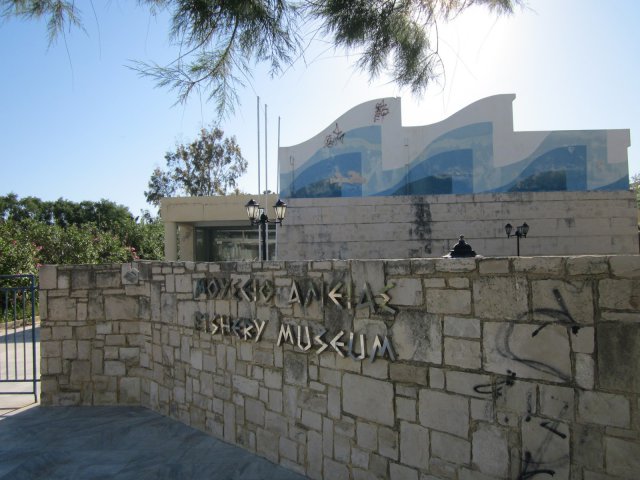
Kolymvari has a Museum of Sea Treasures and Fishing Tradition, known in the village simply as the Fishing Museum (Μουσείο Αλιείας). The idea was born in 2000; the building by the harbour was completed in 2001 with money from PESCA, the European fisheries programme, and regular opening to visitors began in August 2005. The display tells of everyday life in the coastal communities and of how the sea shaped the economy of Kissamos.
The collection includes fishing boats, ancient anchors, harpoons, lamps for night fishing, nets and other gear. A separate section is given over to the natural history of the sea, with collections of fish, bivalves and sea snails, corals, sponges and echinoderms. The museum has, however, been closed for some years: the company that ran it is no longer active, the municipality of Platanias holds only a little over a quarter of the shares and, by its own account, is trying to clear away the legal obstacles to reopening.
The monastery of Panagia Odigitria Gonia
On the edge of the village, about a kilometre to the north, stands the monastery of the Panagia Odigitria, known as Gonia Monastery (Μονή Γωνιάς). The name means “corner” and describes its position in the western angle of the Gulf of Chania, right on the water. It is a stauropegial monastery for men, and with its high enclosing wall it has the look of a Venetian fort; within are the monks’ cells, the abbot’s quarters, the refectory, storerooms and cellars, ranged around a courtyard with a fountain of 1708. The bell tower was added in 1849. The katholikon, built between 1618 and 1634, has a triconch plan with a dome, a narthex and two side chapels, and so recalls the monastery churches of Mount Athos. The monastery guards Byzantine and post-Byzantine icons, among them works of the Cretan School by painters such as Andreas Ritzos, Konstantinos Palaiokapas, Parthenios and Neilos, together with manuscripts, relics and other ecclesiastical objects; since 2017 they have been shown in a museum of their own. The patronal feast is the Dormition of the Virgin on 15 August.
According to monastic tradition, the history of Gonia began in the 9th century on Cape Rodopou, at the place called Menies, beside the ancient sanctuary of Diktynna, where hermits founded a monastery of St George. Pirate raids are said to have driven the monks south in the 13th century to the spot where the monastery cemetery now lies. In 1618 the Cypriot monk Vlasios moved the community to its present site on the bay; the building was carried forward by the hieromonk Venediktos Tzagarolos. The defensive walls and the arsanas, the masonry boathouse on the shore, show that the monastery was at once a spiritual centre, a place of refuge and a working estate.
Tradition has it that Vlasios the Cypriot was the first founder, and that the Virgin herself showed him where the monastery was to stand. After the Ottoman conquest of Crete, which began in 1645, Gonia went through hard times and was plundered again and again – in 1652, during the rising of 1822, in 1841 and in 1867, when it was shelled from the sea; a cannonball from that bombardment is still lodged in the wall facing the water. Its abbots nevertheless preserved the property and kept up the teaching of reading, writing and the ecclesiastical arts; one of them, Misael Apostolidis, went on to teach Greek to King Otto and to serve as the first rector of the University of Athens. During the German occupation of 1941–44 the buildings were damaged, the monks imprisoned and the monastery looted after weapons had been found there. The arsanas is a reminder that the monastery was as closely tied to the sea as to farming and the spiritual life. On the ground above the monastery walls the Orthodox Academy of Crete has been at work since 1968, a centre for conferences and encounter that carries on the educational tradition of the place.
Kolymvari today
Today Kolymvari is a fishing village, a wine and olive-growing district and a point of departure all in one: for Gonia Monastery, for the lonely Rodopou peninsula and for the beaches in the north-west of the Chania region. It has seen far less tourist development than the resorts of Maleme and Platanias further east. Fish tavernas stand in a row by the small harbour, and in front stretches a long pebble beach with clear water that deepens quickly. A stroll along the seafront can take in the Vassos monument, a look at the museum and a visit to the monastery. Seen together, they reveal in a single place not merely a seaside resort but the history of the Cretan sea, of the culture of the Church and of the struggle for political freedom.