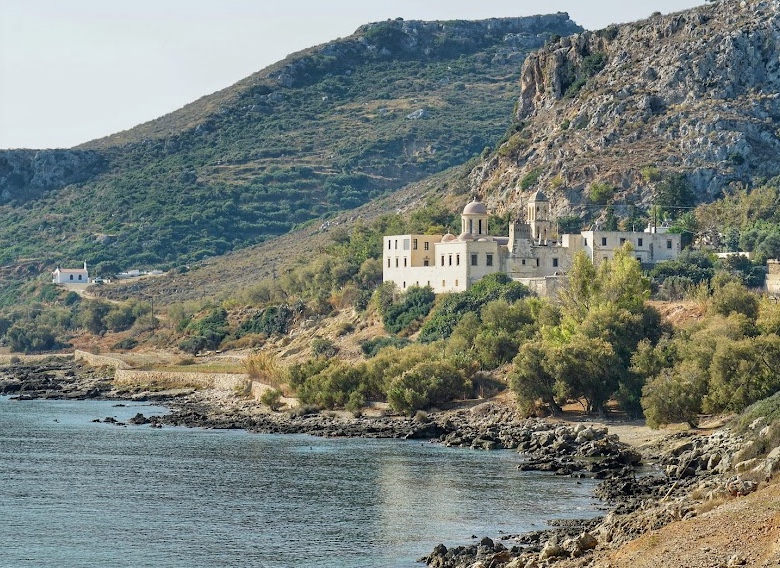
Gonia Monastery: the Panagia Odigitria above Kolymvari
The most complete guide to Crete: 221 places on the map, 23 routes and 49 articles — with photos, videos and the story behind every place. Everything is open and free: no sign-up, no paid sections and no advertising, open or hidden. You can install the guide on your smartphone as an app.
Routes drawn along real roads
Weather at every stop
Full-text search
“Near me” by geolocation
Create your own printable itinerary
Satellite, terrain, dark mode
Works offline
⌕
Searches 1.7 million characters of descriptions, not just names
—places
4regions
—routes
—with video
Search results
—
Interactive map
Find what is near you
Filters narrow the map and the list at once. Zoom out and pins group together.
Region
Category
Фильтры карты
Landmarks
Featured places
RegionCategory
Routes
Ready-made day trips
Individual places
Articles about landmarks
The Monastery of the Panagia Odigitria Gonia
The Monastery of the Panagia Odigitria Gonia (Μονή Παναγίας Οδηγήτριας Γωνιάς), usually shortened to Gonia Monastery and known affectionately as “Kyra Gonia”, the Lady of the Corner, stands directly above the sea about a kilometre north of Kolymvari, at the root of the Spatha peninsula, which is also called Rodopou, some 26 kilometres west of Chania. The name – gonia means “corner” – describes its position in the western angle of the Bay of Chania, from where the whole sweep of coast towards the city lies open to view. It is an Orthodox monastery for men, enclosed by defensive walls, dedicated to the Dormition of the All-Holy Mother of God; its principal feast falls on 15 August. The present complex, one of the largest and best preserved monasteries on the island, draws together the ecclesiastical, educational and military history of western Crete, and it remains an active community under the Metropolis of Kissamos and Selino.
From Menies to the present monastery
The story of the community begins around the middle of the 9th century. At Menies, near the tip of the peninsula, monks founded a monastery of St George immediately beside the ancient sanctuary of Diktynna, the Cretan form of Artemis Britomartis, on the very ruins of her temple. The district had a long tradition of the hermit life, but pirate raids forced the monks to withdraw further south: in the 13th century a small establishment grew up on the site of what is now the monastery cemetery, and it was from this that the history of Gonia emerged.
Building on the present site began in 1618. The first founder was the monk Vlasios, a Cypriot from Amasia, who directed the work until 1631; it was continued by the priest-monk Venediktos Tzagarolos, a member of a distinguished Chania family, who between 1631 and 1645 added the refectory, the abbot’s quarters and the storerooms, while a large donation from the nobleman Georgios Mourmouris helped to complete and endow the monastery. The katholikon was finished in 1634, as an inscription carved on the western side of the dome records; the remaining buildings were completed in 1637. Venetian features are unmistakable in the architecture – the portals, the cornices, the bell-cote – while the plan, with its three apses, recalls the principal churches of the monasteries of Mount Athos. The katholikon has a narthex, a dome and flanking chapels, and the cells, refectory and storehouses are ranged around the courtyard in the manner of a fortress, a design that gave real protection against raiders from the sea.
The icon of the Mother of God and the monastery’s tradition
Bound up with the foundation on the new site is a church tradition about the miraculous discovery of an icon of the Virgin. The story goes that Vlasios saw a light in a wooded spot – some tellings describe the icon lit by a lamp – and found the image there; after he had prayed, the Mother of God commanded him to build a church on the place of the discovery. When an attempt was made to carry the icon elsewhere, it returned of its own accord to its original place, and this was understood as a direction from above. So the monastery came by its dedication to the Odigitria, the one who shows the way.
The Ottoman period and the stauropegial rank
After the Ottoman conquest of Crete, which began with the landing of the Turkish army on this very stretch of coast on 23 June 1645, the monastery was repeatedly attacked and laid waste. Serious damage is recorded in 1645, 1652, 1822, 1841 and 1867; the history of Gonia is therefore not a quiet, unbroken development but a sequence of destruction and rebuilding. On the outer wall of the church facing the sea a cannonball embedded in the masonry is still pointed out as a memento of the bombardment: it was fired from Turkish warships on 14 June 1867, when two monks and three labourers were killed and the library was burned, and a small plaque records the date. Before the worst of the looting the monks sent some forty of their most valuable icons away to other Greek lands for safekeeping, and these came back after the island’s liberation. In spite of everything the abbots managed to preserve the property, the manuscripts and the life of the church; the English traveller Robert Pashley, who came in 1834, found a wealth of icons here that he had seen in no other Cretan monastery, though he also noted how the house, which before 1821 had kept twenty monks and some sixty labourers, could by then barely work its own land.
In 1662 a patriarchal sigillion, issued under Patriarch Dionysios III and obtained through the efforts of the abbot Isaias Diakopoulos, declared Gonia a stauropegial monastery; the privilege was renewed in 1690, 1778 and 1797. In 1664 a school was opened here, which could operate thanks to the new rank and with the support of the community. Reading, writing and the ecclesiastical arts were taught to clerics and laymen alike, and under Ottoman rule the school belonged to the network of informal “secret schools” that kept Greek letters alive; later the library and museum of the monastery preserved icons, manuscripts and liturgical plate. One of its abbots, Michail Apostolidis, went on to teach Greek to King Otto, to become Archbishop of Athens and to serve as the first rector of the University of Athens.
In 1708 the monastery acquired its fountain, which still stands in the courtyard, and in 1805 the side chapels were added to the katholikon. In 1767 the abbot Isaias Testavouzas hung the first bell, persuading the pasha that it was no more than a shepherd’s bell, so that Gonia became, after Arkadi, the second monastery in Ottoman Crete to possess one. During the rising of 1821 Gonia served as a field hospital; the abbot Parthenios Raspanis, who was in contact with the Filiki Eteria, the secret society of the Greek independence movement, was arrested by the Ottoman authorities in June 1821 and died in prison. After the devastation the monk Parthenios Froudakis reorganised monastic life between 1831 and 1841, only to see the monastery destroyed and abandoned once more in the rising of 1841. Further destruction came with the revolt of 1866 to 1867, in which two monks of Gonia, Parthenios Peridis – founder in 1851 of the first Greek school in the district of Kissamos and known as “Captain Papa” – and Parthenios Kelaidis, who blessed the first insurgents and their weapons in 1866, played leading parts.
Timoleon Vassos and the year 1897
In February 1897 Colonel Timoleon Vassos landed beside the monastery with a Greek expeditionary force of roughly 1,500 men, coming ashore at Kolymvari on 2 February. It comprised two battalions of infantry, a battalion of engineers, Evzones and mountain artillery. Vassos proclaimed the occupation of Crete in the name of the King of the Hellenes and set up his headquarters in Gonia, where for some twenty days he and his staff planned their operations; from here his troops took the tower at Voukolies and pushed on towards Alikianos. The landing became one of the immediate causes of the Greco-Turkish War of 1897, but European diplomacy led not to immediate union with Greece but to international administration and, in 1898, to the autonomy of the island.
The 20th century: war, school and the Academy of Crete
The present bell tower dates from 1849, and in 1935 the monastery was placed under statutory protection as a monument. In the Second World War, after the fall of Athens, the Evelpidon Military Academy, the officer cadet school of the Greek army, was quartered at Gonia, and its cadets were soon caught up in the Battle of Crete; before that, British engineers building the airfield at Maleme had lodged here. Afterwards German troops requisitioned the monastery and interned the monks: in August 1941 weapons were discovered in one of the chapels, and six monks together with the abbot Ioakeim Latinakis and Bishop Evdokimos Syngelakis were arrested and interrogated at the Gestapo headquarters in Chania before being released. The buildings became a barracks, the choir stalls, the iconostasis and manuscripts from the library were destroyed, and at Easter 1942 the community resumed its life in part, while a section of the complex served as a German camp until 1944. In a curious epilogue, between 1960 and 1970 the monastery gave a temporary resting place to the remains of German soldiers before their transfer to the war cemetery at Maleme.
In the 1960s, on land made available by the monastery, work began on the Orthodox Academy of Crete. It opened in 1968 and continues the educational mission that Gonia had fulfilled since the monastery school of the 17th century; the monastery has since given further land for schools, agricultural institutions and public buildings in the district. The museum of the monastery keeps icons, manuscripts and church relics; among the works, icons of the 17th century and paintings by Cretan masters stand out. Chief among them are a Crucifixion and a St Nicholas of 1637 – both by Konstantinos Paleokapas – and a Transfiguration of the 15th century, as well as a Christ the High Priest and a Virgin Eleousa by Andreas Ritzos, the pioneering Cretan painter of the 15th century: evidence that Gonia was an important centre of Byzantine painting in the last phase of Venetian rule. The katholikon itself retains a carved wooden iconostasis of the 17th century with icons by the painter-monk Parthenios.
Visiting the monastery
In October 2017 an ecclesiastical museum was opened in the monastery, in the great vaulted basement that once served as an agricultural store; it is run jointly with the Metropolis of Kissamos and Selino. Its rooms display post-Byzantine icons of the 15th to 17th centuries, manuscripts, silver-bound Gospel books, crosses, liturgical vessels, reliquaries and works of the Cretan School. Besides the pieces by Ritzos and Paleokapas there are a multi-scene icon of the story of Joseph by the monk Neilos (1642), a Dormition of the Virgin with scenes from her life (1728), icons of St Paraskevi and St Catherine, works by the 18th-century painters Georgios Stais, Dimitrios Sgouros and Konstantinos Papadopoulos, two old monastic codices recording the history of the house, early printed books, vestments – including an antimension bearing the signature of Patriarch Meletios Pigas (1590–1601) – and metalwork and woodcarving. Photography is not permitted inside the museum. It carries on the educational work of the community and lets its history be read not only in walls and traditions but in the surviving objects of church life.
Gonia lies about a kilometre from Kolymvari and is easily reached on foot from the village along the coast road; the monastery also makes a natural stop on the way out to the Rodopou peninsula and the Diktynna sanctuary at Menies. Services should not be photographed without permission, and the opening hours usually include a long break at midday. The feast of the Dormition on 15 August is the great season of pilgrimage, but even on an ordinary day one can see the defensive walls, the quiet courtyard with the katholikon, the old fountain, the museum and the arsanas, the monastery’s boathouse on the shore. From the terrace behind the church the view takes in the whole bay as far as Chania.