The most complete guide to Crete: 221 places on the map, 23 routes and 49 articles — with photos, videos and the story behind every place. No sign-up, no trackers.
Routes drawn along real roads
Weather at every stop
Full-text search
“Near me” by geolocation
Create your own printable itinerary
Satellite, terrain, dark mode
Works offline
⌕
Searches 1.7 million characters of descriptions, not just names
—places
4regions
—routes
—with video
Search results
—
Interactive map
Find what is near you
Filters narrow the map and the list at once. Zoom out and pins group together.
Region
Category
Фильтры карты
Landmarks
Featured places
RegionCategory
Routes
Ready-made day trips
Individual places
Articles about landmarks
Episkopi and the church of the Archangel Michael
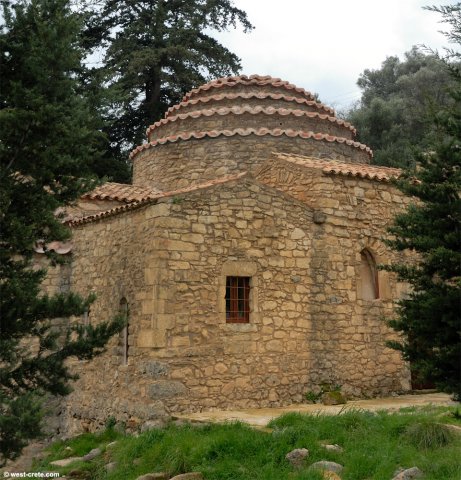
Episkopi (Επισκοπή) lies among green hillsides in western Crete, in the eastern part of the Kissamos district, about ten kilometres inland from Kolymvari on the road that climbs south from the coastal highway through Spilia towards Deliana. Olive groves, vineyards and small stream valleys shape the surrounding country. Its most important sanctuary is the church of the Archangel Michael, known to local people as the Rotonda, which stands a little outside the village on sloping ground, with space to park beside it. In the medieval sources the settlement is associated with the episcopal see of Kissamos, and it is from this ecclesiastical function that it takes its name.
The Early Christian Rotonda
The church is dated to the second half of the 6th century, the age of the emperor Justinian, when large Christian buildings were going up across Crete. It was raised on the site of an older basilica, remains of which survive in the masonry, and archaeologists believe it served at first as a baptistery – a stone font sunk into the floor of one of the side rooms recalls that use. The Rotonda of Episkopi is regarded as one of the island’s most important Early Christian monuments and, alongside the Rotunda of St George in Thessaloniki, is one of only a handful of centrally planned buildings of its kind in the Balkans, and among the best preserved. Some call it the oldest church in Crete in which services are still held; it has been in use without a break since it was built. Graves of the 7th and 8th centuries, excavated in the churchyard along one side of the building, show that the faithful were being buried in its shadow within a few generations.
The dome is made up of five concentric rings that narrow in steps towards the top. The result is a stepped profile, easily picked out from the valley around, which has no counterpart in Crete and very few anywhere in Byzantine architecture. Inside, parts of the mosaic floor survive, with geometric patterns, plants and animals and Christian motifs, together with wall paintings of several periods: images of the Archangel Michael and of the Virgin – among them the type known as the Blachernitissa – scenes from the Gospels such as the Ascension, the Evangelist Matthew, St George and other saints. The conservators have identified several layers lying one over another: the oldest of the 6th to 7th century, to which the Ascension and the saints of the dome, the Evangelists of the narthex and the archangel of the apse belong; one of the 8th century, plain crosses without figures, which is linked with Iconoclasm and was later whitewashed over; a decoration of high quality from the end of the 12th century, close in manner to the Comnenian painting of Constantinople; and lastly frescoes of the early 14th century attributed to the painter Michail Veneris and his workshop. These layers show how the church was renewed over the centuries while keeping its original form.
The see of Kissamos and the memory of Melchisedek
When the ancient city of Kissamos on the coast fell into decay, the bishop’s seat was moved to the safer hinterland, and the Rotonda rose to the rank of cathedral. In Byzantine and later times Episkopi remained bound up with the episcopal organisation of Kissamos, and the church was the centre of worship for the surrounding district; the fine repainting of the Comnenian period is thought to mark the moment the see was established here. Local church history is linked with Bishop Melchisedek of Kissamos, who resided here and who in 1821, at the outbreak of the uprising, was hanged by the Turks in Splantzia Square in Chania; he was canonised in 2000, and is commemorated in the Rotonda on 14 December. His memory is a reminder that the Rotonda was not only a monument of architecture but a living church, woven into the history of the Church of Crete.
The spring of Agionero
Not far from the village is the spring of Agionero. Its name is formed from the Greek words άγιο νερό, “holy water”. Local people come here to draw water and to pray, and the spring is considered part of the spiritual landscape of Episkopi. In Orthodox tradition an agiasma, a hallowed spring, is bound up with the remembrance of God’s blessing and is not treated as an ordinary well, but venerated as a place of prayer.
Notes for the visit
For a long time the Rotonda could be seen only from outside, and it has often been shut for conservation work; a custodian from the Chania Ephorate of Antiquities is now on site during the season. It is open from mid-morning until early or mid-afternoon and closed on Tuesdays, though the details change from year to year. Give your eyes time: only after a few minutes do the colours of the frescoes and the tesserae of the floor emerge from the half-light. The medieval chapel of Agios Stefanos at Drakona, about a kilometre away, combines easily with the visit.
Episkopi brings together a rural landscape, a church in which people still pray, and a rare monument of Early Christian architecture. In the Rotonda the periods can be read one after another – from the basilica of late antiquity to the Byzantine and later paintings. A visit therefore lets the history of Kissamos appear not as a string of separate dates, but as the unbroken life of a single holy place.