Cave of St John the Hermit: the holy spring in the Avlaki gorge
The most complete guide to Crete: 221 places on the map, 23 routes and 49 articles — with photos, videos and the story behind every place. Everything is open and free: no sign-up, no paid sections and no advertising, open or hidden. You can install the guide on your smartphone as an app.
Routes drawn along real roads
Weather at every stop
Full-text search
“Near me” by geolocation
Create your own printable itinerary
Satellite, terrain, dark mode
Works offline
⌕
Searches 1.7 million characters of descriptions, not just names
—places
4regions
—routes
—with video
Search results
—
Interactive map
Find what is near you
Filters narrow the map and the list at once. Zoom out and pins group together.
Region
Category
Фильтры карты
Landmarks
Featured places
RegionCategory
Routes
Ready-made day trips
Individual places
Articles about landmarks
The cave above the Avlaki gorge
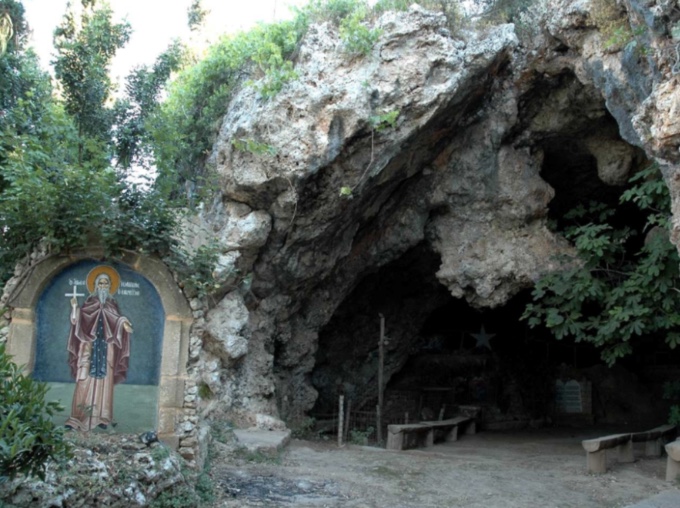
The cave of St John the Hermit lies on the Akrotiri peninsula, some twenty kilometres north-east of Chania, above the Avlaki gorge, immediately beside the ruins of the monastery of Katholiko and below the monastery of Gouverneto, in the hilly country known as the Arkoudovounia. In Greek tradition the saint is called John the Hermit (Ιωάννης ο Ερημίτης) and John Xenos (Ιωάννης ο Ξένος). “Xenos” here means the wanderer or stranger: the epithet recalls his travels and the hospitality he found in many places across Crete, where the churches and monasteries he founded still stand from the Messara to Rethymno and the far west.
The cave is bound up with the last stage of his earthly journey. According to local tradition, after his time at Azogires and Marathokefala he withdrew into the almost inaccessible gorge of Akrotiri to devote his life to prayer and silence. Later the monastery of Katholiko grew up beside the cave; its name is simply the Greek word “katholikon”, the principal church of a monastery. That church is for the most part hewn out of the living rock and carries in front of it a carefully worked façade, which shows the influence of Italian late Gothic and of Mannerism; the design of the 17th-century buildings is said to draw on the architectural treatises of Sebastiano Serlio. After the saint’s death in the first half of the 11th century hermits and ascetics gathered in the gorge, whose walls are still pitted with their cells, and the community grew into a monastery that for centuries was among the most venerated on the island.
The tradition of St John’s journey
According to church tradition John came to Crete from Egypt together with ninety-eight God-bearing Fathers. Their route is associated with Azogires in the district of Selino, where the ninety-eight Fathers lived as ascetics and are venerated to this day; John is counted as the ninety-ninth. One legend tells that a storm drove the company’s boat to the island of Gavdos and separated John from his companions, whereupon he spread his habit on the water and crossed on it to Paleochora. As more and more people came to the Fathers and the fame of his miracles spread through the district, he sought out ever lonelier places – first the cave of Marathokefala, then the Avlaki gorge on Akrotiri, where he is said to have lived on wild greens and carobs. On the period in which he lived the accounts do not agree: one strand of the tradition identifies him with the St John Xenos of the 11th century, the founder of Myriokefala and other churches, who according to his own surviving testament was born about 970 at Siba – probably Sivas on the Messara Plain – and was still active in 1027; other church narratives place his life considerably later. His formal canonisation by the Orthodox Church in 1632 gave the cult, and the monastery beside the cave, a fresh impetus.
In the cave the tradition lives on of a water that sprang forth at the saint’s prayer. In one telling John, tormented by thirst, struck the rock with a sword; in another it was his staff. From the stone a spring broke out which, according to local tradition, has never run dry – and water does indeed stand in the cave all year round, collected in a plastered underground cistern cut into the rock to catch it. These are two versions of one legend, and both lay the emphasis not on weapon or staff but on the saint’s prayer and the gift of divine help.
Miracles associated with the spring
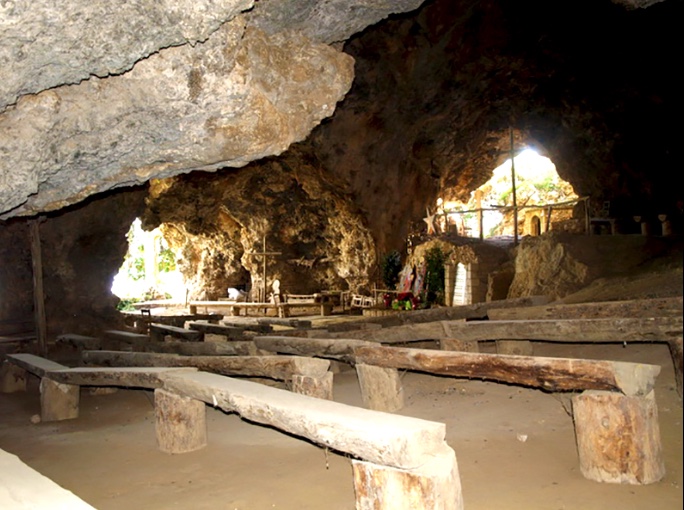
The holy water of the cave is venerated as an agiasma – as water sanctified by the holiness of the place and by the prayer of the Church. Tradition relates that the blind, the deaf and people with grave diseases of the kidneys came here and were healed. Pilgrims drink of the water, wash their faces with it and pray to St John for help and strength; icons and oil lamps are kept both at the entrance and at the far end of the cave.
What an agiasma is
The Greek word αγίασμα means “sanctuary” or “hallowed water”. In the Orthodox tradition a spring becomes an agiasma not because of any unusual natural property but because prayer, the memory of a saint and the blessing of a priest are joined to it. For that reason the water is drawn with care, and the place is approached as a holy one rather than as a curiosity.
The saint’s last years and death
According to Orthodox tradition St John lived for about three years in this cave, which runs well over a hundred metres into the mountain – 135 metres in all – along the bed of an ancient underground stream, with stalactites, stalagmites and several chambers. Venerated here are the place of his last prayer and the ledge of rock on which, so it is told, he fell asleep in death; at the very end of the cave a large stone basin is traditionally held to be his grave, and about fifteen metres from the entrance a small side chamber with an artificial doorway has yielded human bones, probably those of a later hermit. No excavation has ever been carried out, and old inscriptions cut into the walls and stalactites remain unstudied. Another tradition tells that a hunter unintentionally wounded the ascetic mortally with an arrow – he took the stooping figure wrapped in skins for an animal – and that the saint forgave him before he died; the repentant hunter begged forgiveness at John’s grave. The Church relates further that the ninety-eight Fathers of Azogires died on the same day, as they had prayed together that they might. Their memory is kept on 7 October, when the faithful from all over western Crete descend to the cave and to the small chapel of the saint to the right of its entrance.
The way down the gorge
An old path, paved and in places cut into the rock, leads from the monastery of Gouverneto down through the Avlaki gorge to the cave. It passes first the church of St Anthony and then the Arkoudospilios, the Bear Cave, with its bear-shaped stalagmite and a small chapel of the Panagia Arkoudiotissa, a place where Artemis was worshipped in antiquity, and then drops by some 140 steps to the saint’s cave and the ruins of Katholiko. There a massive bridge spans the gorge, built around 1620 under Jeremias Tzagarolos: it served as a forecourt to the church, held storerooms in its vaults and carried two-storeyed buildings for the pilgrims. How important the pilgrimage was is shown by a church register of 1637, in which its income ranks among the highest on the island. Because the gorge opens towards the sea the monastery was eventually abandoned for fear of pirate raids; local lore has it that a ship-shaped rock at the mouth of the gorge is a pirate vessel turned to stone by the abbot’s curse. Beyond the ruins the path continues to the sea, where a narrow inlet of clear water holds the remains of the monastery’s little harbour. The whole walk from Gouverneto to the inlet and back is about four and a half kilometres and takes two to three hours; the stretch is stony and in places damp, and there is one short scramble over rock below the monastery. The climb back is shadeless and there is no water on the way; a torch is needed for the cave. Since access is across the grounds of Gouverneto, its opening hours and its dress code apply, and cars are left at the monastery.
The cave, the ruins of Katholiko and the gorge together form a single, self-contained pilgrim landscape on Akrotiri: here nature cannot be separated from the memory of the ascetic, from his life of prayer and from the centuries-old veneration of St John.