Maleme: the airfield that decided the Battle of Crete
The most complete guide to Crete: 221 places on the map, 23 routes and 49 articles — with photos, videos and the story behind every place. Everything is open and free: no sign-up, no paid sections and no advertising, open or hidden. You can install the guide on your smartphone as an app.
Routes drawn along real roads
Weather at every stop
Full-text search
“Near me” by geolocation
Create your own printable itinerary
Satellite, terrain, dark mode
Works offline
⌕
Searches 1.7 million characters of descriptions, not just names
—places
4regions
—routes
—with video
Search results
—
Interactive map
Find what is near you
Filters narrow the map and the list at once. Zoom out and pins group together.
Region
Category
Фильтры карты
Landmarks
Featured places
RegionCategory
Routes
Ready-made day trips
Individual places
Articles about landmarks
Maleme: remembering the battle, and a Minoan tomb
Maleme (Μάλεμε) is a coastal village in the municipality of Platanias, some sixteen kilometres west of Chania; the census of 2021 recorded 568 inhabitants. Among orange groves, olive orchards and a long pebble beach there is little, at first sight, to suggest that the name belongs to the military history of the 20th century. Yet it cannot be separated from the airfield on the western edge of the village and from the Battle of Crete in May 1941. On Hill 107, the rise behind the runway, lies the German war cemetery – one of the best-known places of remembrance on the island, and one of the most difficult.
The airfield, a small civilian strip, had been laid out before the war and was used by British forces; a memorial between Maleme and Tavronitis commemorates the airmen of Nos 30 and 33 Squadrons of the Royal Air Force who died here. On 20 May 1941 it became the principal objective of the German airborne operation code-named “Merkur” (Mercury): whoever held the runway could fly reinforcements and heavy equipment on to the island. The narrow coastal plain thus became one of the pivotal points of the whole Battle of Crete.
Hill 107 – the gateway to Crete
Hill 107 commands the runway, the coast road and the mouth of the river Tavronitis. It was held by the 22nd New Zealand Infantry Battalion under Lieutenant Colonel Leslie Andrew, a holder of the Victoria Cross – some 600 men, with the 21st and 23rd Battalions further back. To cover both airfield and hill, Andrew had been obliged to spread his companies over a wide area. The paratroopers dropped on the first day suffered grievously on the slopes – one company of the Assault Regiment lost 112 dead out of 126 men – and by evening they were almost out of ammunition. Andrew, however, had lost touch with most of his units, his signals having failed; a small counter-attack by his reserve came to nothing, and the support he asked of his brigade commander, Brigadier James Hargest, did not arrive. Fearing that he would be overrun, he had the hill evacuated during the night of 20–21 May, while forward platoons, largely intact, fought on at the airfield without knowing of the withdrawal and slipped away only when they found themselves abandoned. By the next day the height was in German hands and the first transport aircraft were landing on the strip under fire. Greek writers therefore call Hill 107 the “Kerkoporta”, the postern left open through which the island fell; the battalion itself lost 64 killed and 114 wounded.
The German war cemetery
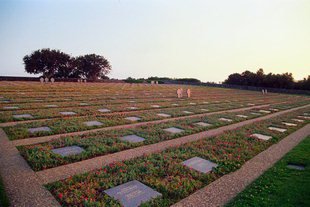
The cemetery holds 4,465 German soldiers. Most fell during the airborne landings and the subsequent fighting for Crete, the majority of them paratroopers; others died in the years of occupation up to 1945. Their remains were recovered between April and November 1960 from field graves and provisional burial grounds in every part of the island, and until a war graves agreement had been ratified the coffins were kept at the nearby Gonia Monastery at Kolymvari. Reburial on the hill began in 1971, and the cemetery was formally inaugurated on 6 October 1974. It is maintained by the Volksbund Deutsche Kriegsgräberfürsorge, the German war graves commission, a private association with its seat in Kassel; a German airborne division took on the patronage of the site in 1975.
The layout is deliberately restrained. From the entrance building, with its registers of names and a small exhibition, a path climbs the slope to four burial fields corresponding to the four main sectors of the fighting: Chania, Maleme, Rethymno and Heraklion. Flat stone slabs, each for two dead, lie among low ground-cover plants that flower red in spring; on the memorial square metal plaques carry the names of some 360 men who fell on Crete but whose bodies could not be recovered. From the top the view runs across the runway, the olive groves and the bed of the Tavronitis to Gonia Monastery and the Rodopou peninsula, with the White Mountains behind. One of the singular facts about the place is that for years the graves were tended by two men of the Cretan resistance: Georgios Psychoundakis, author of the memoirs of a resistance runner, and Manolis Paterakis.
The well-kept appearance of the cemetery does not stand for any reconciliation with the occupation, nor does it cancel the crimes committed against the people of Crete – the villages burnt in reprisal and the men and women who were shot. It follows a different principle: graves are treated as places of burial, and the remembrance of the dead is kept apart from any justification of the war and of the regime they served. Close at hand are monuments and sites of memory of the Cretan resistance and, by the airfield, a memorial to the defenders. A visit to Maleme therefore calls for respect towards several historical perspectives, some of them sharply opposed. The cemetery lies about a kilometre above the village, has its own car park and can be visited throughout the year.
The Minoan built tomb on Kafkala hill
Not far from the cemetery, on the rise known as Kafkala (Καυκάλα), a Late Minoan tholos tomb survives. It came to light by chance in 1907 and was systematically investigated in 1966 by Kostis Davaras, then in charge of antiquities in the region; the Greek archaeological service dates it to Late Minoan III B, that is to the 13th century BC. The burial chamber is built of large dressed blocks of limestone, stands about four metres high, has an almost square plan of 4.32 by 4.46 metres and was evidently once roofed by a corbelled vault of pyramidal form. It is reached by a long dromos cut into the slope, about 13.8 metres long, just under two metres wide and lined with carefully worked stones. The doorway is two metres high and 1.60 metres wide, spanned by a massive lintel with a relieving triangle above it, and two stone sockets found at the entrance probably carried a wooden door. The floor of the chamber consisted of pebbles set in lime mortar, and the walls bore traces of pale plaster.
The tomb had been robbed long before any scholar examined it. The excavation nevertheless produced sherds of vessels and two precious seals: one of bronze, the other of agate engraved with a stag. During the Second World War a bomb – the air raids of 1943 and 1944 are mentioned – brought down part of the roof. The consolidation work completed in 1970 saved the structure and made its architectural form legible once more.
The monument is a reminder that the history of Maleme began long before the Second World War. Further traces of Minoan settlement have been recorded in the surrounding area, and finds from the west of the island are kept in the Archaeological Museum of Chania. Tholos and war cemetery, side by side, bring two wholly different worlds into a single landscape: a prehistoric tradition of burial and the modern commemoration of war.
Maleme today
Maleme today is a lively seaside village with beaches, gardens and the usual amenities of a resort – hotels, tavernas, a pharmacy and shops line the old coast road. The cemetery is signposted from the centre and reached in a few minutes by a narrow road running uphill; a track to the tomb branches off shortly before it. The site of the tomb is uneven and not suited to visitors with limited mobility. The two visits combine easily, though they ask for different frames of mind: one is a place of remembrance of the 20th century, the other an archaeological monument of the Bronze Age. It is precisely this proximity that makes Maleme an important stop on any historical itinerary through western Crete.