The most complete guide to Crete: 221 places on the map, 23 routes and 49 articles — with photos, videos and the story behind every place. Everything is open and free: no sign-up, no paid sections and no advertising, open or hidden. You can install the guide on your smartphone as an app.
Routes drawn along real roads
Weather at every stop
Full-text search
“Near me” by geolocation
Create your own printable itinerary
Satellite, terrain, dark mode
Works offline
⌕
Searches 1.7 million characters of descriptions, not just names
—places
4regions
—routes
—with video
Search results
—
Interactive map
Find what is near you
Filters narrow the map and the list at once. Zoom out and pins group together.
Region
Category
Фильтры карты
Landmarks
Featured places
RegionCategory
Routes
Ready-made day trips
Individual places
Articles about landmarks
Gonia and its monastic memory
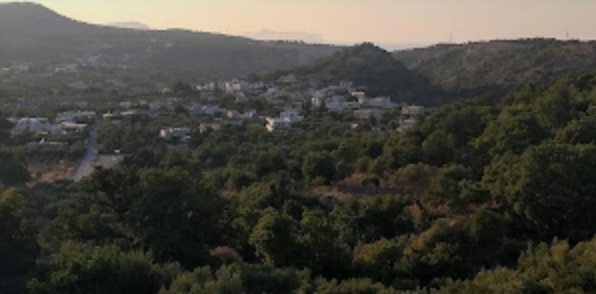
Gonia is a hilltop village about ten kilometres south-west of Rethymno, standing at roughly 220 metres above sea level. Its name means simply “corner”, and is explained by its position in the angle of a small valley. From the height a broad view opens over the surrounding country; the approach itself runs through farming land in which the fringes of the town give way to olive groves and small villages. Among the olive trees stand valonia oaks – outliers of the great oak wood that stretches from Atsipopoulo and Prines as far as here. The parish church, dedicated to St John the Theologian and renovated in 1887, has a carved wooden iconostasis, and on the edge of the village there is a cave chapel of St Peter and St Paul in whose crypt, it is said, the parish hid its icons from the Turks; one of them, recovered, now hangs on the iconostasis of the church. Since the 1990s new settlers have brought tavernas, shops and cheese-making to what had been a purely agricultural community.
The settlement took shape in the 14th century – tradition puts its foundation at about 1350, by Cretans who moved in from the villages round about – and under Ottoman rule it was burnt three times, in 1770, 1821 and 1866. Its history is linked above all with two coenobitic monasteries, that of St Irene (Agia Irini) and that of St Anastasia. A monastery is called coenobitic when the brothers or sisters live as a community, work their property in common and are subject to a common rule.
The monastery of St Irene
According to local and church tradition the monastery of St Irene was already in existence in the 15th century. The records of the Metropolis of Rethymno connect its history with a still older documentary witness of 1362, a Venetian deed that describes it as a large house with considerable property; it may have been founded as early as the second Byzantine period, between 961 and 1204, by ascetics who had settled in the caves of the rock. The last mention from the Venetian period dates from 1637, and in 1751 the monastery appears on a monastic seal.
The monastery had been in decline since the revolution of 1821, and in the rising of 1866 the buildings suffered heavy damage; in 1895 a seminary for priests, with ten pupils, functioned here for a short time, before Ottoman troops burnt the complex down in 1896. In 1900 the monastery was formally dissolved and made over to Arsani Monastery as a dependency. After the destruction and a long period of dereliction the complex was restored in the 20th century; in 1989, at the instigation of Metropolitan Theodoros Tzedakis, it came back to life when the first three nuns arrived to begin the work. The restoration, in which the sisters themselves took a hand, received the Europa Nostra award in 1995 for the preservation of the architectural heritage; the church was reopened for worship in 2003 and consecrated in August 2011 by Patriarch Theodoros of Alexandria. Today the site houses a convent of some eight nuns, an ecclesiastical museum and workshops in which the sisters paint icons – some of them on pieces of pottery – weave, embroider and sew liturgical vestments; to these they add the processing of herbs into soaps and extracts, candle-making and the copying of liturgical manuscripts.
From outside, the walled complex has the look of a small fortress. Within, the working quarters characteristic of Cretan monasteries have survived: the olive press and the stable had entrances of their own, so that the draught animals need not be led through the main courtyard, and a chapel of St Raphael, St Nicholas and St Irene has been built over the remains of the old oil mill. The three-aisled church is partly hewn out of the living rock and partly built of masonry – perhaps a unique example in Cretan church building. In it is venerated the icon of St Irene which Ioannis Stathakis painted in 1871, after the destruction of 1866; further works by this painter are shown in the museum, together with icons painted by the sisters, personal belongings of Metropolitan Tzedakis and objects and books that belonged to Bishop Titos Sylligardakis. Local tradition relates that one of the monks cured the daughter of the pasha of Rethymno and was rewarded with leave to enlarge the church, which originally had a single aisle; the story lives on in the religious memory of the house.
The monastery of St Anastasia
Of the monastery of St Anastasia little more than ruins now remains. Tradition has it that during the persecutions the nuns hid the monastery bells, the sacred vessels and other treasures in a nearby well. The history of the house is also bound up with the hard times of Ottoman rule: local tradition tells of the plundering of the monasteries and of repeated attacks on Gonia as a Christian village – three burnings within a century are remembered. These stories explain why the memory of the two monasteries has stayed alive in the village, even after their communities had vanished.
Driving on
Continue along the road and after about a kilometre you come to the village of Agios Andreas. At the town hall, by the crossroads, you can turn off once more and after roughly three kilometres reach Ano Valsamonero.