Kato Valsamonero – the church of St John Chrysostom and the cave of Spilios tou Vasilé
The most complete guide to Crete: 221 places on the map, 23 routes and 49 articles — with photos, videos and the story behind every place. No sign-up, no trackers.
Routes drawn along real roads
Weather at every stop
Full-text search
“Near me” by geolocation
Create your own printable itinerary
Satellite, terrain, dark mode
Works offline
⌕
Searches 1.7 million characters of descriptions, not just names
—places
4regions
—routes
—with video
Search results
—
Interactive map
Find what is near you
Filters narrow the map and the list at once. Zoom out and pins group together.
Region
Category
Фильтры карты
Landmarks
Featured places
RegionCategory
Routes
Ready-made day trips
Individual places
Articles about landmarks
Kato Valsamonero: the church of St John and the cave of Vasilé
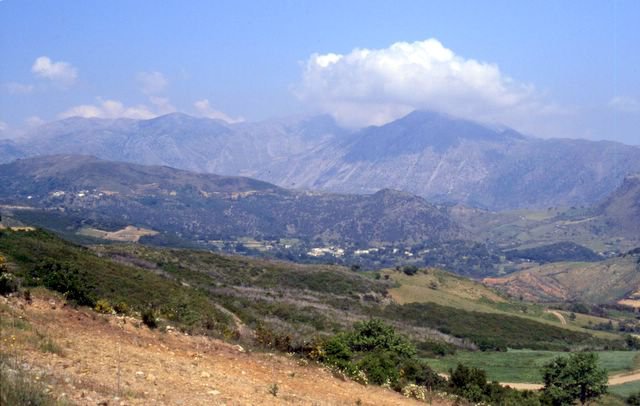
Kato Valsamonero (Lower Valsamonero) lies on a hill about fourteen kilometres from Rethymno, at a height of some 250 metres. From here one sees the plain towards Chania, the Sea of Crete and the summits of the White Mountains, which are covered with snow in winter. This position governs both the look of the landscape and the historical role of the village: it is one of the old settlements of the Rethymno hinterland, and under the Venetians the district counted as an important military area. At the census of 2011 just under 200 inhabitants were recorded. The parish church, dedicated to the Holy Trinity, stands in the middle of the village, which has twice been commended by the prefecture as one of the best-kept settlements in the district.
The place name joins the word “balsamo”, balsam – that is, an aromatic plant that thrives here – to the Greek “nero”, water. What is meant is either the numerous springs of the neighbourhood or one particular spring to which healing power was ascribed: its water was held to be so pure and so good for the digestion that people spoke of it as a balm. The village first enters the written record in the Venetian period: in 1577 it appears as “Varsamonero Kato”, and in 1583 some 209 inhabitants were counted. The settlement lay within the Venetian defensive system in the north-west of the island.
The church of St John Chrysostom
The principal sight of Kato Valsamonero is the church of St John Chrysostom, a small single-aisled building. Its frescoes are dated to the late 14th century; the surviving scenes include the Transfiguration of Christ, the Nativity, the Myrrh-bearing Women, the Massacre of the Innocents and depictions of the torments of hell. The paintings belong to the late Byzantine tradition and form an important part of Cretan church painting; in manner they have even been called rare frescoes of Renaissance character. There appear to be two layers of painting, the earlier reaching back to an older period, and the faces of the saints were damaged in Ottoman times.
The cave of Vasilé and the memory of the resistance
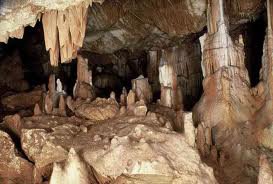
South of the village lies the cave of Spilios tou Vasilé (Σπήλαιο του Βασιλέ), called the “King’s Cave” in some guidebooks. The name can be understood as “cave of Vasilé” and is connected with a local field name; the translation “King’s Cave” has established itself mainly in descriptions written for visitors. It is one of three caves in the territory of the village – the others are at the places called Trypiti and Kouroupotos. Stories cluster round it of underground passages, of a light said to have appeared in its depths, and of other peculiarities of the place.
During the German occupation the cave served the Cretan resistance as a hiding place and base. In 1944 an all-Cretan gathering of resistance fighters took place here. The district had seen such assemblies before: in 1822, during the War of Independence, some 3,000 Cretans are said to have mustered at Kato Valsamonero before a major engagement. The cave is thus not merely a natural feature but also a place of remembrance for the events of the Second World War in Crete.
Other monuments of Kato Valsamonero
In and around the village other ecclesiastical monuments have survived: a half-ruined church of the Mother of God, dated to the 10th or 11th century – the old Panagia Hodegetria, once a small monastery founded before the Ottoman conquest, of which stretches of wall and the remains of a gateway still stand – the church of St Paraskevi, and scanty monastic remains, among them those of a house dedicated to the Holy Spirit. After the departure of the Muslim population at the beginning of the 20th century Kato Valsamonero was resettled by Greek families from various villages of Crete; rural life continued to depend on tillage and stock-raising.
The story of this resettlement explains a good deal about the character of the village. After 1669, according to local tradition, only Muslims lived here; the Christian inhabitants had been driven out, and a single miller is said to have stayed. For 1834 some thirty Turkish families are mentioned, for 1881 about 260 Muslim inhabitants and just one Christian. A village tale from the rising of 1897 tells of six Ottoman soldiers who were killed here and whose bodies were never found. Between 1900 and 1920 families arrived from some 25 different Cretan villages, so that the present inhabitants are without exception the descendants of incomers; the Petrocheilos, Kallitsounakis, Menioudakis, Lionis and Marinakis families are reckoned among the oldest. Natives of the village include the dancer Parakevas Menioudakis and the footballer Giannis Marinakis.