The most complete guide to Crete: 221 places on the map, 23 routes and 49 articles — with photos, videos and the story behind every place. No sign-up, no trackers.
Routes drawn along real roads
Weather at every stop
Full-text search
“Near me” by geolocation
Create your own printable itinerary
Satellite, terrain, dark mode
Works offline
⌕
Searches 1.7 million characters of descriptions, not just names
—places
4regions
—routes
—with video
Search results
—
Interactive map
Find what is near you
Filters narrow the map and the list at once. Zoom out and pins group together.
Region
Category
Фильтры карты
Landmarks
Featured places
RegionCategory
Routes
Ready-made day trips
Individual places
Articles about landmarks
Platanes – the seaside resort east of Rethymno
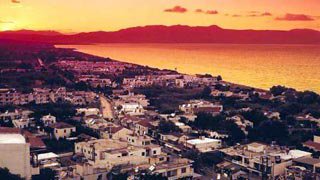
Platanes lies about five kilometres east of Rethymno and is joined to the town by an unbroken ribbon of building along the coast. It is one of the three adjoining eastern suburbs – Perivolia, Misiria and Platanes – that were once separate settlements and have now been absorbed into the fabric of the town. The broad sandy beach, a continuation of Rethymno’s town beach and part of a sweep of sand that runs on for a dozen kilometres or so to Skaleta, is fitted out for bathing and water sports: parasols, showers, lifeguards and firm walkways that make it easier for people with limited mobility to reach the water are all provided, and the stretch has been awarded the Blue Flag. The seabed shelves gently, but the bay lies open to the north and the water is often choppy. Hotels, apartment blocks, tavernas, bars and clubs stand close at hand, so that holiday life carries on in the evening well beyond the beach.
The Greek name Πλατανές goes back to the plane trees that once grew by the springs and along the tracks. Water was plentiful: it is here that the river coming down from the Prasses gorge reaches the sea – it is called the Platanias after the village. The stream runs strongly until spring, and big planes still shade its bed higher up. For a long time the settlement kept the character of a farming community. In Ottoman times an aga had his seat here, and incomers from Asia Minor lived in the village; after the liberation of Crete and the exchange of populations in 1923 the make-up of the village community changed fundamentally.
In the old part of Platanes, a few hundred metres inland from the coast road, churches and traces of the earlier settlement survive. Local tradition singles out the chapel of St John Rizologos: its name is associated with fever and with the legend of the curing of malaria.
Platanes today
Today Platanes combines the conveniences of a town with a holiday by the sea. Rethymno, Perivolia, Misiria and the eastern beaches around Adelianos Kampos are all quickly reached from here, by service bus as readily as along the coast road; yet the place has not lost its connection with the landscape and with the history of what was once the rural edge of town.
Those who want to escape the bustle of the seafront for a while need not go far: inland lies the Prasses gorge, and round about are churches and the old bridge of San Marco. The bridge, a Venetian work in stone over the Platanias, crosses the river in one arch nearly 18 metres wide and is reckoned the longest single-arched bridge on Crete. The gorge begins south of the village of Prasses, some ten kilometres south-east of Rethymno, and winds for about six kilometres between huge boulders and through the rocky Gargana hills before the stream emerges at Platanes; it is an easy walk of around four hours with barely a hundred metres of descent, but only from about mid-June to mid-October, since water flows through it for the rest of the year. Buzzards circle above it, and it shelters a small population of Bonelli’s eagle. Platanes is also a convenient base for excursions to Arkadi Monastery and the villages of the hinterland. The beach is at its best in the early morning, when the sunbeds are still empty and the sand now and then shows the broad track of a turtle that has buried her clutch in the night.