The most complete guide to Crete: 221 places on the map, 23 routes and 49 articles — with photos, videos and the story behind every place. Everything is open and free: no sign-up, no paid sections and no advertising, open or hidden. You can install the guide on your smartphone as an app.
Routes drawn along real roads
Weather at every stop
Full-text search
“Near me” by geolocation
Create your own printable itinerary
Satellite, terrain, dark mode
Works offline
⌕
Searches 1.7 million characters of descriptions, not just names
—places
4regions
—routes
—with video
Search results
—
Interactive map
Find what is near you
Filters narrow the map and the list at once. Zoom out and pins group together.
Region
Category
Фильтры карты
Landmarks
Featured places
RegionCategory
Routes
Ready-made day trips
Individual places
Articles about landmarks
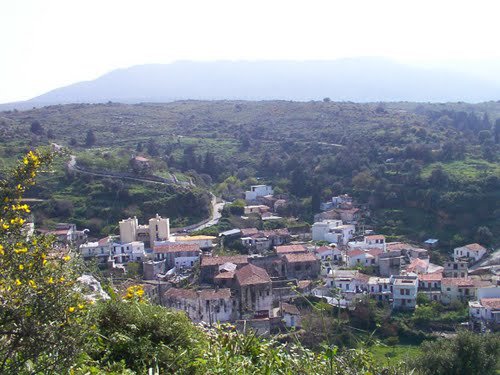
Prasies – a green village at the foot of the mountains
Prasies lies in a wooded valley on the road that climbs from Rethymno to the Amari valley – the upland basin between Psiloritis and Mount Kedros – surrounded by olive groves and fertile gardens. Venetian arches, stone façades, inner courtyards and later Ottoman additions have grown together here by degrees. The village is named in the censuses of the 16th century; today about a hundred people still live here.
The old water system, with its springs, its fountain and its stone troughs, shows how much water meant to the village community. It was drunk, used to irrigate the gardens and needed for the work of house and farmyard. Prasies therefore grew up not merely as a settlement on a through road, but as a favoured valley with a dependable supply of water – the same abundance that in our own day led to the building of the Potami dam a little further up the valley.
Old churches and frescoes
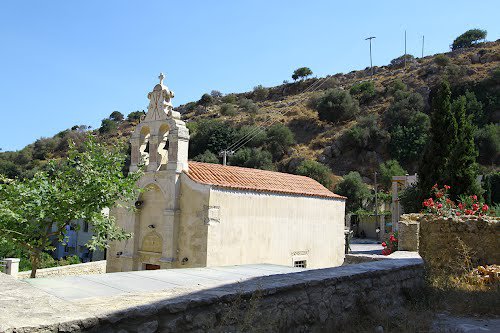
In the village cemetery a church with wall paintings of the 14th century has survived. Prasies also has the churches of St Stephen, of Sts Constantine and Helen, of St John Rigologos, of the Archangel Michael, of the Transfiguration of Christ and of the Panagia Myrtidiotissa. Such a wealth of churches in so small a village gives some idea of how closely woven the life of the Church was in Crete.
East of Prasies begins the Prassano Gorge, known for its rich flora and fauna. The water from the Potami area flows down through it to Platanias, on the coast just east of Rethymno; nearby, springs and parts of the old water system have been preserved.
Venetian architecture and water
Prasies first comes into clear view in the Venetian registers of the late 16th century: in 1577 Francesco Barozzi lists the place as Prasses in the province of Rethymno, and the census of 1583 gives 285 inhabitants. Archaeology, however, points to a far earlier opening-up of the valley. The old houses preserve arched doorways, vaulted storerooms, olive presses, wine presses and stone courtyards. The old water system, the springs, the fountain and the troughs make plain how water sustained the drinking, the irrigation and the daily labour of the village community.
Churches and frescoes
The cemetery church with its paintings of the 14th century is the most important of the churches for the history of art. In the village itself and its immediate surroundings are the churches of St Stephen, of Sts Constantine and Helen, of St John Rigologos, of the Archangel Michael, of the Transfiguration and of the Panagia Myrtidiotissa. Taken together they show that Prasies was no chance roadside village but an established parish. The feast of the Myrtidiotissa on 24 September is still the great day of the village; local tradition connects the veneration of the icon with survivors of a plague epidemic who are said to have moved here from an abandoned neighbouring village.
Kastri and the ancient surroundings
On the hill of Kastri, about a kilometre south of Prasies, the remains of a Late Minoan settlement were found. Pottery shows that life went on in the Geometric and Roman periods; sherds of the same kind also came to light at Agios Kosmas, some two kilometres south of the village. In later centuries small tower-like buildings, the koules, kept watch over the valley – they date from Ottoman times, and one of them stands not far from the bridge of Sima by the present Potami reservoir. The three surviving ruins make it possible to see how the roads and passages between Rethymno, the Prassano Gorge and the interior were controlled.
The Prassano Gorge
From the eastern edge of the village a track and a footpath lead into the Prassano Gorge. Its stream bed is part of the course of the Platanias, and today it also carries the overflow of the Potami dam as it winds for about six kilometres through the rocky hills of Gargana. High rock walls, great plane trees, springs and a rich flora make it a cool walk, with birds of prey circling overhead – buzzards, and a small population of Bonelli’s eagle. The full traverse takes about three hours, and care is needed in places, where the bed is choked with huge boulders and can be hard going. The descent itself is slight, only about a hundred metres. Water runs in the gorge until spring, so that it is passable essentially from June to October.
Prasies today
Prasies has kept the face of a living village: the fields are worked, the churches are in use, the old waterworks preserved. A visit combines a stroll through the Venetian lanes with the walk into the gorge and with the archaeological landscape of Kastri – and can easily be joined to an onward drive to the Potami reservoir or into the Amari valley.