The most complete guide to Crete: 221 places on the map, 23 routes and 49 articles — with photos, videos and the story behind every place. Everything is open and free: no sign-up, no paid sections and no advertising, open or hidden. You can install the guide on your smartphone as an app.
Routes drawn along real roads
Weather at every stop
Full-text search
“Near me” by geolocation
Create your own printable itinerary
Satellite, terrain, dark mode
Works offline
⌕
Searches 1.7 million characters of descriptions, not just names
—places
4regions
—routes
—with video
Search results
—
Interactive map
Find what is near you
Filters narrow the map and the list at once. Zoom out and pins group together.
Region
Category
Фильтры карты
Landmarks
Featured places
RegionCategory
Routes
Ready-made day trips
Individual places
Articles about landmarks
Spili – mountain town of springs and churches
Spili (Σπήλι) lies at about 430 metres above sea level, some 30 km south of Rethymno – roughly forty minutes by car, or an hour on the KTEL bus – on the western slope of Kedros; the height that rises directly above the town is called Vorizis. Around 800 people live here, considerably more in summer, though the 2021 census counted 634 registered residents. The name is taken from the many caves (spilia) of the neighbourhood, above all the Peristere grotto to the north-west, where according to local tradition a miracle-working image of the Virgin painted on the rock was once venerated. In Venetian times Spili consisted of two separate settlements, Panochori and Perachori, the upper and the outer village; stone houses, dressed-stone doorways and paved lanes recall that period. Standing on the pass between the north coast and the Libyan Sea, the town grew up as a farming and trading settlement and a halt for travellers and merchants long before tourism arrived.
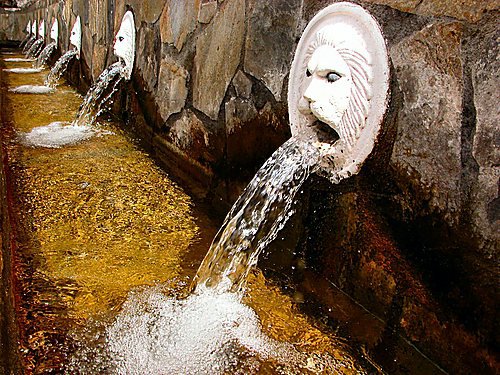
The principal sight is the Kefalovrysi fountain on the square beneath the old plane trees, where drinkable spring water flows without ceasing from twenty-five stone lion heads set in a long row. The same mountain stream formerly drove the town’s watermills, of which several survive – at least one is said still to work – and irrigated gardens and small holdings. The mills recall the economic life of Spili before modern piped water.
The Kefalovrysi fountain and the 25 lion heads
The Venetian-style fountain, generally dated to around the 16th century, is no museum piece but part of daily life: the inhabitants draw their water here, travellers stop, and the coolness is particularly welcome in the summer months. The spring yields some 330 cubic metres an hour; its iron-bearing water keeps a steady temperature of about 13 °C the whole year round. It is best drunk straight from the cupped hand – and the bottle filled for the journey onward. Public parking lies close to the square, and the town is an easy stop on the drive from the north coast to Agia Galini, Preveli or Plakias.
The old churches of Spili
Twenty-one churches and chapels are counted in the town and its countryside, several of them of Byzantine and post-Byzantine date. The church of St Charalambos and St Theodore is a two-aisled building of the 14th century. At the entrance to the town, next to the school, stands the medieval church of St George, and the church of St Antony also dates from the 14th century. In the religious architecture of Spili small barrel-vaulted churches stand side by side with later additions, and most of the older buildings are kept locked outside service times, so the key must be sought in the neighbourhood.
The church of the Panagia and of the Transfiguration of the Saviour (Metamorfosi tou Sotiros) is a double church of the 14th century. Its frescoes include scenes rare in Cretan painting, concerned with the hereafter, the Last Judgement and the hope of resurrection. The painting is to be read as a single connected theological programme that accompanies prayer and the liturgy, in the manner of the many small fresco churches of the Rethymno hinterland that were decorated under Venetian rule.
The cathedral of St Peter and St Paul
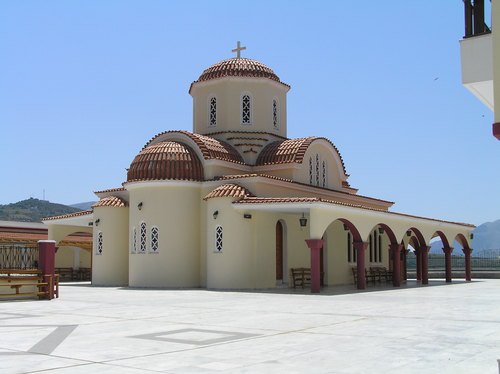
The three-aisled church of the Holy Apostles Peter and Paul was built in 1962, the very year in which the bishoprics of the Church of Crete were raised to the rank of metropolises, and serves as the cathedral of the metropolis. In it the memory of the holy Bishop Nikon and of St Isidore is also kept. There is also the church of St Raphael, to which the buildings of the bishop’s residence are attached. Thus in a single small town medieval fresco churches stand next to a modern church that represents the church life of the present day in the district of Rethymno.
From the history of the town
The chronicle of Spili has its share of troubled pages. In 1790 Giakoumis Tsouderos is said to have killed two janissaries who tried to break up a wedding; in June 1821 there was a skirmish here with Ottoman troops, and the inhabitants also took an active part in the uprising of 1866. In the Second World War the village was spared, according to tradition, because a German officer interceded for those who had taken him in after an aircraft crash. Spili is also a home of Cretan music: the music teacher Thanasis Skordalos, one of the most celebrated lyra players of the 20th century, came from here, as did other well-known lyra players and dancers.
Spili as a starting point
Spili is well placed on the road to the south coast and, as a small hub, offers banks, a post office and a health centre. From here one drives on to the Kourtaliotiko Gorge, which ends at the palm beach of Preveli, or to the Patsos Gorge about 10 km to the north; northwards the Spili–Gerakari stage of the European long-distance path E4 climbs past the church of Agio Pnevma through olive groves. South of the town a shady path follows the stream, in which trout hold their place. Spring and autumn are the pleasantest seasons for walking, while in high summer the shade of the planes and the cold water of the fountain are the chief attraction. In the town itself water, plane trees, the Venetian square and the fresco churches combine into a single historical landscape.