The most complete guide to Crete: 221 places on the map, 23 routes and 49 articles — with photos, videos and the story behind every place. Everything is open and free: no sign-up, no paid sections and no advertising, open or hidden. You can install the guide on your smartphone as an app.
Routes drawn along real roads
Weather at every stop
Full-text search
“Near me” by geolocation
Create your own printable itinerary
Satellite, terrain, dark mode
Works offline
⌕
Searches 1.7 million characters of descriptions, not just names
—places
4regions
—routes
—with video
Search results
—
Interactive map
Find what is near you
Filters narrow the map and the list at once. Zoom out and pins group together.
Region
Category
Фильтры карты
Landmarks
Featured places
RegionCategory
Routes
Ready-made day trips
Individual places
Articles about landmarks
Odigitria and the “Cretan Athos”
In the south-west of the Asterousia Mountains, where the Messara Plain gives way to a bare, sun-scorched upland, stands one of the oldest and most respected monasteries in Crete: the Moni Odigitrias (Μονή Οδηγήτριας). It lies at about 250 metres above sea level, at the end of the surfaced road that runs up from the village of Sivas, and at the head of a gorge whose rock walls are pitted with countless caves. Hermits lived in them for centuries, and at its end one of the loveliest beaches on the island opens to the sea.
The district is called the “Cretan Athos” because the Gorge of the Saints, Agiofarango, has been a place of ascetic life since the first Christian centuries. It is a short and easy walk: the gorge proper is about a kilometre and a half long, drops no more than thirty metres, and can be covered in about an hour there and back at an unhurried pace. Its spiritual head is Odigitria Monastery, founded in the 14th century and among the oldest on the island. Many visitors, admittedly, come chiefly for the beach at the mouth of the gorge. But first things first.
Agiofarango – the Gorge of the Saints
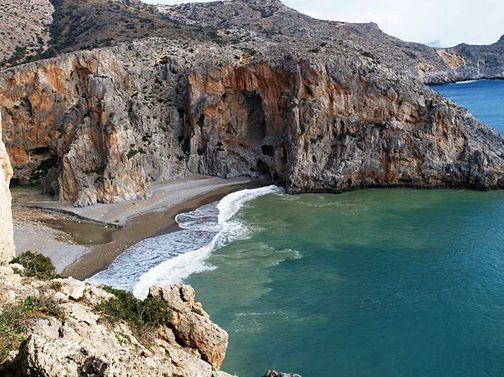
Agiofarango lies south of the monastery and is formed by two stream beds. One comes from the north-north-east, from the area of Gialomonochoro, the other from the north-east, from the monastery itself. They meet by the church of Agia Kyriaki, continue quietly for a while to the west and south, and then enter the gorge proper, which opens to the Libyan Sea. There lies a small but splendid beach of fine shingle, with deep, clear and usually calm water; to the west of it the sea has formed a rock arch beneath which one can swim, and to the south-east, hidden among vertical cliffs, is Vourvoulitis, a salty pool in an open sinkhole that communicates with the sea by an underwater passage – to be admired from above, for the descent is extremely dangerous. For most of the way huge, sheer walls rise on either side, with cave after cave in them; shortly before the sea there is a climbing area. Agiofarango has a wild, austere beauty. Drivers follow the unsurfaced track from the monastery for about four kilometres to a signposted turning and leave the car on a small level space at its end, from where the sea is 25 to 35 minutes on foot; it is wiser not to park under a tree, since the goats climb on to car roofs to reach the leaves. Boats also come round from Matala, Agia Galini, Kokkinos Pyrgos and Kali Limenes. As there are no springs and little shade, plenty of drinking water is needed. Out of respect for the character of the place, nude bathing is not appropriate here.
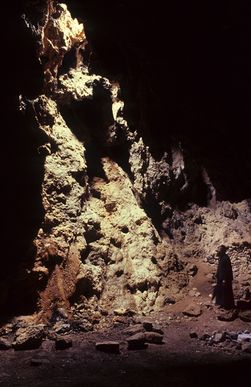
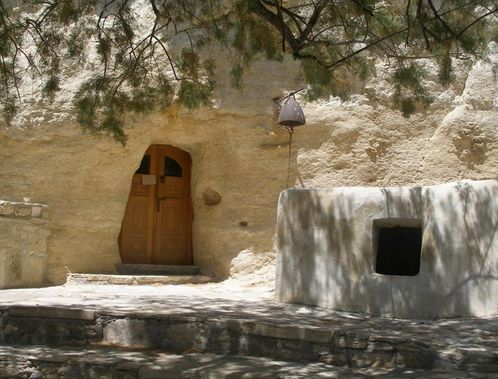
The cave church of Agia Kyriaki, some two kilometres from the monastery on the way to the gorge, is already an introduction to this world. It stands on the eastern slope of the Gialomonochoro stream at a spot called Kokkinos Volakas, the “red rock”, after the great reddish boulder opposite, among carob trees, lentisks and ancient olives. The site was inhabited as early as Minoan times and has served for worship since the Early Christian period. The church is a roomy chamber cut by hand into the soft limestone, with a stone bench along the walls, a simple wooden iconostasis, a small forecourt and a modest belfry; a skylight hewn through the rock, which could be closed with a slab, lets daylight fall into the interior. Inside, loops worked out of the rock catch the eye: according to tradition the monks tied themselves to them during their nightly prayers so as not to fall asleep. Another explanation sees in the cave a tomb or prison of Roman date, or a gaol from the time of Arab rule (827–961), in which captives were bound to the rings. The feast of St Kyriaki is celebrated on 7 July.
The church of St Anthony and the caves of the ascetics
The inaccessibility of the place, far from any settlement, made Agiofarango from the earliest Christian times the first centre of eremitic life not only in this district but in the whole of Crete. The very name of the gorge expresses the holiness attributed to it. Tradition speaks of three hundred hermits who are said to have lived here at one time, each alone in his cave and in complete isolation from the others. And it relates that the crag martins of the gorge do not migrate in winter because the souls of the ascetics live on in them.
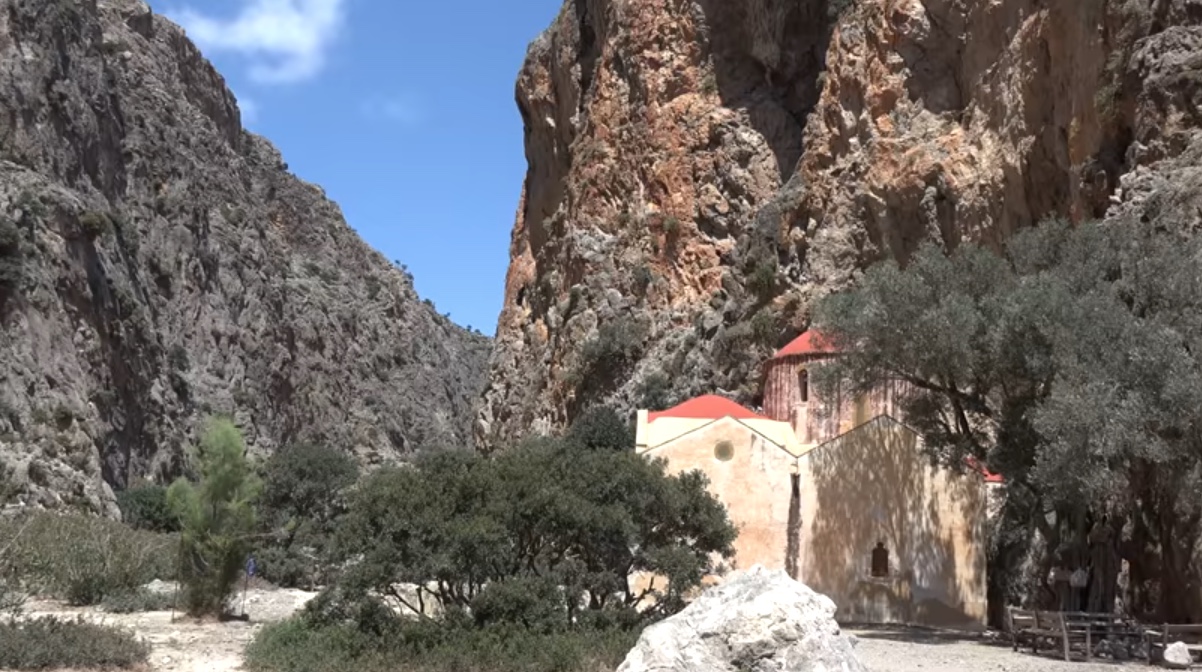
Walking down the gorge, one comes, about 250 metres before the beach, to the church of St Anthony (Agios Antonios). It was the centre of the ascetics, for all their common services were probably held here. It is thought to have reached its present form in three stages: at the beginning there was a tiny chapel in a small rock cave; when the number of hermits grew, a larger space was needed and it was extended. The building was renewed and enlarged for the third and last time in the 14th or 15th century, and so it has come down to us. The church is built with outstanding craftsmanship and was once painted throughout; the closeness of the sea, however, has destroyed the frescoes. In front of the church is the well from which the ascetics drew their water – it is brackish, and not for drinking – for there are no springs for miles around.
South of the church, on a small rise, a buried Minoan circular tomb with a vault was discovered – evidence that people frequented the gorge as early as Minoan times. Finally, going on from the church towards the sea, a cave opens on the left after a short distance.
This is “Goumenospilios”, the “Abbot’s Cave”: its entrance is very low, the interior by contrast spacious. Popular tradition relates that the monks of the monastery of St Anthony lived and held services here while their church was being built. Later the hermits of the whole gorge are said to have gathered in this cave once a year, to count one another and to learn who had died in the year gone by – the one occasion on which men who otherwise lived apart stood face to face. The tradition is not extinct: until very recently a hermit lived at Agiofarango under the care of the monastery.
The founding of the monastery and its layout
According to tradition the monastery was founded by a woman who lived in the district of Livadiotis near the village of Pompia. She came of a noble and wealthy family and had one daughter. After the death of her husband the daughter died too, unexpectedly – on the day of her betrothal. The mother left her house and implored the Mother of God to show her the way. The Panagia showed her the place where a ruined monastery was to be rebuilt, and she herself became a nun. She gave away her entire fortune and raised a large convent, which she named Odigitria. Her lands at Livadiotis she presented to the monastery, and she settled in it under the name of Martha. The name of the nun Martha is recited to this day in the services of the monastery as that of the foundress.
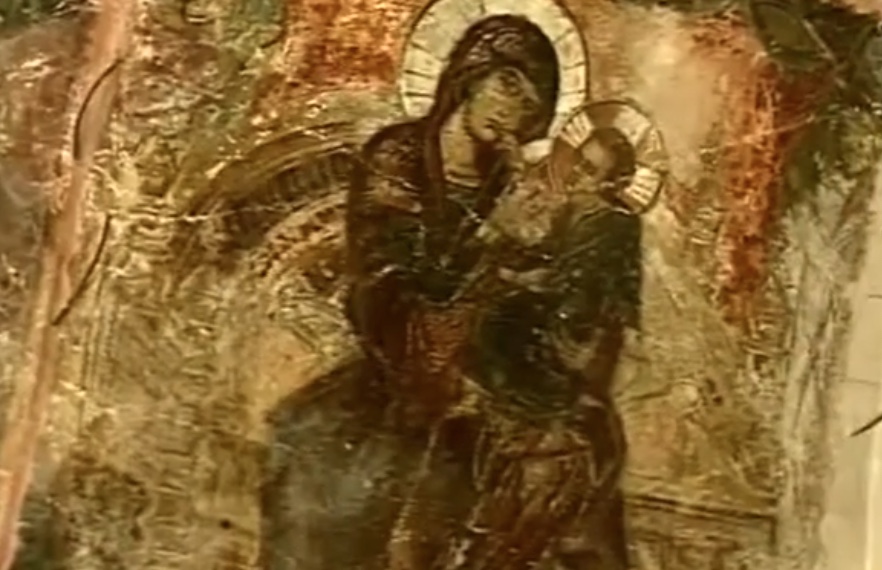
According to another, historical interpretation the name is connected with a copy of the famous icon of the Hodegon Monastery in Constantinople, which was attributed to the Evangelist Luke and was among the most venerated and wonder-working icons of Byzantium. The monastery is first attested in 1393, in a document from the ducal archive of Chandax, the modern Heraklion – the Candia of the Venetians, who then ruled the island.
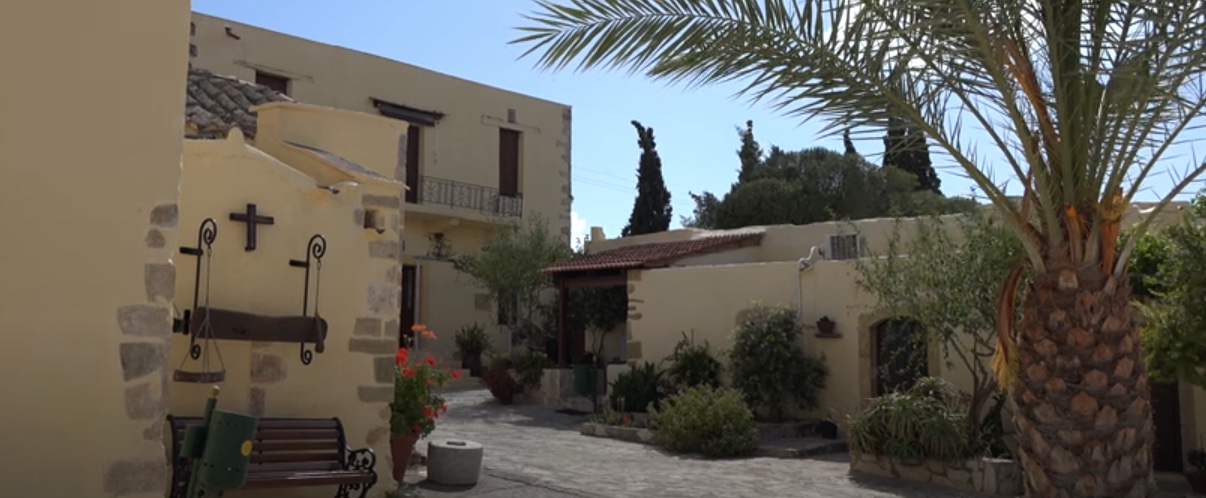
The complex has the character of a fortress: a closed rectangle of walls with three gates, to north, east and west. Above the north gate a stone slab with a cross and the monogram IC XC NK (“Jesus Christ conquers”) gives the year 1568, when the monastery was renovated to its present form and stood at the height of its prosperity. In the middle of the courtyard rises the two-aisled katholikon; the southern aisle is dedicated to the Dormition of the Virgin, the northern to the Apostles Peter and Paul. On the south side the richly decorated tomb of a Venetian named Aloysius Trivizanos, of 1602, survives with coat of arms and inscription – the remnant of a lost third aisle, which belonged to St Phanourios. Around the courtyard are the cells, the guesthouse with the abbot’s lodging and library, the store-rooms, the olive mill, the bakehouse, the wine press, an underground cheese cellar, the graves of former abbots and the cistern, which collected rainwater in case of siege. In the old working quarters in the north-east the monks have set up a small folk museum: on show are the olive press with its stone basins, the masonry oven, a loom and agricultural implements.
Icon painting and the cultural heritage of the monastery
Major works of 15th-century Cretan painting were made for Odigitria Monastery, among them works by the painter Angelos, who created the iconostasis of the church. Four of his icons are preserved in the monastery to this day: “Christ the Vine”, “The Mother of God as Life-giving Spring”, “The Meeting of Peter and Paul” – the embrace of the two apostles, a subject that matches the dedication of the northern aisle – and “St John the Baptist”.
Important evidence of the painting of that period is also provided by the frescoes in two chapels belonging to the monastery: Agios Andreas and Agios Ioannis Prodromos (St John the Baptist) in Vathy Lakkos, the “deep valley” north of the complex. Both were built in the 14th or 15th century. Agios Andreas stands at a spot called Kaka Pila, less than a kilometre from the hermitage of the Agioi Eftychianoi, beside a spring shaded by plane trees; glazed pottery bowls are set into its outer walls as ornament, and its frescoes are in good condition. The wall paintings of both chapels belong to the early phase of the brilliant Palaiologan style; in the chapel of St John, which is painted throughout and is conspicuous for a curiously irregular south window, damp has done some damage. Agios Andreas is celebrated on 30 November, the Beheading of the Baptist on 29 August.
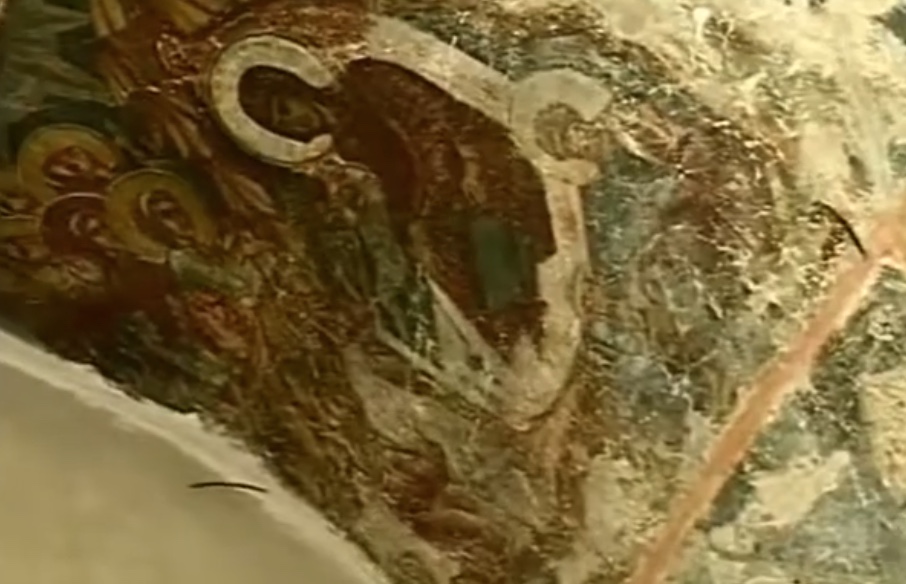
The latest dated frescoes are from the third decade of the 14th century. In the katholikon itself, in the cross-vaulted narthex, remains of a cycle on the Akathist Hymn have survived – sixteen scenes in all – which confirm the foundation in the 14th century; beside them are episodes from the lives of St Anthony and St Paul of Thebes, and a picture of a monk named Gregory and his brethren receiving the blessing of Christ. The monastery also possessed a large library, in which many learned monks and copyists of manuscripts worked. In the State Archives of Venice there are numerous documents, chiefly contracts of purchase and sale, which show that during Venetian rule Odigitria was one of the largest and richest monasteries in Crete. Its own archive, by contrast, begins only in 1830 – everything older was lost in the sackings.
Odigitria in the history of resistance
The monks had already shown their mettle in the Cretan War: in 1648, during the siege of Candia, they resisted the Turks under their abbot Joseph. After the Ottoman conquest the monastery stood up resolutely for the Orthodox faith and for a population that suffered under the violence of its new masters. It shared its modest means with the people of the neighbourhood and supported the Chainides – the irregulars who resisted the Ottoman yoke in the mountains. One of the key figures among them was Xopateras, a monk of the monastery, who has become a symbol of heroism in Crete and who made Odigitria his base when the rising of 1821 broke out. With him and other fighting monks Odigitria took part in the struggle for the liberation of the island. Among the well-known insurgents connected with the monastery were also Michail Kourmoulis, Michail Korakas, Malikoutis and Tsakiris.
After the death of Xopateras the Ottomans laid the monastery waste, destroyed buildings and carried off sacred vessels and books. In 1841 the Holy Synod of Crete resolved on its rebuilding; the Ecumenical Patriarchate supported this in May 1844 and by a sigillion conferred on the monastery the stauropegial rank that placed it directly under the patriarch. That encouraged its revival: as early as 1853 Odigitria was able to support an orphanage in Constantinople and schools in Crete.
In the great revolt of 1866 the monastery, under Abbot Gerasimos Manidakis, served as a powder magazine; the abbot was elected treasurer-general of the rising, and the Ottomans once more took their revenge on the buildings. In August 1882 the aged Captain Michail Korakas of Pompia, then in the last year of his life, came up one final time to hold a memorial service for Xopateras together with the abbot. During the German occupation of 1941–44 the monks hid partisans; icons and treasures were moved as a precaution to the neighbouring village of Listaros. The remote monastery received electricity and running water only in 1977, and since 1989 it has been restored step by step.
Xopateras, the fighting monk
Anyone seeing Odigitria Monastery for the first time from a distance might take it for an old castle. Although it lay away from the coasts that were plagued by pirates in the 16th century, the country round about was then as lonely as it is now. Against enemies of every kind – brigands, Ottomans and others – there was no protection but high walls and monks who could fight.
Outstanding among these monks is the legendary Xopateras, also called Xepapas, whose real name was Ioannis Markakis and who as a monk was Father Ioasaph. Ioannis, born in 1788, wanted to marry a girl of whom his father disapproved. Out of defiance he entered Odigitria Monastery, where he was given the name Ioasaph – a young man, by all accounts, whose temperament was ill suited to the monastic life. He soon joined the Cretan insurgents fighting Ottoman oppression. His exploits became widely known from 1810 onwards; the Ottomans called him “Chainis”, after the Arabic “hain” – traitor, renegade. The Chainides, whom the Cretans also called “Kalisperides” because of their night raids on the Turks (from “kalispera”, good evening), were an emblem of resistance. He was known besides as the “Delis Papas”, the “mad priest”.
The last stand in the tower
Ioasaph’s reputation as a protector of the Christians spread quickly and so alarmed the Ottomans of the district and of Heraklion that they demanded the metropolitan bring him to heel. After threats and pressure the metropolitan stripped him of his priesthood; the priest became an “ex-papas”, a “priest outside”, and from that comes the nickname “Xopateras”. According to another version the metropolitan expelled him because he had killed an Ottoman janissary who had insulted his sister and the honour of his family. Released from the monastic life, he is said to have married and had a child, and to have gone on harrying the Turks with a handful of companions.
After Xopateras had killed the cruel and tyrannical janissary whom tradition calls “Argolidis”, the Ottomans decided to attack the monastery: in February 1828, with 3,000 men. Xopateras had been warned and called other captains of the Messara to his aid; but they could not reach him because the river Geropotamos had burst its banks. In the monastery at that moment were five monks and five lay people, among them the sister of Xopateras; the story also names his nephew Troullinos, a comrade called Vlatakis from Melambes, and his own wife and child.
From the tower that still stands in the north-west corner of the monastery, close to the main gate, Xopateras and his companions fought an unequal battle that lasted three days and three nights. Among their weapons, it is said, were ten beehives hurled down on the besiegers; some thirty Turks were killed and fifteen wounded. On the third day all his companions had fallen – his sister suffocated – and Xopateras fought on alone, wounded though he was. The end came when the Ottomans set the tower on fire. He stepped out for the final fight, a firearm in one hand and a sword in the other. After his death the Ottomans struck off his head, stuck it on a lance and carried it round the district as a token of their “triumph” – which in truth bore witness to the unbending spirit of Crete rather than to a victory of the conquerors. Cretan folk songs celebrate him to this day. The tower in which Xopateras met a hero’s death can be seen in the following picture, and visitors may look inside; tradition ascribes its building to the Byzantine general Nikephoros Phokas in the year 961, and above the entrance the machicolation survives from which attackers were doused with hot oil or water.
The chapels of Martsalo and of the Agioi Eftychianoi
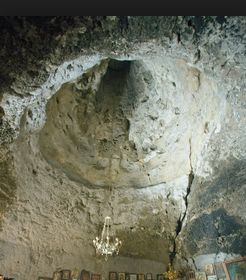
Five kilometres from the monastery, in the gorge of Martsalo, lies a church of the Panagia, the Mother of God. This cave church, the “Panagia Martsaliani”, is dedicated to the Annunciation – after an icon that was found in it: a shepherd is said to have come upon the forgotten sanctuary by chance, hidden beneath rocks, with the icon inside. It is remarkable for being hewn out of the rock in the shape of a cone, like a bread oven – a form so reminiscent of the Minoan vaulted tombs that the church is believed to occupy the site of one. Its depth is eight metres, its height to the crown of the dome ten metres, and the rock walls are covered with icons. The church can be reached only on foot; on 15 August, the feast of the Dormition, people come over in numbers from the Messara. A little over a kilometre further on, the gorge ends at a small beach.
During the revolt of 1866 to 1869 the Ottomans raided Martsalo in order to capture the abbot of the monastery – tradition calls him Georgios Gogolainis, from the province of Malevizi – and destroyed all the icons of the church. The two principal icons of the Virgin at Martsalo, “In Thee Rejoiceth” and “The Annunciation”, were painted by Ioannis Stathakis around 1867; they are now kept in the katholikon of Odigitria Monastery.
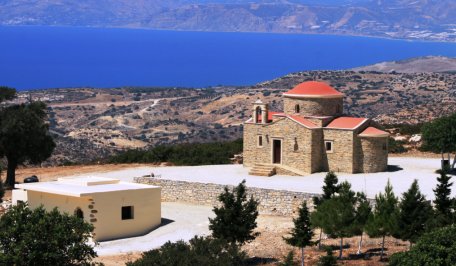
West of the monastery, a good kilometre away on the hill of Raxos and reached by an unsurfaced track, stands the handsome church of Saints Eftychios, Eftychianos and Kassiani. It was built on the ruins of an older place of worship dedicated to the same saints. Construction began early in 2008; on 8 May 2011 the church was consecrated and the place brought back to life as a convent. It is an expressive example of the contemporary neo-Byzantine architecture of the region.
The lives of the saints
According to legend the brothers Eftychios and Eftychianos performed their ascetic labours in this district. Their tomb gave the place its venerable name – “at the Saints” (stous Agious) – which marks the land as hallowed by their presence. Their sister Kassiani chose for her life of renunciation a cave in the steep rock face of Cape Lithino, or Kefali; it is now called the “Cave of Kassiani” or the “Cave of the Nun”.
From the beginning of the Christian era the district was home to many monks and hermits, who settled in its numerous caves. It is supposed that the Agioi Eftychianoi lived here during the period of Arab rule (827–961). On the same spot lie the remains of the church of a monastery that St John the Stranger (Ioannis Xenos), also known as St John the Hermit, founded in the 10th century in honour of the saints after he had discovered their graves. This monastery was apparently destroyed in the great Cretan War (1645–1669); its monks afterwards found refuge at Odigitria.
Eftychios was Bishop of Gortyn and Archbishop of Crete. He is said to have withdrawn into solitude because of the persecution of the Church, or to have been banished to the hill of Raxos, where he continued his ministry together with his brother, the monk Eftychianos. St Eftychianos suffered martyrdom near the village of Listaros, at the spot called “Manaria”, where a chapel of the Archangel Michael now stands. On the rock on which he was beheaded the imprints of his hand and of the axe are shown. Eftychios and Kassiani buried him in a cave, in which later, in accordance with his last wish, Eftychios himself was also laid to rest. Today this cave, with an arched tomb recess of the kind known as an arcosolium, serves as a chapel of Odigitria Monastery in honour of the three holy siblings; their feast is kept on 17 August.
The relics of the Agioi Eftychianoi are venerated in Odigitria Monastery. The grave of St Kassiani has never been found. Numerous traditions and tales have gathered about the place – among them stories of mysterious natural phenomena that are said to have prevented some seekers from reaching the cave of the saints.