The most complete guide to Crete: 221 places on the map, 23 routes and 49 articles — with photos, videos and the story behind every place. No sign-up, no trackers.
Routes drawn along real roads
Weather at every stop
Full-text search
“Near me” by geolocation
Create your own printable itinerary
Satellite, terrain, dark mode
Works offline
⌕
Searches 1.7 million characters of descriptions, not just names
—places
4regions
—routes
—with video
Search results
—
Interactive map
Find what is near you
Filters narrow the map and the list at once. Zoom out and pins group together.
Region
Category
Фильтры карты
Landmarks
Featured places
RegionCategory
Routes
Ready-made day trips
Individual places
Articles about landmarks
Lentas and ancient Lebena
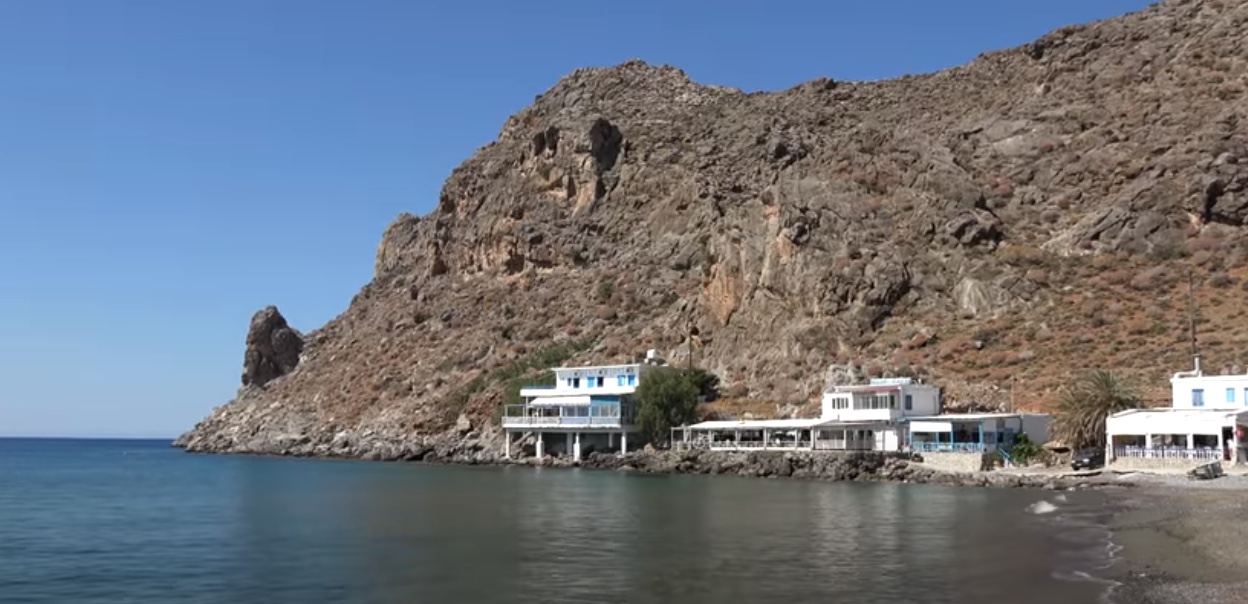
Lentas (Λέντας) lies some 74 kilometres south of Heraklion, beyond the bare ridges of the Asterousia Mountains, on a sheltered bay of the Libyan Sea. Two capes frame it: Cape Liontas, the Lion Cape, to the west and Cape Psamidomouri to the east. The road leaves the Messara Plain near Agii Deka, climbs to the mountain village of Miamou – to whose community Lentas belongs, within the municipality of Gortyn – and then drops in long hairpins to the sea, a narrow but surfaced road with wide views over the water all the way down. This is among the warmest and driest corners of Crete: the mean annual temperature is around 21 °C, barely 360 millimetres of rain fall in a year, and the climate is classed as semi-arid. Scarcely eighty people live here all year round – the census of 2011 recorded 79 inhabitants. Yet behind the modest row of houses along the shore lies a history that begins in prehistoric times and remains visible to this day in the ruins of ancient Lebena.
The name Lentas is bound up with the image of the lion. The western cape pushes out into the sea like an animal at rest, its head turned towards the south; a path leads up to its crest in about a quarter of an hour, and the view from there at sunset is the best in the bay. A local legend tells of one of the lions that drew the chariot of Rhea, mother of the gods: her anger turned it to stone on this spot. Another village tale has Cleopatra calling here and leaving three beasts behind to keep watch until her return – the lion of the cape, a crocodile at Cape Trafoulas to the east and an elephant at the small beach that bears its name. The ancient name of the town, Λεβήν (Leben, later Lebena), is thought by some scholars to be pre-Greek, perhaps Phoenician – a Semitic word for the lion, labi or lavi, which would likewise refer to the outline of the cape. Another reading derives it from a Phoenician word for “white” and has the pale rocks of the coast in mind. On Venetian sea charts of the 16th and 17th centuries the anchorage appears as “Leon”. Myth, landscape and linguistic memory have thus settled into a single name.
From Minoan settlement to harbour of Gortyn
The first traces of human life on the Lion Cape go back to the Neolithic; a settlement is securely attested in the Early Minoan period, between about 2600 and 2000 BC. To this era belong the circular vaulted tombs of the neighbourhood, at the sites of Papoura, Gerokampos and Zervou, which the Cretan archaeologist Stylianos Alexiou investigated between 1958 and 1960 and later published with Peter Warren. There are five in all – two at Papoura, two at Gerokampos, some three kilometres west of the village beside the coast road, and one at Zervou. The larger tomb at Gerokampos has an internal diameter of 5.15 metres and walls almost two metres thick, entered through a low doorway of three stone slabs only 60 centimetres wide; built in Early Minoan I, it stayed in use for centuries and held the remains of at least a thousand clay vessels. The tombs contained Cycladic figurines, stone vases, jewellery – more than 1,100 beads from Gerokampos alone – seals of ivory and steatite, bronze daggers, obsidian blades, clay models of animals and boats, and Egyptian scarabs: evidence that the people of this coast had connections across the sea as early as the third millennium. The finds are kept in the Archaeological Museum of Heraklion.
Later Lebena grew into the harbour and maritime trading station of Gortyn, one of the most powerful cities of Crete, which lay inland in the Messara. It was one of two ports that served the city, and through it the fertile plain was linked with the Libyan Sea, with Egypt, Cyrenaica and the islands of the Aegean. In Hellenistic and Roman times, however, the place owed its fame less to trade than to the sanctuary of Asklepios.
Lebena – sanctuary of Asklepios and place of healing
At the beginning of the 4th century BC the Gortynians established a sanctuary of Asklepios at a healing spring; the buildings visible today are dated by some scholars only to the 3rd and early 2nd centuries BC, and the temple in its present form belongs to a Roman rebuilding of the 1st or 2nd century AD. Pausanias reports that the cult reached Lebena from Balagrai in Cyrenaica, that is, from the African coast opposite. In Greek religion Asklepios was the god of the healing art, his daughter Hygieia the guardian of health and cleanliness; here she was worshipped with the epithet Soteira, the Saviour. The complex was laid out on an artificial terrace at the foot of the hill, about 200 metres from the shore, and comprised the temple, two colonnaded halls or stoas – the western one almost 27 metres long, the northern one added in the 2nd century BC – a treasury, and the spring with its nymphaeum; beside them lay rooms in which the sick and the pilgrims were lodged. They came from all over the Mediterranean and left votive inscriptions and offerings in memory of the help they had received.
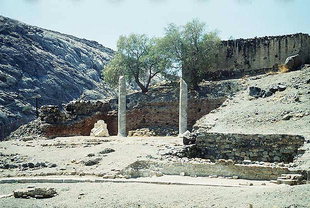
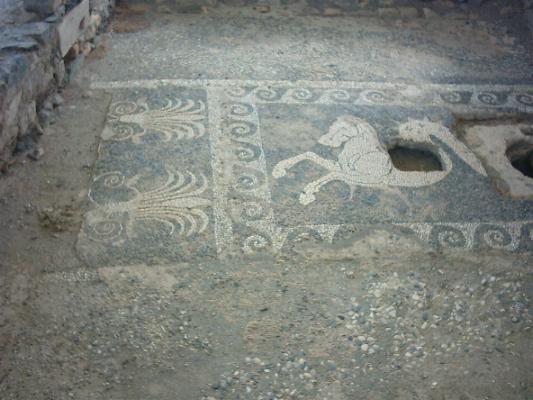
Parts of the cella of the temple still stand: brick walls, once faced with white marble and preserved to a height of up to 3.40 metres, together with two marble columns 4.70 metres high. The floor was paved with white marble slabs in the centre and bordered with mosaic. Against the west wall a marble podium some six metres long probably carried the cult statues of Asklepios and Hygieia. A broad marble staircase linked the terraces of the sanctuary. Most striking of all is the mosaic in the so-called treasury at the end of the west stoa, of the 3rd century BC: a sea-horse, a hippocamp, is set in black, white and red pebbles, surrounded by bands of running spirals, with palmettes in a second panel. Beneath the floor lay a shaft 1.90 metres deep, closed by a lid that could be locked, in which the offerings were kept. The water of the spring, which rises a few metres below the level of the nymphaeum, was led through terracotta pipes into the baths, where long basins of some 7.5 by 1.6 metres allowed patients to be immersed; a second supply came by a stone-built conduit from the spring of Kefalovrysa, four kilometres away.
Treatment at Lebena combined water, rest, medical applications and care for the patient’s state of mind. The sources mention rooms for the recovery of the body and a separate “psychiatrion” – literally a “place for the healing of the soul”. What is meant is not a psychiatric clinic in the modern sense but one element of the ancient idea of recovery as a whole, in which bodily health also depended on inner calm, on music, poetry, theatre and dance. The sanctuary was held to be especially good for complaints of the stomach and of the blood, and it remained in use, in one form or another, for the better part of a thousand years.
Accounts of cures of this kind survive at Lebena too, chiefly from the 2nd and 1st centuries BC. The best known is that of the Roman Publius Granius Rufus, who had suffered for two years from an unremitting cough and spat blood. The god prescribed him a course of treatment in which ritual instructions were combined with remedies made from rocket, iris and figs. Another inscription tells how the sacred spring once ran dry and was found again through a vision sent by the god. The writer Philostratus says in his Life of Apollonius of Tyana that all Crete flocked to Lebena as Asia flocked to Pergamon, and that many Libyans too crossed the sea to it. During that very visit, he adds, an earthquake shook the island and the sea drew back seven stadia – about 1.3 kilometres. An analysis carried out by the University of Thessaloniki in the 1950s described the spring water as slightly alkaline and of excellent taste; measurements earlier in the century had found it lukewarm, at about 22 °C, with sodium chloride as its principal mineral content.
Xenonas, earthquake and Roman rebuilding
Among the ruins the remains of the “xenonas”, the house for those who had travelled here, can be made out. The Greek word ξενώνας comes from ξένος, “stranger, guest”, and denotes a hostel for travellers; in modern Greek it is the word for small guesthouses and pensions. In about 46 or 47 BC a severe earthquake damaged the sanctuary and the buildings of the town. The Romans, who had ruled Crete since 67 BC and had made Gortyn the capital of their province, restored the complex and added baths, with mosaic-floored rooms for the wealthier patients. Under the emperors the sanctuary enjoyed its greatest prosperity – it seems to have served as a kind of sanatorium for well-to-do Romans from North Africa – and Lebena went on receiving the sick and the devout.
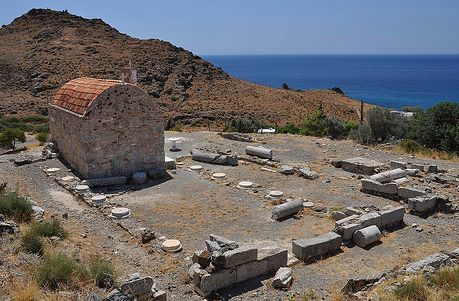
With the spread of Christianity the pagan sanctuary gradually lost its importance and in the end served as a quarry. The stone and marble of the dismantled buildings were used for an Early Christian basilica, a three-aisled church with a narthex and a timber roof, built in the 5th century and rebuilt after damage in the 6th; its remains, like the fragments of the ancient healing complex, can be seen on the excavation site. In the 14th century the small church of Agios Ioannis Theologos, St John the Divine, was built into its ruins, with pieces of ancient column embedded in its walls. The town itself probably fell into final decay in the 7th and 8th centuries, when the south coast of Crete lay defenceless before the raids of pirates.
The ruins were first noted in the mid-19th century by the British naval surveyor Captain T. A. B. Spratt. The sanctuary was first examined scientifically in 1900 by the Italian archaeologist Federico Halbherr, and the Italian Archaeological School returned for further campaigns in 1910 and 1912–13. Among Halbherr’s finds were statues of Asklepios and Hygieia, which were later lost. During the German occupation in the Second World War the remaining columns, according to local accounts, suffered serious damage.
Lentas today
Today Lentas keeps the character both of a quiet seaside village and of a place of archaeological memory. A wide protected zone around the ancient remains prevents the village from growing – and to that it owes its peace. Beach, bay and rocky cape make it easy to see why the old image of the lion has lasted so long, and the ruins of Lebena, on the slope immediately above the houses, are a reminder that the harbour of Gortyn and one of the best-known healing sanctuaries of Crete once stood here. A walk along the shore brings landscape, traces of the ancient town and the Early Christian basilica into view side by side – different ages of the same stretch of the south Cretan coast. The village is also a convenient base for walks in the Asterousia, whose summits rise to 1,231 metres at Kofinas.
Those who stay will find tavernas and simple rooms in the village, on a beach of sand and fine shingle where the water is shallow and usually calm. West of the Lion Cape, about a kilometre away, lies the long beach of Dytikos, also called Diskos, shaded by tamarisks and served by a few tavernas, where people have camped and bathed naked for decades; it is open to the west wind, which can raise heavy surf and makes the seabed shelve abruptly. Five kilometres to the east the bay of Loutra opens, with a small fishing harbour, reached past the coves of Petrakis and Tsigounas. On the beaches round about the loggerhead turtle (Caretta caretta) lays its eggs between May and September – the nests are protected and should not be disturbed.