The most complete guide to Crete: 221 places on the map, 23 routes and 49 articles — with photos, videos and the story behind every place. Everything is open and free: no sign-up, no paid sections and no advertising, open or hidden. You can install the guide on your smartphone as an app.
Routes drawn along real roads
Weather at every stop
Full-text search
“Near me” by geolocation
Create your own printable itinerary
Satellite, terrain, dark mode
Works offline
⌕
Searches 1.7 million characters of descriptions, not just names
—places
4regions
—routes
—with video
Search results
—
Interactive map
Find what is near you
Filters narrow the map and the list at once. Zoom out and pins group together.
Region
Category
Фильтры карты
Landmarks
Featured places
RegionCategory
Routes
Ready-made day trips
Individual places
Articles about landmarks
Anyone driving to Phaistos should make a point of stopping at Gortyn, and anyone bound for Gortyn should not leave out Phaistos. Yet the city repays the journey on its own account. It lies some 45 kilometres south of Heraklion and about a kilometre from the village of Agii Deka, on either side of the main road that runs down into the Messara and on towards Phaistos and Matala, and its ruins straggle far beyond the fenced enclosure into the olive groves. The remains are spread over an area roughly two kilometres across, which makes this the largest archaeological site in Crete; much of it has never been dug, and exploring what lies outside the fence is long, hot walking in summer.
Myth and early history
Gortyn (Γόρτυνα, in antiquity Γόρτυς) looks back on a history that runs from the Minoan age to late antiquity.
Of the two brothers of Minos, Rhadamanthys and Sarpedon, legend has it that Rhadamanthys was given the city of Phaistos to rule, while Sarpedon – like his brothers a son of Zeus and Europa – received Gortyn.
There is another version of the myth, for which the geographer Strabo is usually cited: according to this the city was built by Gortys, a son of Sarpedon, and named after him. Other ancient voices made this Gortys a son of Rhadamanthys, and the Arcadians claimed him as a hero from Tegea – a tradition recorded by Pausanias, who has the first settlers come from that Peloponnesian town. Older names have come down to us as well: Larissa, Kremnia and Hellotis, the last of them an epithet of Europa.
Be that as it may, tradition holds that Gortyn was already a powerful, labyrinthine city in Minoan times, akin in its layout to Knossos and Phaistos. In the age of the Old Palaces it is said to have had no walls – a sign that for centuries it knew no outside enemies and lived peaceably alongside the other cities of Crete. After the devastating earthquake of c. 1700 BC it is supposed to have been rebuilt at once and to have gone on growing, and after the eruption of the Santorini volcano and the tidal wave that followed it recovered, so the story goes, as quickly as Knossos and Phaistos. What archaeology can actually vouch for in this early period is more modest: occupation of the citadel hill from the Neolithic onwards, and a Minoan country house at Kannia, south of the village of Mitropoli. In the Bronze Age the place seems to have been a small settlement in the shadow of the palace at Phaistos. A new settlement was founded on the hilltop around 1050 BC, and from the Geometric period, in the 8th century BC, the city proper spread down from the citadel into the plain; an agora was laid out in the 6th century. Homer already knows Gortyn as “walled”: it appears in the Catalogue of Ships in the second book of the Iliad, and in the Odyssey part of Menelaus’ fleet is driven onto the coast near the city on the voyage home from Troy.
The city grew so strong that it subjugated Phaistos and took over its trading harbours. The final destruction of Phaistos is dated to the middle of the 2nd century BC, around 150, but by the 3rd century BC Gortyn already controlled Matala and Lebena. That century was not untroubled – during the Lyttian War of about 220 BC the citizens fell out among themselves over which alliance to join – but the city emerged from it as mistress of south-central Crete and on excellent terms with Ptolemy IV of Egypt. Even so, Gortyn was not the first city of Crete in Minoan or Classical Greek times, though it always held the rank of an important regional centre and counted, with Knossos, among the two most powerful communities on the island.
Capital of Roman Crete
Gortyn had struck up friendly relations with Rome while the wars between the Cretan cities were still going on; in 189 BC even Hannibal is said to have taken refuge here for a short time. When the Cretan cities joined forces against the Roman conquest in the years 69 to 67 BC – the campaign led by Quintus Caecilius Metellus, thereafter surnamed Creticus – Gortyn stood aside, sided with the invader and so escaped destruction. As a reward for this – or, more probably, for geopolitical reasons – a decision was taken in 27 BC that settled the city’s fate for centuries.
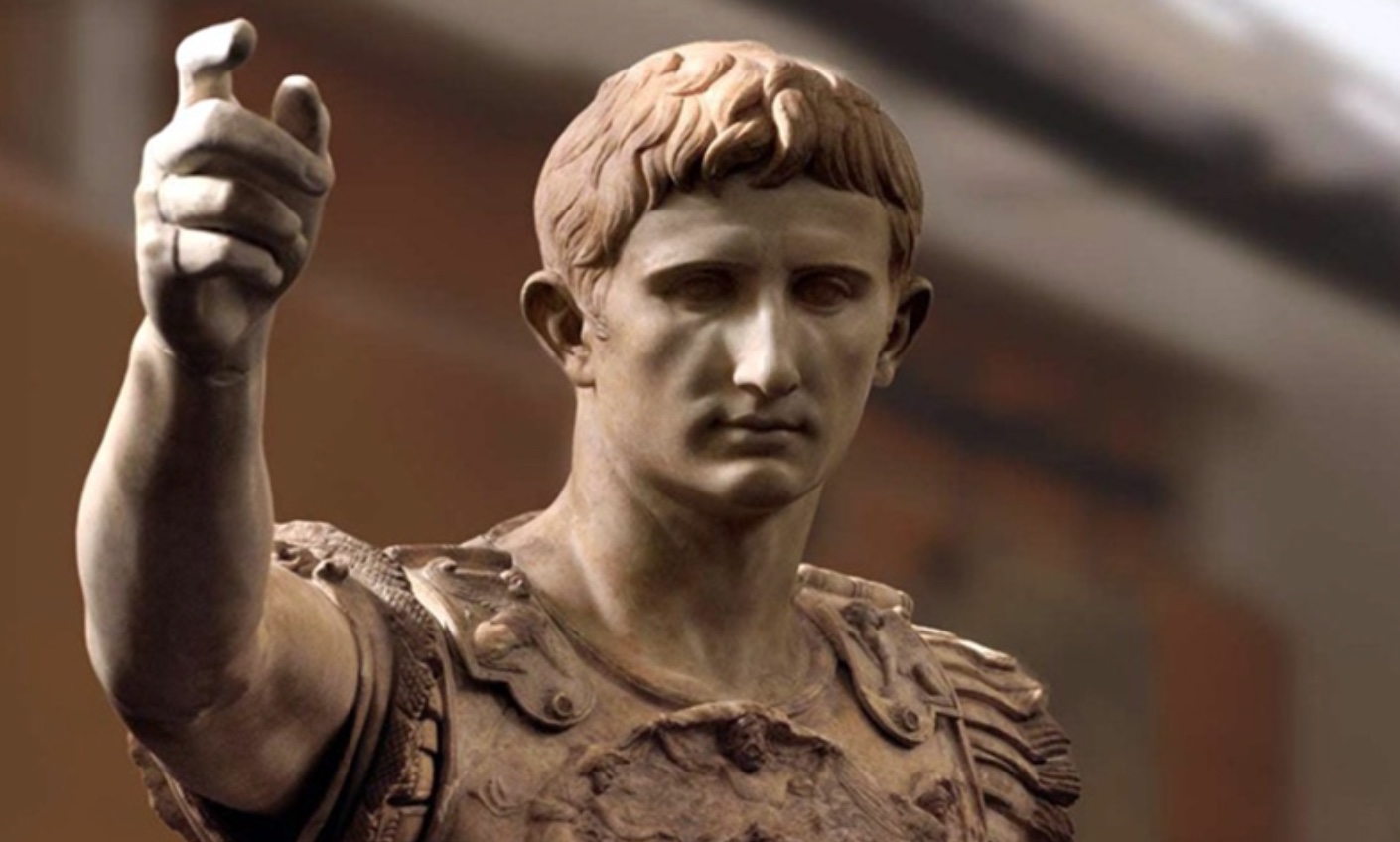
The emperor Augustus chose Gortyn as capital of the senatorial province of Crete and Cyrene (Creta et Cyrenae), headed by a proconsul with a quaestor at his side. This arrangement lasted until about AD 295; after Diocletian’s reform Gortyn became capital of a separate province of Crete. It also remained the seat of the Koinon, the league of Cretan cities.
The harbour towns on the Libyan Sea – Matala, Lasaia and Lebena – became hubs of the trade between the East, North Africa and Rome. For Gortyn a new period of prosperity began, in its economy and in its building alike; merchants and wealthy landowners from every part of the empire settled here. Under these new conditions it was the first city in Crete to be Romanised, and it was Romanised quickly and thoroughly.
The new requirements soon led to the city being remodelled on the Roman pattern. It reached its height between the reign of Hadrian and the early Severan period, that is in the 2nd and 3rd centuries AD. For this period a population of 50,000 to 60,000 is assumed, and the urban area covered about 4,000 stremmata, or roughly 400 hectares. The city spread east and south, acquired a new street grid, temples, theatres, baths, aqueducts and a racecourse – a hippodrome described as unique in Greece – together with an amphitheatre, and so took on the character of a great Roman city. Trajan’s name is attached to two of the principal buildings, the Odeon and the governor’s headquarters. Imposing public buildings such as the so-called Praetorium complex served not merely the administration but, above all, to set the greatness of Rome before people’s eyes. The portraits found here tell the same story: heads of Tiberius, Caligula, Hadrian, Antoninus Pius and Marcus Aurelius are among the Gortyn sculptures now in museums.
From pagan to Christian Gortyn
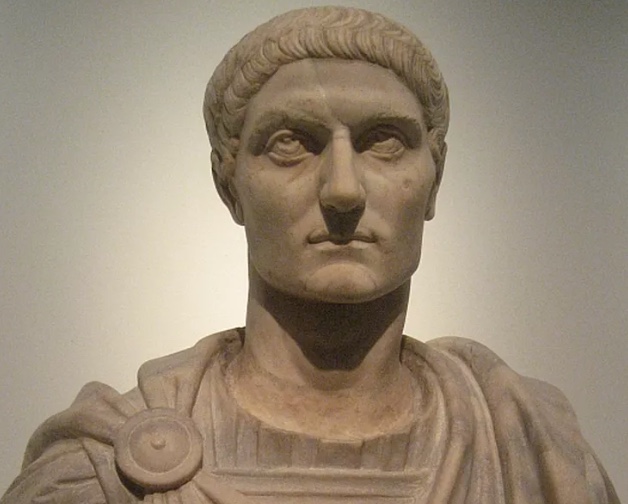
Two events usher in the next era: the agreement of Milan in AD 313, which put an end to the persecutions and favoured the spread of Christianity, and a decision taken by Constantine the Great.
In AD 324 Constantine moved the capital of the empire from Rome to Byzantion, the old Greek colony on the Bosphorus, which was renamed Constantinople in his honour. With this begins the transformation of the Roman Empire from a pagan to a Christian civilisation. The Christian phase of the empire is what modern historians call Byzantium – a term the Middle Ages themselves did not know.
Crete’s favoured position in the middle of the eastern Mediterranean made the island an important staging post for trade to and from the new capital. After Diocletian’s reform at the end of the 3rd century Gortyn remained capital of Crete, and it evidently kept that position until the Arab conquest of the island in the years 823 to 828. At the same time the tradition of the Church was at work, according to which the Apostle Paul and his disciple Titus, who is regarded as founder and first bishop of the Church of Crete, preached the Gospel here; Gortyn is accordingly reckoned the first Cretan city to have received the new faith. As early as about AD 250, under the emperor Decius, ten Christians are said to have suffered martyrdom at Gortyn – in the city’s amphitheatre, according to the tradition. These are the Agii Deka, the Ten Saints, who gave the neighbouring village its name.
This apostolic tradition secured Gortyn its precedence and made it the metropolis of the Church of Crete – the Greek word means “mother city” – where the metropolitan had his seat. One of its 2nd-century bishops, Philip of Gortyn, is also remembered by name. To this day the village on the southern side of the ancient city is called Mitropoli.
Rebuilding after the earthquake of 365
The severe earthquake that struck Crete in AD 365 did great damage in most of the ancient cities, Gortyn among them.
So that the city might survive and rise again, the emperors granted supplies of food and money. In the course of the 5th century, however, the work of reconstruction was interrupted by fresh disasters. Together with the reorganisation of the imperial administration from the 4th century onwards, and with the religious needs that arose as Christian worship gradually prevailed and took organised form, this led to far-reaching changes in the face of the city. The old cult places, the theatres and the agora were given up one after another; residential quarters grew up on the public land thus released, and parts of the old street grid were taken over by Christian places of worship. On the citadel the 7th-century BC temple of Athena Poliouchos was turned into a church in the 6th century. Gradually the heart of the city came to beat further west, in the district where the great Christian monuments were built – among them, at present-day Mitropoli, a five-aisled episcopal church that ranked among the largest basilicas in Crete.
The 6th century, and especially the reign of Justinian the Great, emperor of the Christian Roman Empire, was for Crete a time of prosperity and general renewal; building went on at Gortyn right through the centuries from the 4th to the 9th. In spite of repeated earthquakes in the 7th and 8th centuries, in spite of the waves of plague and the social and economic upheavals, most of the ancient cities managed to survive. Under the emperor Heraclius, in the 7th century, Gortyn was even given its most extensive circuit of fortifications.
The finds from the so-called Byzantine Quarter show that even after the destructive 7th-century earthquake – it is usually placed around the year 670 – Gortyn had strength enough to keep its workshops going and to import goods from Carthage, Alexandria, Syria and Palestine, North Africa, Asia Minor and Cyprus.
From North Africa came above all fine tableware, often of considerable size, with a glossy red surface and stamped decoration of the kind that is characteristic of the potteries there. To this may be added amphorae covering the period from the 5th to the 8th century. They prove that the exchange of goods continued even when the Byzantine provinces of North Africa had already fallen into Arab hands.
Decline and the transfer of the capital to Chandax (Heraklion)
The economic and demographic consequences of the earthquakes, and the insecurity caused by the Arab raids, which began around the middle of the 7th century and grew more frequent in the 8th, forced the inhabitants of the cities to seek safety in fortified places that were hard to reach. The part of Gortyn that lay in the plain was abandoned, and the few remaining inhabitants withdrew to the fortified acropolis.
In AD 823 the Arabs, led by Abu Hafs Omar, landed on the island, according to local tradition in the neighbourhood of Keratokambos on the south coast, and conquered it step by step by 828. Gortyn was destroyed and never lived in again. When the Byzantine general and future emperor Nikephoros Phokas liberated Crete in 961, its former greatness was already gone. The Arab interlude had revealed the strategic vulnerability of Crete’s south coast and shown the advantages of another town’s position: Chandax, today’s Heraklion, to which the capital of the island was transferred. So ended the best part of a thousand years in which Gortyn had been capital of Crete.
Today Gortyn is among the most instructive archaeological sites on the island, because nearly every period of Cretan history is represented here. The city has been investigated since 1884, chiefly by the Italian Archaeological School at Athens, which has been digging systematically since 1898. The whole of the ancient urban area stretches from the hill of Agios Ioannis in the north to the villages of Agii Deka in the east and Mitropoli in the south; only a small part north of the road, with the basilica of St Titus, the Odeon and the law code, is fenced and open to visitors on payment of an entrance fee. The same enclosure has a small sculpture gallery with statues from the excavations. The monuments south of the road lie scattered among the olives and are for the most part fenced off, to be looked at from outside; finding one’s way between them takes patience. What there is to see is described below.
The Great Inscription: the law code of Gortyn
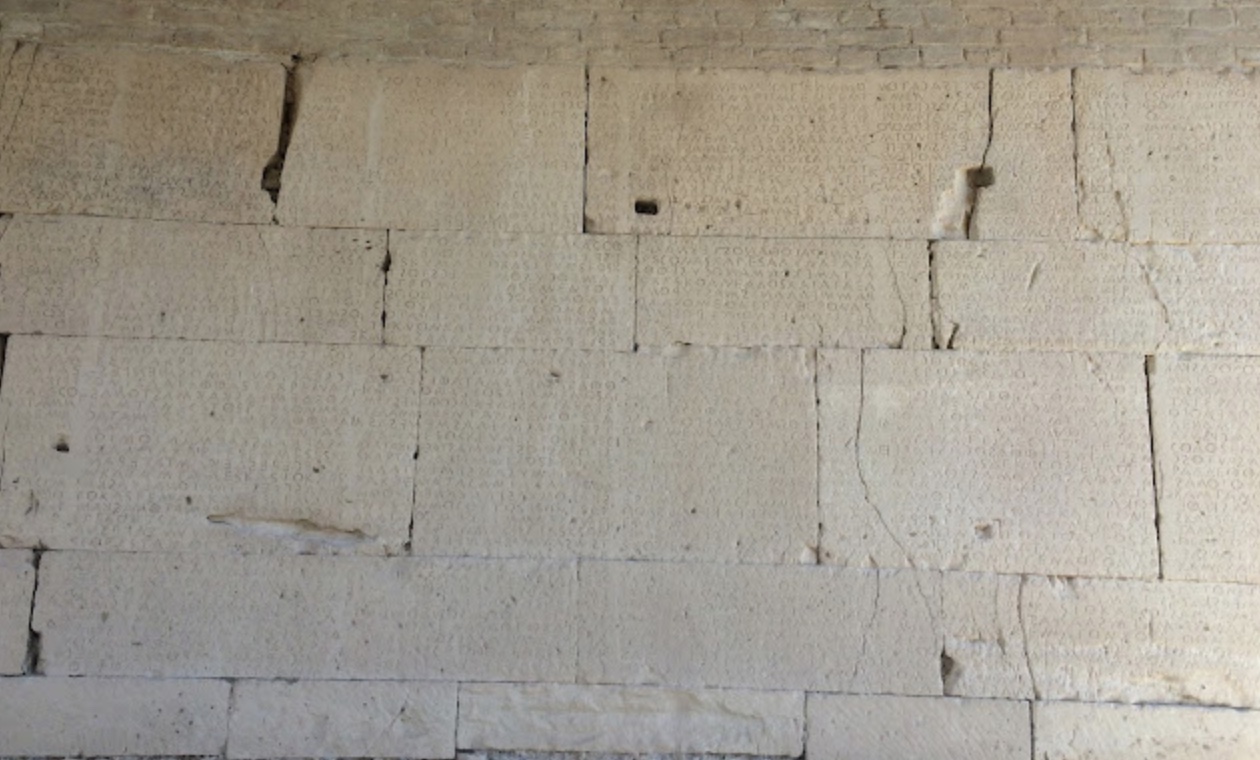
Built into a wall near the theatre – more precisely, in the area of the later Odeon, where a mill channel cut through the ancient remains – was a slab covered with letters. Scholars deciphered it and recognised in it individual laws of the city of Gortyn from the 5th century BC. The protracted search for the missing parts of this body of law would furnish the plot of a detective novel. The first block was discovered in 1857 by French travellers, Georges Perrot and Louis Thenon, in the wall of a watermill; it went to the Louvre. In 1879 Bernard Haussoullier found a further fragment, and in 1884 the Italian Federico Halbherr and the German Ernst Fabricius, assisted by the Cretan scholar Stefanos Xanthoudidis, came upon the bulk of the text after farmers from Agii Deka, digging for building stone, had uncovered inscribed blocks – first four columns beside the mill, then the remaining eight. Greek and foreign archaeologists alike have taken part in the excavation of Gortyn ever since.
In the end, a good two decades after the first find, twelve columns had been brought together – which is why the Greeks speak of the “Dodekadeltos”, the inscription of the twelve tablets. It contains provisions of family and property law, together with articles regulating the public life of the city-state. Of what were once some 640 lines, a good 600 survive, all cut by a single mason. The stones belonged originally to a circular building about 30 metres in diameter. In the 1st century AD the Romans carefully took the blocks of this older rotunda over into the rear wall of their Odeon; there the inscription still stands, some nine metres wide and a metre and a half high, beneath a protective brick vault put up by the Greek Archaeological Service in 1889, only a few years after the discovery. It is the longest ancient Greek inscription in existence bar one, that of Diogenes of Oenoanda. What is remarkable is that these laws provide for neither the death penalty nor imprisonment as a punishment; accordingly there were no prisons either, and the code expressly forbids seizing a person before trial. Offences were dealt with by fines, the amount of which depended on the status of those involved – free citizen, serf, slave or foreigner. A slave who assaulted a free person paid most, a free man who wronged a slave least. It may of course be that the relevant tablets have simply not come down to us.
Some provisions from the law of Gortyn
If there is a dispute as to whether a person is free or a slave, those who testify that he is free shall prevail.
If a man is caught in adultery with a free woman in the house of her father, her brother or her husband, he shall pay a hundred staters, but if elsewhere, fifty. (It is the man, not the woman, who is fined.)
If a husband and wife divorce, the wife shall keep what was her own, which she had when she came to her husband, and in addition half of the produce, if her property yields any, half of whatever she has woven, if there is anything, and five staters if the husband is to blame for the divorce.
If a woman who was given in marriage by her father or brother becomes an heiress and does not wish to remain married to the man to whom she was given, although he wishes to continue the marriage, then, if she has children, she shall receive the share of the property due to her under the law and be free to marry another.
The basilica of St Titus in brief
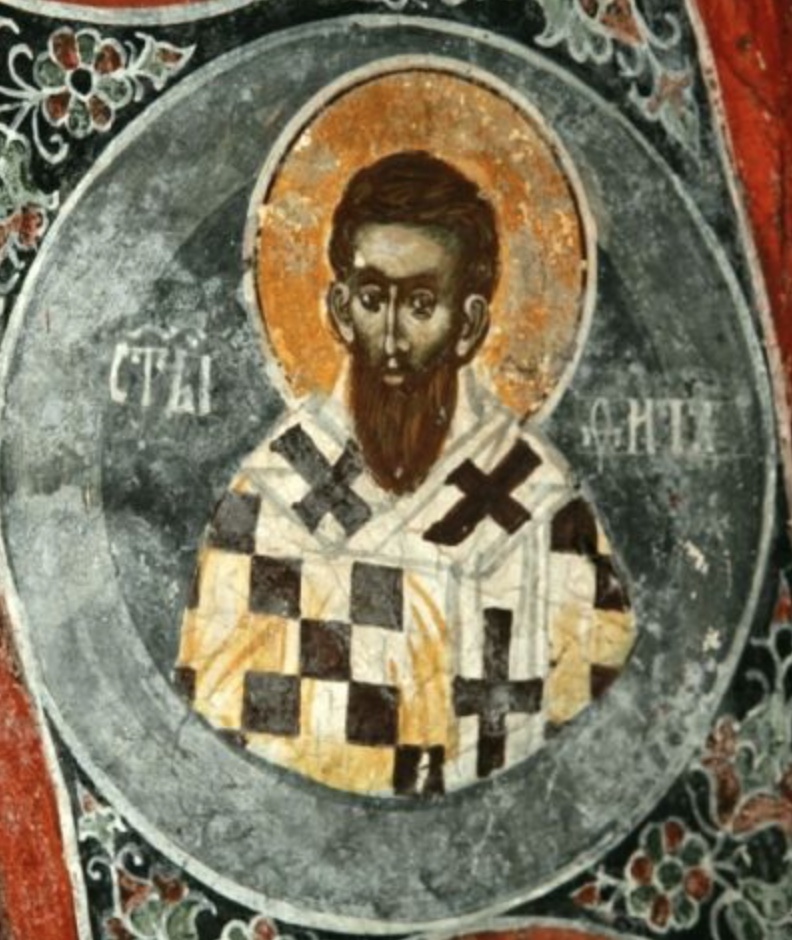
The basilica of St Titus (Agios Titos) goes back to the 6th century and was rebuilt after an earthquake at the end of the 8th century. St Titus, one of the Seventy, disciple of the Apostle Paul and first bishop of Crete, is said by tradition to have been born on the island and to have died here too, at Gortyn, at the very end of the 1st century or the beginning of the 2nd. It is to him that the Epistle to Titus, part of the New Testament, is addressed.
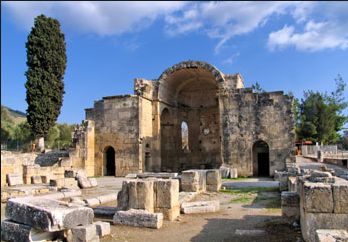
In the courtyard of the basilica stand marble sarcophagi that were intended for clergy. Of the building itself it is chiefly the east end with the sanctuary – the bema and the two side chambers, the pastophoria – that rises almost to its full height, in large, squared blocks of stone: one of the most striking sights that early Christianity has left in Crete.
The church in closer detail
The church of St Titus stands in the part of the site that is open to visitors, on the spot once occupied by the Hellenistic and Roman agora and not far from the ruins of the Roman Odeon. It was excavated in 1900 by Giuseppe Gerola and in 1901 by Stefanos Xanthoudidis – the same Cretan scholar who had helped to recover the law code – and published in 1926 by Anastasios Orlandos. The singular architecture of the monument, and the lack of reliable stratigraphic evidence from those first investigations, led to its being regarded as an architectural special case and dated now to the age of Justinian, now to the end of the 6th century, to the 7th or the 8th, and even to the 10th; some accounts still describe it as a 10th-century church over a 7th-century predecessor. Even the connection with the Apostle Titus was disputed: it was proposed that the building was the katholikon of a monastery of the Mother of God of Blachernae, founded by Archbishop Andrew of Crete in the first half of the 8th century.
Only the fresh investigations carried out in the course of the restoration and presentation of the monument, which the 13th Ephorate of Antiquities in Heraklion undertook between 2013 and 2015 under the direction of its ephor, Vasiliki Sythiakaki, have settled the open questions of interpretation. It turned out that the domed church was built on the foundations of an Early Byzantine three-aisled basilica of the 6th century, which remained in use into the 8th. The position of this basilica on the old agora, where Titus may first have preached, and its considerable distance from the other Christian buildings of the city – the episcopal church lay away to the south, at Mitropoli – are taken as evidence that this was the site of the martyrion of Titus, the memorial of his witness and his teaching at Gortyn.
The successor building rose on the foundations of the first after the devastating earthquake of 795, which razed the city to the ground, and it was already in use before the Arab invasion (823–828). That it was the only building in the lower city to be put up anew from the foundations underlines how much it meant to the inhabitants. Every piece of usable material from the ruined Roman and Christian monuments went into it, marble from the nearby theatre included. Even so, the building was carefully planned, as befitted its standing. This is shown by its transitional type, which attempts to fit a cross-in-square, domed church into the ground plan of a three-aisled basilica, with the dome carried on four piers, and by the dignified façades of large squared blocks, which imitate the pseudo-isodomic ashlar masonry of the splendid Roman buildings whose ruins were then still standing upright.
The cruciform core is crowned by a dome; three apses close it to the east, and two smaller ones end the arms of the cross to north and south; a narthex divided into three, to which five doors led from the courtyard, lay on the west. What stands to roof height today is the sanctuary – the bema with its flanking pastophoria. The complexity of the construction; the forms that point to a martyrion – the triconch sanctuary and the triconch core of the cross; the use of the building as a place of burial; the successive layers of wall decoration; the rich architectural sculpture; the many Byzantine donations; the alterations of the Venetian period; and its unbroken use as a place of worship since Early Byzantine times: all these are weighty testimony to the connection of the monument with the founder of the Cretan Church, the Apostle Titus.
Paul, Titus and Gortyn
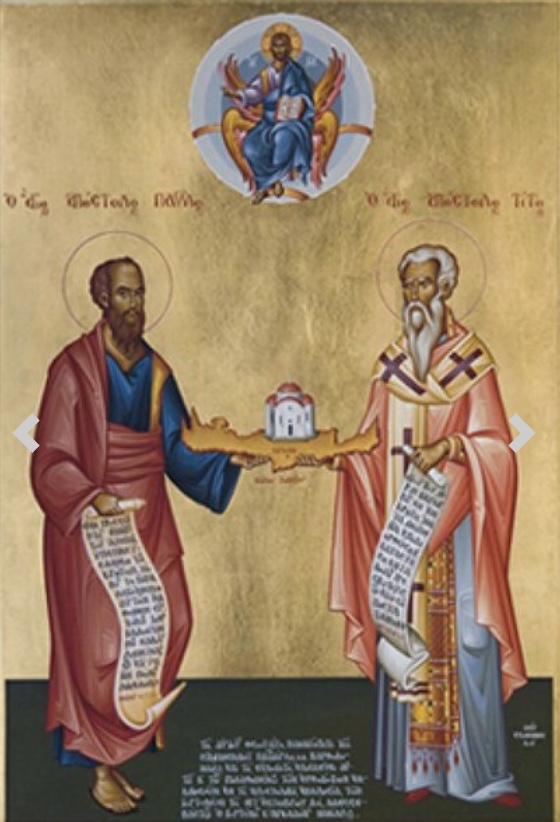
Tradition links Gortyn with the Apostle Paul. He came to know the island when the ship that was carrying him to Rome as a prisoner, around AD 59, was forced to seek shelter at Kali Limenes (“Good Harbours”) on the south coast, not far from Gortyn; the Acts of the Apostles tell the story. According to the Epistle to Titus in the New Testament, Paul later returned to Crete to preach the word of God and left his disciple Titus behind to set the congregations in order and to appoint elders in every city (Titus 1:5). Titus is therefore regarded as the first bishop of the Church of Crete and is venerated as the island’s patron saint. According to tradition he was buried at Gortyn, from where his relics were later translated to Chandax, today’s Heraklion. This link with the apostolic tradition was the reason why Gortyn was raised to the rank of a metropolitan see, a “mother city”.
From the Epistle of Paul the Apostle to Titus
My son Titus: “(2:11) For the grace of God that bringeth salvation hath appeared to all men, (2:12) teaching us that, denying ungodliness and worldly lusts, we should live soberly, righteously, and godly, in this present world; (2:13) looking for that blessed hope, and the glorious appearing of the great God and our Saviour Jesus Christ; (2:14) who gave himself for us, that he might redeem us from all iniquity, and purify unto himself a peculiar people, zealous of good works. (3:4) But after that the kindness and love of God our Saviour toward man appeared, (3:5) not by works of righteousness which we have done, but according to his mercy he saved us, by the washing of regeneration, and renewing of the Holy Ghost; (3:6) which he shed on us abundantly through Jesus Christ our Saviour; (3:7) that being justified by his grace, we should be made heirs according to the hope of eternal life.” (Titus 2:11–14; 3:4–7, King James Version)
In more detail: the life of the Apostle Titus
Titus, one of the Seventy, came according to this tradition from the island of Crete and was the son of distinguished pagan parents. As a young man he devoted himself closely to Greek philosophy and the ancient poets. For all his learning he led a virtuous life and did not give himself up to the vices and passions that were common to most pagans; he preserved his virginity, as the holy martyr-bishop Ignatius of Antioch, the “God-bearer”, testifies of him. For the sake of such a life God did not leave him without help. At the age of twenty Titus heard in a dream a voice urging him to abandon the wisdom of the Hellenes, which brings the soul no salvation, and to seek that which saves. He waited a further year to see whether such a summons would come to him again – and indeed he was directed to acquaint himself with the teaching of the prophets of God. The first thing that came into his hands to read was the Book of the Prophet Isaiah. Opening it at the forty-first chapter, he was struck by words that seemed to have been spoken about the state of his own soul.
When word reached Crete of a great prophet who had appeared in Palestine, and of his miracles, the governor of the island, who was Titus’s uncle by blood, sent his nephew there. That prophet was the Lord Jesus Christ himself, made man of the Virgin Mary and come into the world to redeem the human race from the burden of original sin. In Jerusalem Titus saw the Lord, heard him preach and came to believe. He was a witness of the Saviour’s Passion on the Cross and of his death, of his glorious Resurrection and of his Ascension. On the day of Pentecost the future apostle stood in the crowd and heard the Twelve, after the descent of the Holy Spirit, speaking in various tongues, among them the language of the Cretans (Acts 2:11).
Titus received baptism from the Apostle Paul, whose closest disciple he became; he is generally believed to have been a Gentile and Paul’s own convert. He accompanied Paul on his missionary journeys, repeatedly carried out his commissions in the newly founded congregations – the Epistles to the Corinthians name him as the go-between who was sent from Ephesus to Corinth in the mid-50s to settle the quarrels there, rejoined Paul in Macedonia with good news, and afterwards organised the collection for the Christians of Jerusalem – and was with him in Jerusalem at the council of AD 48–49. Titus was numbered among the Seventy Apostles and consecrated bishop of Crete by Paul. Around the year 65, shortly before his second imprisonment, Paul addressed a pastoral letter to his chosen one (Titus 1–3). When the Apostle was taken to Rome as a prisoner to stand before the emperor’s tribunal, Titus left his Cretan flock for a time and went to Rome to serve his spiritual father. After Paul’s martyrdom he returned to the capital of Crete, to Gortyn.
Titus governed his flock with wisdom and laboured to enlighten the pagans with the light of the Christian faith. The gift of miracles, it is said, was granted to him. At a pagan festival in honour of the goddess Artemis – the Diana of the Romans – he preached before a great crowd. Seeing that they would not listen to him, he prayed that the Lord himself would show those who had gone astray the vanity of idols; whereupon the image of the goddess fell before the eyes of all and shattered. On another occasion he prayed that the Lord would not allow the completion of a temple of Zeus that was under construction, and the building collapsed upon itself. By such signs he brought many to faith in Christ. Having enlightened the surrounding lands as well, he fell asleep in peace at the great age of ninety-four; before his death his face shone like the sun. His death at Gortyn is placed in AD 96 or 107; the New Testament does not record it.
The head of the Apostle is kept in Heraklion, the present capital of Crete, in the church of Agios Titos. When the Ottomans took the city in 1669, the Venetians carried the relic away to Venice; only in 1966, after almost three centuries, did it return home, and the skull is venerated there to this day. The saint’s feast day, 25 August, is celebrated by the Church of Crete with particular solemnity – in Heraklion and in the ruins of his basilica at Gortyn alike. The Orthodox calendar remembers him again on 4 January, and the Western Church on 26 January.
The Odeon of Gortyn
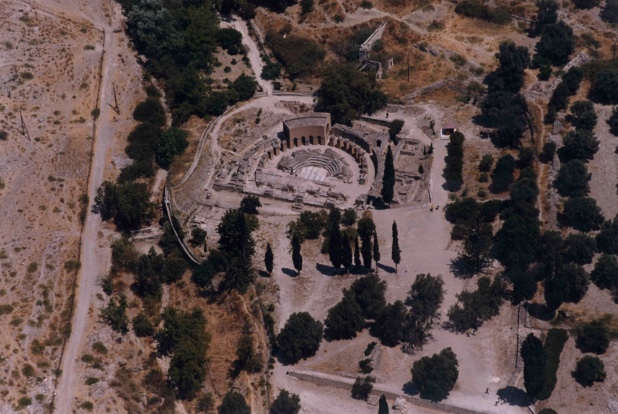
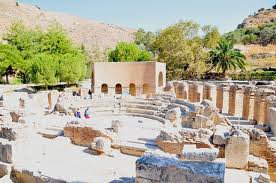
To the right of the church of St Titus, a few steps to the north, stands the well-preserved Roman Odeon, which is considered the most important of its kind in Crete. It is sometimes assigned to the 1st century BC; in its present form it belongs to the 1st century AD, was restored under Trajan after earthquake damage, and was repaired several more times down to the 4th century. It has marble tiers of seats, of which three rows survive, and a raised, rectangular stage building, once roofed, with three entrances, niches for marble statues and a mosaic floor with a geometric pattern. The almost semicircular orchestra, about 8.5 metres across, is paved with slabs of white and bluish marble. The auditorium rested on a vaulted ambulatory, the outer wall of which was articulated by eighteen arches; two entrances lay on the north side. The arches, the seating and the outline of the stage can all still be clearly made out.
The Odeon was put up on the site of an older building, whose marble and ashlar served as building material – according to the excavators a place of assembly of Classical and Hellenistic date, a rotunda some 30 metres across. From it come the blocks bearing the Great Inscription, which the Roman builders set into the curved north wall and which can still be read there today, under a protective structure of brick. From the 6th century the building was no longer used as a theatre; graves were dug in the area of the stage.
The Great Theatre of Gortyn
The Great Theatre lies on the south-eastern slope of the hill of Agios Ioannis, the acropolis, west of the excavation area open to visitors and on the far side of the stream bed. It is the oldest of the city’s theatres. Its uncovering began in the summer of 2011 under a programme agreement for cultural development between the Ministry of Culture and Sports and the Region of Crete, which finances the research; the work is carried out by the Ephorate of Antiquities of Heraklion. European travellers who visited the district from the 16th century onwards knew the monument, but their descriptions differ considerably from the picture that is now gradually emerging. Before work began, the outline of the upper auditorium was barely discernible, and everything else lay under a fill several metres deep. After intensive work in three excavation seasons (2011, 2012 and 2014–2015) the greater part of the auditorium and the orchestra had been exposed, together with a considerable part of the stage building and a section of a structure east of the stage whose function and possible connection with the theatre have still to be clarified. Since 2020, when a second agreement was signed for the completion of the excavation and the restoration of the monument, the investigations have been directed at the southern entrance passage, the parodos.
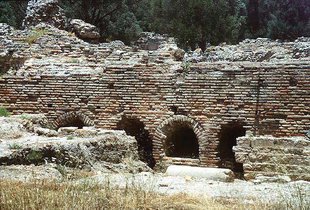
The theatre ranks among the large Roman theatres: its greatest diameter is about 93 metres, and its capacity is estimated at some 7,500 spectators. In later times it was thoroughly exploited as a quarry; tellingly, the seats and stairways of the middle and upper tiers are almost entirely missing, as is the original paving of the orchestra. Two ambulatories divide the auditorium into a lower, a middle and an upper tier; at the edge of the uppermost tier, remains suggest a roofed promenade. The substructure of the tiers consists of vaulted walls, laid out radially and concentrically, which form covered chambers and carry the rows of seats. In the lower tier a few seats still lie in their original position. The two surviving ambulatories were at first covered and led the audience to their tiers; above them ran open gangways, the diazomata, by which the higher rows were reached. That the approaches from outside to the orchestra were vaulted too is shown by voussoirs found at the presumed position of the northern parodos.
The orchestra is slightly horseshoe-shaped and measures about 20 metres in diameter. At its edge a strip of marble floor some 0.90 metres wide was found, made of rectangular slabs alternating with square ones, some of them reused. The front of the stage is articulated by alternately rectangular and semicircular plastered niches; its greatest height is estimated at 1.5 metres. Of the stage area only part of the central section has so far been uncovered. The acting floor, the proskenion, has collapsed: it originally rested on cross vaults, which in turn were carried by stone piers dressed to a prismatic shape. In the middle of the complex, below the level of the acting floor, a covered room came to light which probably connected the space beneath the stage with the stage building.
On the stage lay an extensive destruction layer with countless architectural members of various kinds of marble and of grey granite, and with sculptures that had fallen from the stage building. Their quantity and variety point to a show façade of at least two storeys. In the southern part of the stage a kiln was installed at a later date; around it and inside it were found fragments of sculpture and architectural members already half burnt to lime. This burning of lime from the marble of the theatre is presumably connected with the rebuilding of the neighbouring church of St Titus at the end of the 8th century. According to the excavation evidence the site of the theatre was used once more at the end of the Early Byzantine period, in the 7th and 8th centuries; this is attested by remains of buildings, pottery and coins of Byzantine emperors.
In the covered room beneath the stage stood a four-sided marble altar or base with a visible height of at least 1.20 metres, decorated with Erotes in relief at the corners and a garland on each face. It bears a dedicatory inscription to the emperor Domitian (AD 81–96), whose name was chiselled out because the Senate, soon after his assassination in 96, officially condemned his memory (damnatio memoriae). The inscription shows that the theatre was already in operation in the last quarter of the 1st century AD. A similar, smaller piece was found in the orchestra of the so-called Roman Theatre of Gortyn at the locality of Kazinedes and has been interpreted as a thymele, the altar of the orchestra. In every area examined so far numerous fragments of sculpture have come to light; their number and the types recognised make it plain that stage and auditorium alike were richly furnished with statuary. Some are already on display in the Archaeological Museum of the Messara, with which the theatre is eventually to be linked as a further part of the ancient city open to visitors. In the long term the theatre is to be restored far enough to accommodate cultural events.
The plane tree of Europa
Behind the Odeon, at the back of the enclosure, grows a venerable plane tree around which the myth has twined itself. In its shade, the story goes, Europa lay with Zeus, who had appeared to her in the form of a magnificent bull and carried her across the sea from the Phoenician coast to Crete; from this union came three sons, Minos, Rhadamanthys and Sarpedon. One peculiarity of the tree is astonishing and yet perfectly real: it is evergreen and does not shed its leaves in winter, unlike ordinary planes – ever since that day, says the legend. Theophrastus and Pliny already mention the plane tree of Gortyn that keeps its leaves; botanists know this rare form of the Oriental plane, Platanus orientalis var. cretica, from only about fifty trees scattered across Crete, among them specimens at Azogires in the far south-west, at Vori, Vryses and Fodele. The tree is protected as a natural monument, as is its fellow at Azogires. It is not, in truth, a giant: planes renew themselves readily from the root, and what one sees is the latest growth of a very old stock. On the island the belief persists that its leaves help childless couples to a son, and people used to pick them for that purpose. This is the very plane that is shown on the coins of Gortyn, with Europa sitting pensively in its branches – a sign of how nearly she was honoured here as a goddess.
The temple of Apollo Pythios
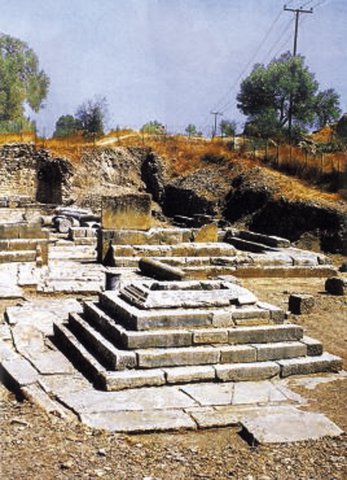
South of the road, in the middle of the olive groves and some 600 metres from the agora, lies the Pythion, the principal sanctuary of the city until Christianity prevailed. Archaeologists place the building of this temple in the 7th century BC; Federico Halbherr uncovered it in 1887. The earliest structure was a plain, roughly square room with a treasury, its roof carried on four wooden supports. Over the centuries it was enlarged and altered many times: in the Hellenistic period a monumental porch was added, in Roman times colonnades in the interior and an apse for the cult statue of Apollo; to the west of it a small theatre was built. Finally, in the 6th century, the church of St Titus is said to have been built from its marble, while houses and water conduits spread across the abandoned precinct. What remains of the pre-Christian sanctuary is therefore chiefly the impressive stepped altar in front of the façade and the inscriptions cut into the ashlar blocks – laws and treaties of the city, older still than the Great Inscription and dated to between about 600 and 525 BC, which makes them the earliest layer of Gortyn’s written law.
The sanctuary of the Egyptian gods
This sanctuary, a few steps north of the Pythion, was founded, it is thought, in the 4th century BC and was dedicated to Isis, Serapis and Anubis; in the form in which it survives it dates, as a dedicatory inscription attests, from the 1st to 2nd century AD. It is the only one of its kind on the whole island, although the worship of these gods was widespread in Crete from the 4th century BC to the 1st century AD. The architecture is noteworthy: a rectangular cult room with a colonnade on the west and three niches in the rear wall, in the middle one of which stood the image of Serapis, flanked by Isis and Hermes-Anubis; on the south side a concealed underground crypt with a small basin for the ritual purifications; on the east side, outside the walls of the cult room, a large cistern. The marble statues of the gods no longer stand in their places – what was recovered of them has gone to the museum, where a 2nd-century group of Isis and Serapis in the guise of Persephone and Pluto is among the sculptures from Gortyn.
The baths
In the course of the excavations the archaeologists uncovered several bathing rooms with water at different temperatures, from the hot caldarium by way of the tepid tepidarium to the cold frigidarium, together with a hall for company and entertainment and ancillary rooms. One set of baths belongs to the Praetorium and may have been the governor’s own; another stood near the agora and the temple of Apollo. The baths meant a great deal to the Romans: people met there, concluded business, and looked after their bodies and their social connections at the same time. The establishments were supplied by the aqueducts that brought water from the springs at the foot of Psiloritis near Zaros – a few of the arches still stand – and by large reservoirs such as the Nymphaeum immediately north of the Praetorium, at first an open fountain house lined with marble and adorned with statues of nymphs, which in the 7th century was converted into a vaulted cistern. The high technical standard of the baths of Gortyn, the capital, makes them the spas of their day.
The Praetorium
In the block bounded by the West Street and the North Street arose the complex of the so-called Praetorium, the largest in the ancient city. It probably served as the official seat and residence of the Roman governor and was altered many times in the course of some eight centuries; first laid out in the 1st century AD, as we see it now it is in essentials a building of the 2nd century – begun, it seems, under Trajan – and was repaired in the 4th century, after the great earthquake. At its core was a colonnaded court of about a thousand square metres, surrounded by large halls with marble floors, columns and statues. The western part, between the Hellenistic stadium and the West Street, was used for the administration; here lay a basilical hall, three-aisled in its 4th-century form, in which justice was dispensed. The stadium, converted into a gymnasium, remained in use until the 3rd century AD and was then rebuilt as a bath complex. In the vacant eastern part a temple to the deified emperors, the Augusti, was put up in the 1st century AD. Into it was incorporated an older monumental altar, perhaps of the 4th century BC, which according to the surviving inscription was dedicated to the Most High God, Theos Hypsistos. The complex remained inhabited until the Arab conquest and housed a monastery in the Middle Byzantine period. Excavation here is still going on.
The acropolis
The acropolis lay on the hill of Agios Ioannis, west of the stream. The excavations have shown that the first traces of human presence go back to the Neolithic; the 6th millennium BC is the date usually given. The superimposed cultural layers bear witness to a history of several thousand years, and many valuable finds were recovered, which are kept in the archaeological museum near Agii Deka, now the Museum of the Messara, and in Heraklion. The fortification with its polygonal circuit wall and corner towers is dated to the period from the 10th to the 6th century BC, and was strengthened again in the 7th century AD, when raiders threatened from the sea. Inside it stood an Archaic temple, built in the 7th century BC and dedicated to Athena Poliouchos, protectress of the city; from it come relief plaques of goddesses in the stiff, frontal Daedalic style and a clay figure of Athena of about 660–650 BC. In the 6th century AD an Early Christian basilica took its place. Sadly, only scant remains of the buildings on the hill survive. The climb is worth making all the same: the view extends over the Messara Plain as far as the gulf of the same name, and at one’s feet, almost hidden by olive trees, lies the whole extent of the former capital.