The most complete guide to Crete: 221 places on the map, 23 routes and 49 articles — with photos, videos and the story behind every place. Everything is open and free: no sign-up, no paid sections and no advertising, open or hidden. You can install the guide on your smartphone as an app.
Routes drawn along real roads
Weather at every stop
Full-text search
“Near me” by geolocation
Create your own printable itinerary
Satellite, terrain, dark mode
Works offline
⌕
Searches 1.7 million characters of descriptions, not just names
—places
4regions
—routes
—with video
Search results
—
Interactive map
Find what is near you
Filters narrow the map and the list at once. Zoom out and pins group together.
Region
Category
Фильтры карты
Landmarks
Featured places
RegionCategory
Routes
Ready-made day trips
Individual places
Articles about landmarks
Zaros and the springs of Psiloritis
Zaros (Ζαρός) lies some 45 kilometres south-west of Heraklion and 12 kilometres from Moires, at about 340 metres at the foot of the southern slopes of Psiloritis, the Ida range, and is among the greenest villages of inland Crete. About 2,000 people live here – the census of 2021 counted 1,740 – in a landscape of orchards, olive groves, plane trees and streams. The name of the place points to its wealth of water: the Greek derivation traces it to “za” (much) and “reo” (to flow), a place, that is, where water runs in plenty. The springs of Votomos and Mati feed the gardens, fields and watercourses of the neighbourhood, and to them Zaros owed its standing over the centuries as one of the principal settlements of the Cretan interior. They still earn it a living: the water is bottled here and sold all over the island, alongside the olive oil, sultanas, citrus fruit and vegetables of the valley.
The fertile, well-watered valley has been settled since antiquity. A Minoan settlement has been identified near Kourtes, and remains of a Roman aqueduct – they can be seen at the spot called Sterna, in the mouth of the gorge – recall that spring water from this district was once carried all the way to Gortyn, capital of the Roman province of Crete and Cyrene. By 1583 the Venetian census recorded 266 inhabitants, and the watermills for which the village is known have been turning since the 16th century.
Lake Votomos
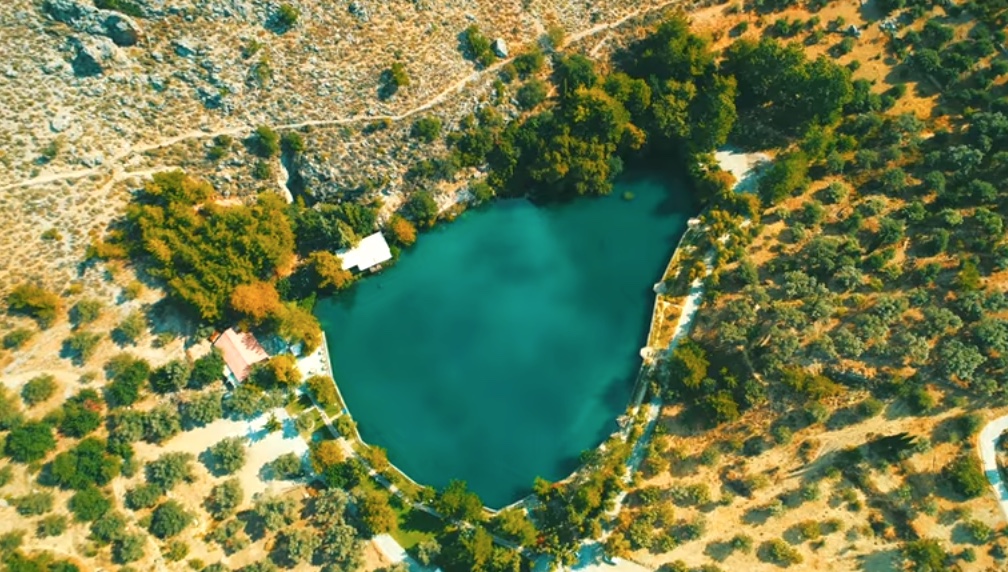
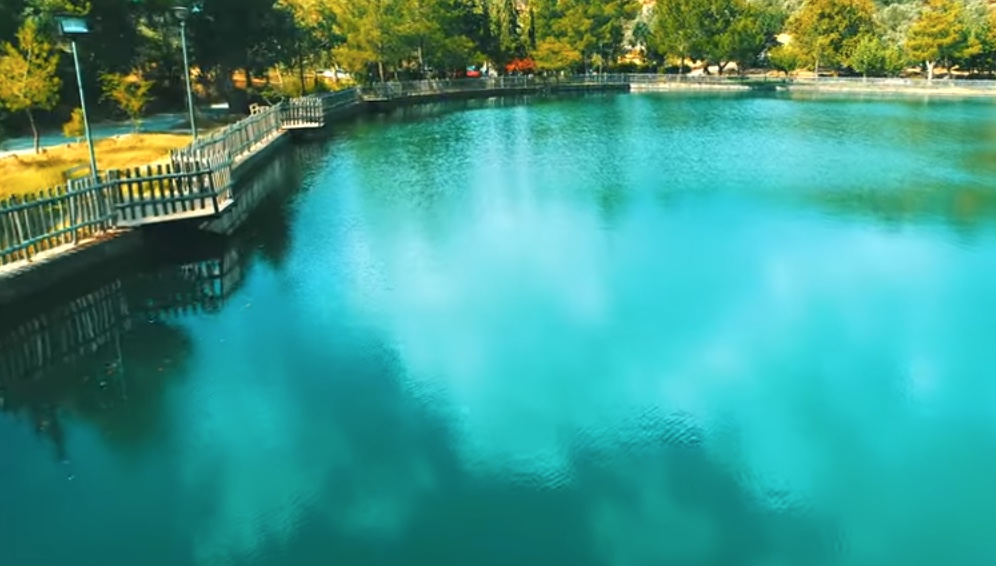
Until the late 1980s there was only a small wetland at the basin of the Votomos spring. In 1987 the Forest Service had the ground laid out and a small reservoir made to hold back the water of the spring. So what had been a marshy corner became one of the best-known places for an outing in the south of Crete: a path round the water, old plane trees, a café-taverna, benches, picnic tables and a playground, and the view of wooded slopes mirrored in the lake.
There are tavernas and coffee houses on the shore, and the local speciality is the trout and rainbow trout raised, together with salmon, in tanks near the springs. One can stroll round the lake at leisure, sit by the water and then carry on along the path into the gorge of Agios Nikolaos. Swans, geese and ducks live on the lake, so that the walk feels more like an encounter with nature than a mere tourist sight. The circuit is level and short, well suited to families with children and to older visitors; the mood is at its best in the early morning and towards evening, when the day trippers are absent. The lake can be reached by car from the village, and buses run to Zaros from Heraklion.
The path to the Rouvas gorge
From the lake a made path leads into the gorge of Agios Nikolaos, reaching after about twenty minutes the monastery of St Nicholas from which it takes its name. It runs between plane trees and rocky slopes, crossing the stream now and again, and ends at one of the few surviving evergreen-oak forests in Greece, the forest of Rouvas (Ρουβάς), where a chapel of St John stands among the kermes oaks. The stretch is about five kilometres long and takes around two and a half hours in normal conditions; those who go on through the forest to the chapel should allow four hours and more for some ten kilometres. It belongs to the network of local mountain paths and is linked with the long-distance path E4, which crosses Psiloritis.
Churches and history of Zaros
Not far away, between Zaros and Vorizia at 550 metres, lies the monastery of St Anthony, known from the period of Venetian rule. This is Vrontisi (Vrontisio), first among the notable monasteries of the district, whose name is linked with the school of painting of the 15th century: its two-aisled church, dedicated to St Anthony and to St Thomas, keeps fragments of 14th-century frescoes, a marble fountain of the 15th century carved with Adam and Eve and the four rivers of Eden stands at the gate, and the six icons that Michael Damaskinos painted for it are now in the museum of St Catherine in Heraklion. In 1866 it served Michail Korakas as a headquarters. The others are the monastery of Agios Nikolaos and that of Varsamonero at Vorizia, of which only the church survives, with frescoes painted between the mid-14th and the mid-15th century and a cult of St Fanourios. They bear witness to the rich religious tradition of the district. In Zaros itself old churches – St Nicholas has kept its wall paintings – watermills and traces of channels fed by the mountain springs have survived; most of the mills still standing were built in the mid-19th century, and the last one in working order is at Kato Votomos. Local museums display church vessels, vestments, Byzantine icons and manuscript books, and a museum of folklore and geology opened in 2014 shows more than 350 kinds of rock and fossil; a visit to Zaros is therefore more than a walk by the lake.
The village also has its place in the more recent cultural history of Crete: the writer Giorgos Iatromanolakis was born here, and it figures in James Aldridge’s wartime novel The Sea Eagle of 1944. Archaeological sites of the Minoan and Roman periods are known in the neighbourhood, and the water of the spring of Sterna and the remains of the Roman aqueduct recall the district’s link with ancient Gortyn. About seven kilometres to the west, moreover, lies the reservoir of Faneromeni, which at about 1,000 stremmata (roughly 100 hectares) is a good deal larger than Lake Votomos. Zaros brings together walking country, rural life, archaeology and monastic heritage in a single mountain setting.