Idaean Cave (Idaion Antron) – the sanctuary of Zeus on Psiloritis
The most complete guide to Crete: 221 places on the map, 23 routes and 49 articles — with photos, videos and the story behind every place. Everything is open and free: no sign-up, no paid sections and no advertising, open or hidden. You can install the guide on your smartphone as an app.
Routes drawn along real roads
Weather at every stop
Full-text search
“Near me” by geolocation
Create your own printable itinerary
Satellite, terrain, dark mode
Works offline
⌕
Searches 1.7 million characters of descriptions, not just names
—places
4regions
—routes
—with video
Search results
—
Interactive map
Find what is near you
Filters narrow the map and the list at once. Zoom out and pins group together.
Region
Category
Фильтры карты
Landmarks
Featured places
RegionCategory
Routes
Ready-made day trips
Individual places
Articles about landmarks
The Idaean Cave – the sanctuary of Zeus on Psiloritis
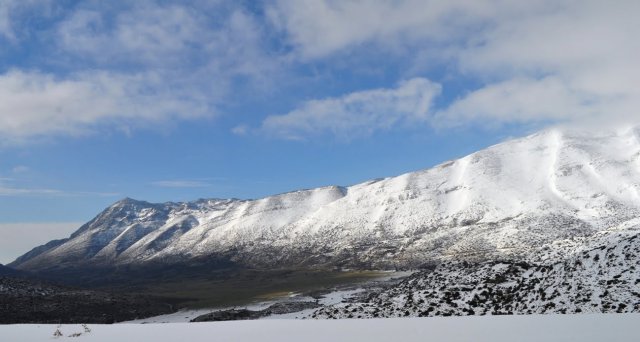
Crete has two caves associated with the birth and upbringing of Zeus: the Dictaean and the Idaean. The Idaean Cave, the Idaion Antron (Ιδαίον Άντρον), lies a few dozen metres above the Nida plateau on the eastern slope of Psiloritis, the ancient Ida, about 20 kilometres from Anogeia, at 1,498 metres above sea level. Locally the cave is known as Spiliara, or the “Cave of the Shepherdess” (Spiliara tis Voskopoulas), after a tradition that a lady of rank was buried here; another local story links it with Charidemos, the Cretan prince of Vitsentzos Kornaros’ verse romance Erotokritos. Ancient sources also give the name Arkesion Antron, which is derived from arkesis, “succour”. The cave was already famous in the earliest Greek literature: in the eighth book of the Iliad Homer speaks of Zeus’ precinct and fragrant altar on Ida, and Apollonius of Rhodes has Aphrodite recall the cave where the infant god was nursed by Adrasteia.
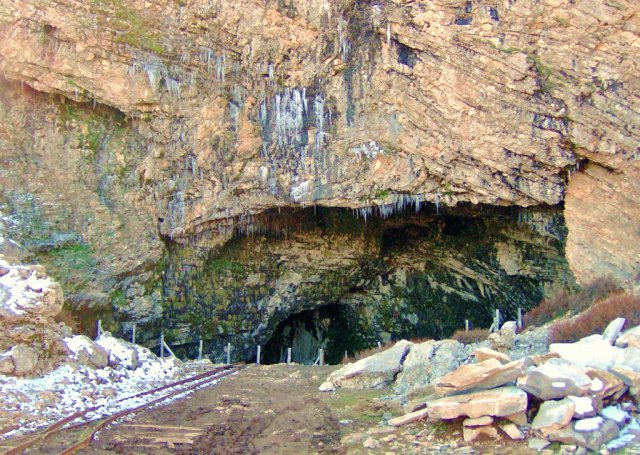
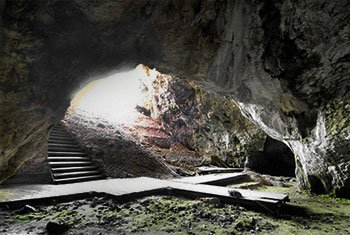
The entrance is a wide rock portal open to the east. From there the floor slopes gently down into the main hall, which measures about 40 by 50 metres; in all the cave covers some 800 square metres. The archaeologists distinguish a central hall, a northern and a southern chamber, and a northern recess, the “adyton”, with a side passage a good twenty metres long. There is little in the way of stalactite decoration – three large stalactites by the entrance are the exception; the cave follows a fault in the folded platy limestone, and its effect depends on the space itself and on the high mountain landscape in front of the portal.
Cave and archaeological sanctuary
The Idaion Antron is not merely a natural cavity in the mountain but one of the most important cult places of Minoan and ancient Greek Crete. Research has demonstrated a human presence since the 4th millennium BC, in the Late Neolithic – at first, presumably, shepherds seeking shelter. The earliest evidence of cult belongs to the 2nd millennium, and by the 15th century BC the cave was already a place of worship of some standing; the object of veneration was then probably a youthful vegetation god who dies and is reborn each year, the so-called Cretan Zeus, whose place the Olympian Zeus later took. The sanctuary was most heavily frequented in the Geometric and Archaic periods, between the 10th and the 6th centuries BC, and saw a revival in Hellenistic and Roman times. In front of the entrance there still stands a rectangular altar hewn from the living rock.
In and around the cave were found bronze shields of the 8th and 7th centuries BC, weapons, vessels, fragments of tripod cauldrons, lamps (especially numerous from the Roman period), coins, seals, jewellery, necklaces of semi-precious stones and gold miniature vases, together with work in ivory, faience, rock crystal, glass, bone and clay. The hammered and engraved shields are among the masterpieces of early Cretan bronze-work; the most famous, a tympanon, shows a god striding over animals between figures beating drums, and is interpreted as Zeus among the Kouretes. Some of the ivories come from North Syrian workshops, and a terracotta pelike depicts the birth of Zeus himself. Many of the pieces are kept in the Archaeological Museum of Heraklion. Their variety shows that pilgrims climbed to the sanctuary from different parts of Crete and from the wider Greek world. Below the cave an ancient building has been partly uncovered, which probably served the running of the sanctuary.
The myth of Rhea, Kronos and the infant Zeus
According to the myth, Kronos feared the prophecy of Gaia and Uranos that his own son would overthrow him, and so swallowed the children of Rhea as soon as they were born: Hestia, Demeter, Hera, Hades and Poseidon. When Rhea was expecting Zeus she came to Crete and hid the child from Kronos. In one of the old versions she gave birth to him in the Dictaean Cave and then entrusted him to the nymphs and the Kouretes, who belong to the mountains of Ida; the nymphs are named as Adrasteia and Ida.
Amaltheia suckled the infant with her milk – tradition also names the nymph Melissa, who fed him honey – and the Kouretes guarded him and drowned his crying by striking their spears and swords against their shields. Rhea, meanwhile, wrapped a stone in swaddling clothes and handed it to Kronos in place of the child. This episode explains the central image of the Idaean sanctuary: in the myth the din of the armed dance becomes the means of protecting the divine child.
Zeus, the birth of the Olympian order and the Cretan hymn
Grown to manhood, Zeus rose against Kronos and forced him to disgorge the children he had swallowed. After his victory over his father he divided the rule of the world with Poseidon and Hades and became the supreme Olympian god. In the Idaean tradition this myth binds the mountain landscape of Crete to the story of the birth of a new divine order. To it belongs King Minos too, who is said to have climbed every nine years to the cave of his father to renew the laws; Plato sets the conversation of his “Laws” on this very road from Knossos to the cave of Zeus, with an Athenian stranger walking in the company of a Cretan and a Spartan.
In later cult practice noisy armed dances were performed in honour of Gaia and Idaean Zeus. The participants moved with shields and weapons and set the rhythm with their blows; such scenes are known from ancient written sources as well. The cave was also the seat of mysteries whose content the initiates kept secret: Pythagoras is said to have been initiated here and to have described the altar as a throne of the god, and the Cretan seer Epimenides is likewise linked with the cave. In the Cretan dances of today certain features of archaic movement can still be recognised – the rhythm, the circling, the hard stamping and the bond between the dance and the festival of the community.
The Idaean Cave today
The cave lies in a harsh high-mountain zone, so a visit has to be planned with an eye to the weather, the snow and the state of the road up to the Nida plateau. The asphalt road from Anogeia ends at a car park on the edge of the plateau; from there a broad path climbs to the portal in about twenty minutes. Snow can lie in the entrance until well into spring, and even in summer it is cool and windy up here, so a jacket and proper footwear are advisable whatever the season. The interior is accessible without a guide, but the floor drops away steeply; the rails of the small excavation railway survive from the years of the dig. The road up from Anogeia passes the Minoan site of Zominthos, and the plateau itself is dotted with the mitata, the drystone shepherds’ huts of the Psiloritis pastures. Today the Idaion Antron is at once an archaeological monument, the seat of an immemorial cult and part of the natural landscape of Psiloritis. Its significance is not to be found in any single episode of the myth, but in the concord of archaeological finds, ancient texts and the living memory of Crete.