Anogeia – mountain village, culture and the memory of resistance
The most complete guide to Crete: 221 places on the map, 23 routes and 49 articles — with photos, videos and the story behind every place. Everything is open and free: no sign-up, no paid sections and no advertising, open or hidden. You can install the guide on your smartphone as an app.
Routes drawn along real roads
Weather at every stop
Full-text search
“Near me” by geolocation
Create your own printable itinerary
Satellite, terrain, dark mode
Works offline
⌕
Searches 1.7 million characters of descriptions, not just names
—places
4regions
—routes
—with video
Search results
—
Interactive map
Find what is near you
Filters narrow the map and the list at once. Zoom out and pins group together.
Region
Category
Фильтры карты
Landmarks
Featured places
RegionCategory
Routes
Ready-made day trips
Individual places
Articles about landmarks
Anogeia – mountain settlements on Psiloritis
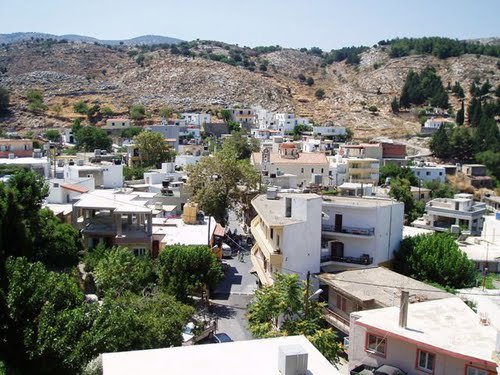
Anogeia (Ανώγεια) is not one compact village but a group of quarters and settlements on the northern flank of Psiloritis, at an altitude of roughly 740 to 750 metres, a good 35 kilometres west of Heraklion and about 55 kilometres from Rethymno. The name means something like “the upland”. Anogeia comprises Perachori, Armi, Metochi, Mesochoria and Synoikismos, and the municipality, which stretches over more than a hundred square kilometres of mountain, counted 2,240 inhabitants at the 2021 census. The division into quarters mirrors the history of a mountain community: houses and lanes climb the slope, and squares, fountains and churches each form a separate focus of daily life.
In the lower part, Perachori, stand the church of the Dormition of the Virgin, fountains and centuries-old plane trees; here people sit in the kafenia on the square, and outside the shops hang the woven blankets and embroideries for which the women of Anogeia are known. Higher up lie Armi and Metochi; in Metochi are the church of Agios Dimitrios and the open-air “Nikos Xylouris” theatre, which seats 1,500. In summer it is the setting for festivals of folk music, dance and drama that draw performers from all over Crete; a further gathering devoted to Cretan tradition, the Yakinthia, is held each July high above the village on the edge of the Nida plateau.
The history of Anogeia up to the 20th century
Anogeia has existed for at least a thousand years. After the Byzantine emperor Nikephoros Phokas had won Crete back in the 10th century, the settlements on the slopes of Psiloritis passed into the hands of noble families close to the imperial administration. The Venetian chronicles likewise mention prosperous settlements under the common name of Anogeia. Local tradition, for its part, traces the place back to emigrants from nearby Axos, which is why it was long called “Axika Anogia”.
The mountain community has suffered three great destructions: the Ottoman assault of 1822 under Sherif Pasha, who found the village deserted, its men away fighting in the Messara, and put it to the torch; the burning of 1867 after the uprising of 1866; and its annihilation by German troops in 1944. Between these catastrophes the inhabitants rebuilt houses, churches and livelihoods again and again. The history of Anogeia is therefore not only a history of destruction but just as much one of unremitting reconstruction.
The church of St John the Baptist
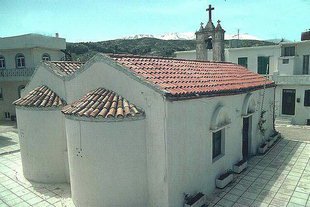
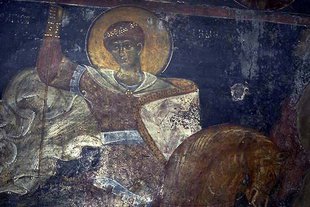
In the Armi quarter stands the two-aisled church of St John the Baptist and the Presentation of the Virgin. The south aisle is dedicated to the Baptist, the north aisle to the feast of the Presentation of the Virgin in the Temple. The surviving frescoes date from the 14th century and show scenes from the life of Christ, the Passion, the life of the Baptist and figures of saints. Best known is the image of the Virgin Glykophilousa, “she who kisses sweetly”, holding the Child against her cheek; in Anogeia she is called Paramythia, the Comforter.
Anogeia in the years of the German occupation
In the Second World War the people of Anogeia supported the Cretan resistance; a committee for liberation was formed here as early as 1941, armed groups took shape in the village and British liaison officers found shelter in it. At the end of April 1944 the party that had abducted the German general Heinrich Kreipe passed through on its way over the mountains to the south coast. In August came further provocations: on the 7th villagers attacked a German detachment and freed the hostages it had taken, a German sergeant was killed, and on the 8th partisans ambushed a German column at Damasta, leaving some thirty soldiers dead. All this served as the grounds for the brutal order to wipe out the village.
On 13 August 1944 the German commander of Fortress Crete, General Friedrich-Wilhelm Müller, issued the order to raze Anogeia to the ground and to execute every man found in the village itself or within a radius of one kilometre. The order explicitly cited Anogeia as a centre of British espionage, the Damasta sabotage as having been launched from here, and the passage of Kreipe’s abductors through the village. Three regiments are said to have taken part in the operation, some two thousand men in all, who ringed the village and posted pickets on the surrounding heights. Destruction and looting went on until 5 September, twenty-three days: houses, schools and cheese dairies were set alight and dynamited, three churches were used as stables, the livestock was driven off, and the inhabitants who had escaped into the mountains were hunted down. Of the 940 houses, noted Nikos Kazantzakis, who visited the place a year later, not a single one had been left standing.
The church of St John the Baptist survived the devastation and kept its paintings; it is thus one of the most important witnesses to pre-war Anogeia. Most of the population – some 2,500 women and children among them – had been able to get away in time to neighbouring villages and the high pastures, but the old and infirm who had stayed behind were killed, several of them burnt in their homes; for the occupation years as a whole the community records more than a hundred dead. Müller himself was tried by a Greek court after the war and shot in May 1947. The memory of the dead and of the destruction is kept alive in monuments – the order is carved in stone on the square in front of the town hall – and in annual commemorations on 13 August.
Reconstruction and recognition
After the war Anogeia was built anew. The new houses took on a modern appearance, yet the place kept its division into quarters, its fountains, churches and squares. For the part its people played in the struggle against the German occupation Anogeia was awarded the War Cross, First Class, in 1947, at that time the highest military decoration in Greece.
Today the music and theatre festivals continue, tavernas and cultural associations are busy, and on feast days lyra, songs and mantinades are heard. In the tavernas the lamb of the Psiloritis shepherds comes to the table, often as ofto, cooked beside an open fire. From Anogeia the road climbs on to the Minoan site of Zominthos, about 7.5 kilometres to the west at just under 1,200 metres – a two-storey building of palatial character with more than a hundred rooms on the ground floor alone, brought to light by Yannis Sakellarakis from 1982 and abandoned after an earthquake around 1600 BC – and then to the Nida plateau and the Idaean Cave. Walkers can cover the same ground on the E4 path, an easy but long day of some 19 kilometres across bare, stony country, best between March and September. Anogeia thus remains a place where the history of resistance, the Orthodox churches and a living Cretan culture form a single whole.