The most complete guide to Crete: 221 places on the map, 23 routes and 49 articles — with photos, videos and the story behind every place. Everything is open and free: no sign-up, no paid sections and no advertising, open or hidden. You can install the guide on your smartphone as an app.
Routes drawn along real roads
Weather at every stop
Full-text search
“Near me” by geolocation
Create your own printable itinerary
Satellite, terrain, dark mode
Works offline
⌕
Searches 1.7 million characters of descriptions, not just names
—places
4regions
—routes
—with video
Search results
—
Interactive map
Find what is near you
Filters narrow the map and the list at once. Zoom out and pins group together.
Region
Category
Фильтры карты
Landmarks
Featured places
RegionCategory
Routes
Ready-made day trips
Individual places
Articles about landmarks
Tylissos – the Minoan mansions
One of the most important archaeological discoveries in Crete began with pure chance: a farmer’s mattock struck an enormous bronze cauldron weighing some 50 kilograms. The village of Tylissos (Τύλισος) – a community of fewer than a thousand people at the last census – lies about 14 kilometres west of Heraklion at a height of roughly 200 metres, on the old road that climbs by way of Anogeia into the mountain villages of Malevizi and Mylopotamos. That an ancient town lay hidden here had already been suspected in the 19th century by travellers such as Robert Pashley and Thomas Spratt – the place name, scattered ruins, coins and plundered tombs all pointed to it.
In 1906 a farmer working in a field near the Chalepa monastery found four large bronze cauldrons and took them to Heraklion to sell as scrap copper. In the coppersmith’s workshop the find caught the eye of the physician and archaeologist Iosif Chatzidakis. He recognised its significance, bought the cauldrons for the museum and obtained permission to dig. Work began in June 1912 and went on for about three years, each season falling in the summer months. The cauldrons, riveted together from sheets of bronze, have no counterpart in the prehistoric Aegean and stand today in the Heraklion Archaeological Museum.
Hardly any other place in Crete has kept its name so long: for some four thousand years Tylissos has been called Tylissos. The first settlement goes back to the Prepalatial period – pottery shows the town occupied from Early Minoan II onwards – and unlike many Minoan centres it was not abandoned after the collapse of the palaces around 1200 BC. From the Classical period a treaty is known which, about 450 BC and through the mediation of Argos, regulated relations between Tylissos and its powerful neighbour Knossos.
Architecture and stability of the Minoan houses
Chatzidakis was among the founders of the Archaeological Service in Crete and of the Heraklion Archaeological Museum. His excavations uncovered ancient Tylissos – an important centre of arable farming, stock-raising and craft, known in particular for bronze-working, weaving and pottery. Its position explains its prosperity: the town commanded the road from Knossos to the west and, at the same time, access to the wealth of the Ida range – timber, flocks and wool. The same road continues past the Minoan house of Sklavokampos, which came to light in 1930 when the modern highway was being built and was excavated by Spyridon Marinatos; clay sealings found there were stamped with the same seals as examples from Zakros, Gournia and Agia Triada, a measure of how closely these country houses were tied into one administrative network. Scholars see Tylissos as a kind of outpost of Knossos, whose heyday falls in the Neopalatial period (about 1650–1450 BC) and which, after a destruction around 1450 BC, revived once more and lasted until about 1200 BC.
The houses of Tylissos owed much of their resistance to earthquakes to the give built into their structure. The builders set timber frames into the stone walls, which allowed the buildings to move under a shock instead of breaking, and so reduced the danger of collapse.
Elastic intermediate layers and wooden ties were inserted between the stone blocks and helped the walls to spread their loads. They were not “shock absorbers” in the modern engineering sense, but they did increase the cohesion of the masonry. To this was added the technique of large-scale ashlar building: massive blocks of quarried poros limestone were fitted carefully together without mortar, producing structures of great solidity. This method enabled the houses to come through even severe shocks without serious damage. The plan and disposition of the buildings also took account of the earthquake risk: they were so placed that the danger of collapse was kept as low as possible and the exits were easy to reach.
Houses A, B and C
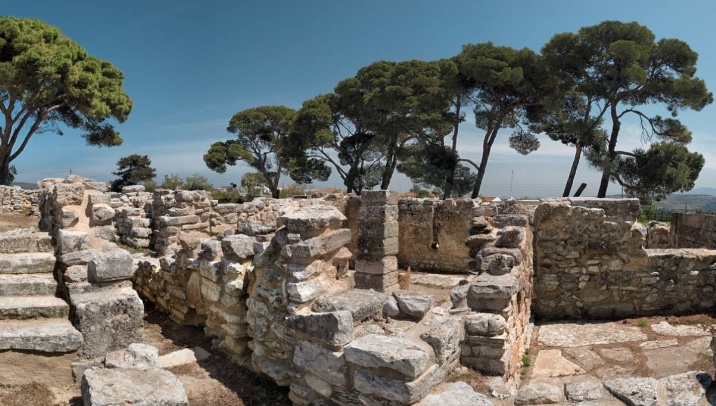
The three mansions of Tylissos are a rare example of Minoan town architecture outside the palatial centres; they show how a prosperous settlement was laid out and how closely it remained bound to Knossos. They bear witness to a high degree of social organisation, to economic strength and to the technical skill of the Minoans.
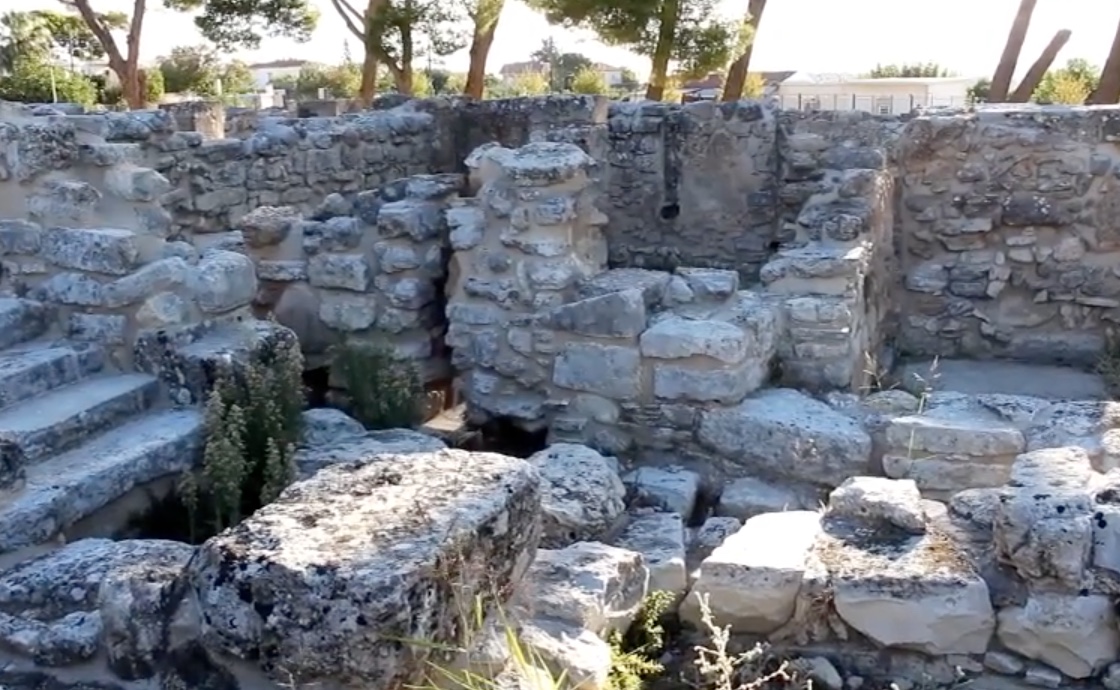
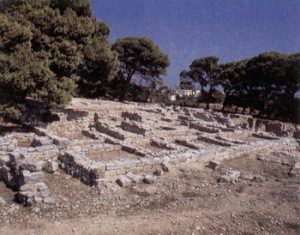
House A, the largest of the three, measures 35 by 18 metres – some 630 square metres on the ground – and comprises 24 rooms. It had two storeys and a monumental tripartite entrance in the middle of the east side, its three doorways divided by two pillars; central living and reception rooms; storerooms, one of them with a column at its centre; and an archive room. A staircase on the north side led to the upper floor. In the north the great storage jars, the pithoi, still stand where they were left; in the south lies the main hall with its multiple doorways and a light-well, and beside it a pillar crypt with a paved floor. Here were found tablets in Linear A, clay sealings, bronze implements and large vessels – the finds show that goods were stored and accounted for in the house. A bronze axe, gold leaf and a lamp of steatite came from the same building, as did the cast bronze statuette of an adorant, a figure in the attitude of prayer, of exceptional quality.
House B, a rectangular building likewise of two storeys and less imposing in its layout, probably served economic or administrative purposes, perhaps as a store attached to House A; from it come an offering table of steatite, a quantity of clay vessels and fragments of frescoes close in style to those of Knossos. House C was notable for a bright central hall and an ingenious system of water supply.
The cistern of House C testifies to a carefully considered use of water. Where fresh water was scarce, the life of the settlement depended on installations of this kind. Systems for collecting and storing rainwater not only supplied drinking water but served agriculture as well, and they show how carefully the builders planned. The large, round, masonry-built basin with its flight of steps belongs to the later building put up in the 14th and 13th centuries BC over the buried House C, its floors about a metre above the old ones; two column bases, thresholds and a smaller stone tank survive from it, and a stone channel brought the water in. Clay pipes found 38 metres to the north-west carried it from the spring of Agios Mamas – the same one that supplies the village to this day.
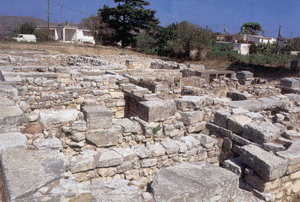
House C itself, at around 350 square metres the smallest, stands north of House A and is entered, like its neighbour, from the east. Its walls survive in places to the full height of the ground floor, and it surprises by its intricate plan, with four corridors and three staircases to the upper storey; the storerooms lay on the west side and the living quarters in the north-west. From it come fragments of miniature frescoes of a kind known almost exclusively from Knossos, perhaps executed by painters from Knossos. A libation vessel of obsidian is also among the most precious objects from Tylissos. The chamber tombs of the late period (1400–1200 BC) contained painted clay chest-shaped sarcophagi, jewellery and seals.
Practical notes for the visit
That the rooms can be read so easily today is due to Nikolaos Platon, who consolidated the walls in the 1940s and again from 1951 to 1955 together with the restorer Zacharias Kanakis; between 1990 and 1994 the three houses were strengthened once more. The site lies on the northern edge of the village, is compact and can be seen in a little under an hour. It is generally open from the morning until early afternoon and closed on Tuesdays. The finds – cauldrons, statuette, tablets and frescoes – are on display in the Heraklion Archaeological Museum. Anyone with a car and time to spare can follow the road towards Anogeia for a look at the house of Sklavokampos, which stands beside it some 22 kilometres from Heraklion.