The most complete guide to Crete: 221 places on the map, 23 routes and 49 articles — with photos, videos and the story behind every place. Everything is open and free: no sign-up, no paid sections and no advertising, open or hidden. You can install the guide on your smartphone as an app.
Routes drawn along real roads
Weather at every stop
Full-text search
“Near me” by geolocation
Create your own printable itinerary
Satellite, terrain, dark mode
Works offline
⌕
Searches 1.7 million characters of descriptions, not just names
—places
4regions
—routes
—with video
Search results
—
Interactive map
Find what is near you
Filters narrow the map and the list at once. Zoom out and pins group together.
Region
Category
Фильтры карты
Landmarks
Featured places
RegionCategory
Routes
Ready-made day trips
Individual places
Articles about landmarks
Savvathiana: the monastery of St Antony and St Sabbas
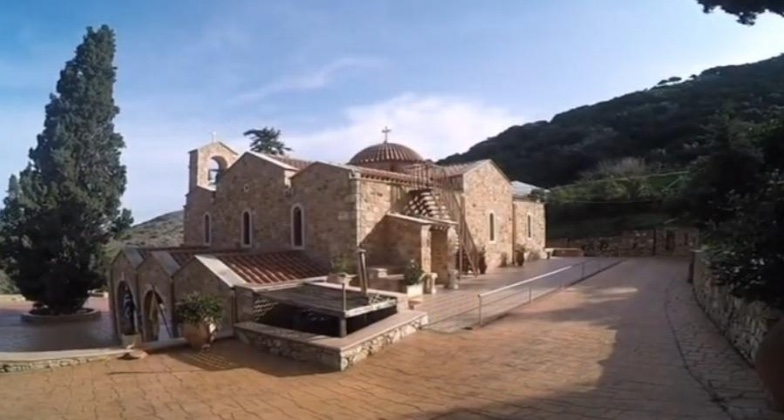
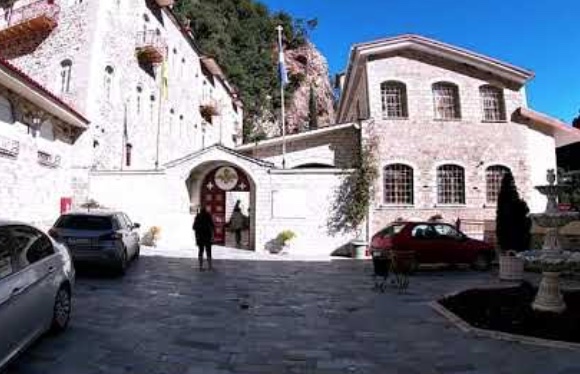
Anyone driving west from Heraklion who climbs the hairpins to Rogdia beyond the bay of Paleokastro – where the triangular Venetian fort, built in 1595 on the advice of the military engineer Latino Orsini, still rises in three tiers on its rock above the beach – comes after a further five kilometres to an asphalted side road that ends in a narrow, well-watered valley. Here, at a height of about 440 metres and some twenty kilometres from the island’s capital, Savvathiana hides behind high walls and a massive gatehouse. Cypresses, orchards and the nuns’ carefully tended flower beds form an unexpected contrast to the bare rock faces all around – a natural fortress which once gave the monks protection from pirates. The road is surfaced all the way to the gate, and the complex has been a listed monument since 1935.
According to tradition the foundation goes back to the year 417. Under the name Savvathiana, however, the monastery first appears in a document of 1549, which calls it the “monastery of St Antony, of the lord Sabbatios”. The name is explained in two ways: some derive it from St Sabbas, to whom a monastery on the coast near Almyros was dedicated, others from a first owner or founder named Sabbatios – some accounts make this Sabbatios a monk and place his foundation as early as the second Byzantine period, between 961 and 1204. It is striking how often the Venetian archives mention the monastery; it was then among the most prosperous in the district. In 1635 an inscription was set above the lintel of the church, giving that year in Greek numeral letters and testifying to the existence of the monastery at the time.
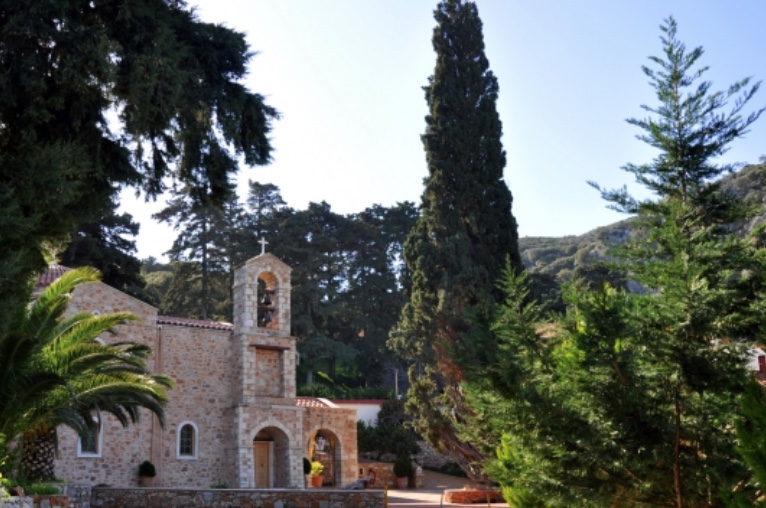
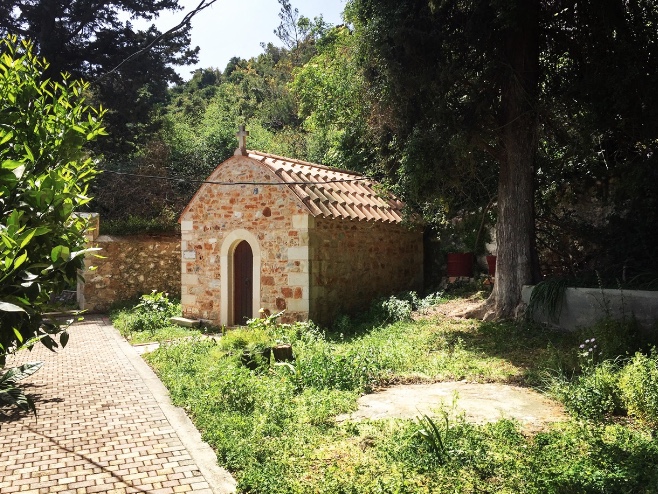
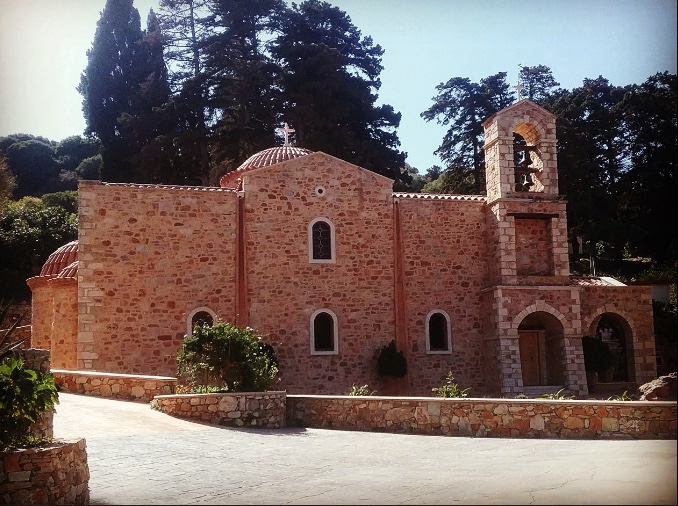
The setting alone is impressive: lying between high rocks, the complex lends the landscape calm and dignity. At its centre stands the katholikon, a domeless, tile-roofed church of two aisles in honour of the Nativity of the All-Holy Mother of God and of the Forty Martyrs; an old carved wooden iconostasis divides the sanctuary from the nave. The most precious part of the ensemble lies some two hundred metres away at the end of a shady path: the cave church of Agios Antonios and Agios Savvas, of the 15th century, the first church of the monastery, partly hewn from the rock and thus a unique witness to its history. The part dedicated to St Sabbas was added in 1955, while the church of St Antony was fitted out for the daily office. Between 2003 and 2008 a new church of St Antony was built of natural stone in the traditional Cretan manner and consecrated on 11 July 2009 – a sign of how the monastery has always adapted itself to the changing needs of its community.
Equally remarkable is the way the buildings are fitted to the ground. Because the slope around the cave church falls away steeply, the cells and domestic buildings were put up on the gentler terraces lower down; the result is the classic arrangement of an Orthodox monastery, with the katholikon in the middle. On the way to the rock church a stone arched bridge spans the stream; its inscription gives the year 1535. Above the bridge the remains of an old watermill have survived. An aqueduct of 1799, renewed in 1843, carried the spring water to the gardens; a barrel-vaulted storehouse survives from the Venetian period; and the abbot’s lodging with the guest wing was built in 1904 under Archimandrite Timotheos Stratakis. The stone-built, vaulted ossuary added in 2002 beside the cemetery shows that building continues here without any break with tradition. A refectory for visitors, the nuns’ cells and a water tower complete the precinct.
The monk Nathanael is regarded as founder and first abbot. After pirates had attacked and destroyed the monastery of St Sabbas on the coast, he is said, as the sole survivor, to have established a new house in the shelter of the mountains in honour of St Antony. In doing so he not only saved the monastic tradition of the district but laid the foundation for generations of monks and pilgrims who sought refuge and spiritual consolation within the walls of Savvathiana.
Nathanael and the memory of St Sabbas
A second version of the tradition moves Nathanael’s activity to the time of the Cretan War (1645–1669). When the Ottomans laid siege to Candia, the monastery suffered severely in 1647 and 1648: its property was confiscated, and the monks who had opposed the attackers were killed or carried off into slavery. Only on the intercession of the Ecumenical Patriarchate were survivors released, and Nathanael is said to have returned in 1648 to rebuild the ruins. Savvathiana is held to be the only monastery in the area of Almyros and Rogdia to have outlasted that war; the fort of Paleokastro on the shore below, which had supported the besieged city, was demolished by the victors so that no enemy could use it again. In 1745 the Ottoman authorities granted permission to repair the cave church.
Maximos Margounios (1549–1602) has also left his mark on the history of the monastery. The humanist, born in Candia, later bishop of Kythira and active in Venice, was one of the most important Greek scholars of his age and a resolute defender of Orthodoxy; tradition even names him as abbot of Savvathiana. His writings and his work as a churchman did much to preserve the Orthodox faith in Crete under the rule of Venice – a legacy to which the monks appealed again in the hard centuries of the Ottoman period.
No less closely bound up with Savvathiana is the name of the icon painter Ioannis Kornaros, who spent his youth here. It was in the monastery that he painted his celebrated icon “Great art Thou, O Lord”. It was long believed lost, until in 1991 the Archaeological Service cleaned a completely blackened panel and the old painting came to light beneath. After restoration it returned to its place and has been the most venerated treasure of the house ever since. A second version of the same subject, dated 1770, is kept at Toplou Monastery in the far east of the island.
Scholars and defenders of the monastery
Evmenios Vourexakis, a learned monk and deacon, was an unbending defender of the monastery who devoted his life to the service of Savvathiana and the protection of its holy things; during the great rising of 1866 he fell in the fighting near Almyros. His grave is in the monastery, as is that of the freedom fighter Iraklis Kokkinidis, a leader of the insurgents of Malevizi and Temenos, who was beheaded near Gazi in 1868; the small pre-industrial olive mill that belonged to his family still stands in the village of Keramoutsi and has been bought by the municipality for use as a folklore museum. As early as 1821 the monks had joined the insurrection. The lives and deeds of these men stand for unshakeable faith and loyalty to spiritual ideals – and they show that Savvathiana is not only a place of prayer but also a stronghold of the cultural and spiritual heritage of Crete.
During the German occupation starving and persecuted inhabitants of Heraklion found shelter here; when the war ended only two aged monks were still living in the decaying buildings. In October 1946 Savvathiana was therefore converted into a convent: eight nuns from the Peloponnesian monastery of Divri moved in under Abbess Melani Vrionaki and put the place in order again. Today the sisterhood devotes itself to icon painting, mosaic, the weaving and embroidering of liturgical vestments on traditional Cretan looms, and organic gardening. Savvathiana is the best known of a whole group of religious houses in the hills west of Heraklion – the convent at Rogdia, Agia Fotini, Pantanassa and St Theodore are the others – which make this corner of Malevizi one of the liveliest monastic districts of the island. The principal feast is kept on 17 January, the day of St Antony, usually in the presence of the Archbishop of Crete. Visitors are welcome; over the midday hours the gate is normally kept shut.