Heraklion: the city, its harbour fortress and its monuments
The most complete guide to Crete: 221 places on the map, 23 routes and 49 articles — with photos, videos and the story behind every place. No sign-up, no trackers.
Routes drawn along real roads
Weather at every stop
Full-text search
“Near me” by geolocation
Create your own printable itinerary
Satellite, terrain, dark mode
Works offline
⌕
Searches 1.7 million characters of descriptions, not just names
—places
4regions
—routes
—with video
Search results
—
Interactive map
Find what is near you
Filters narrow the map and the list at once. Zoom out and pins group together.
Region
Category
Фильтры карты
Landmarks
Featured places
RegionCategory
Routes
Ready-made day trips
Individual places
Articles about landmarks
Heraklion: city, harbour and fortress
The hill on which the centre of the modern city stands has been inhabited since the first millennium BC, and the surrounding district for very much longer. Greeks and Romans knew the place as Herakleion: it served as the harbour of Knossos and bore the name of Herakles. Through the first Byzantine centuries it remained a coastal settlement of no account, overshadowed by Gortyn, then the capital of the island. That changed when the Arabs seized it in 823. Everything that follows begins there.
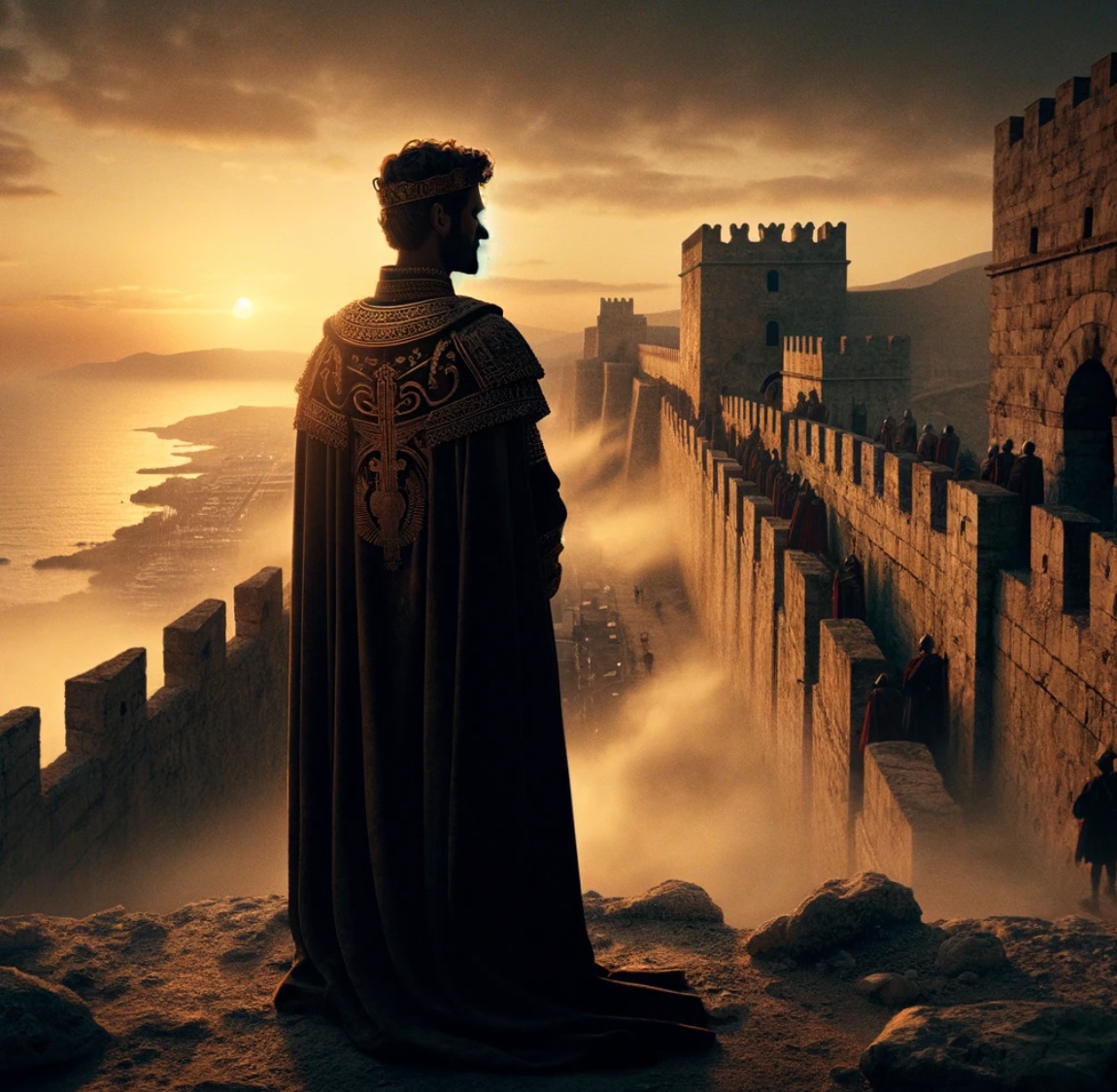
The conquerors were Saracens driven out of Andalusia, led by Abu Hafs Umar. They made the place the capital of their Emirate of Crete and a fortified harbour from which to raid across the Aegean. They called it Rabd al-Khandaq, the ‘Castle of the Moat’, and work on its defences is said to have begun within a year of their arrival: massive walls, and in front of them the deep ditch that gave the town its name. The Greeks turned Khandaq into Chandax, and the Venetians in due course turned Chandax into Candia.
For all these defences, a Byzantine army under Nikephoros Phokas – the future emperor – landed on Crete in 960 and won the city back in March 961, after a siege that had lasted for months. Phokas tried to move the island’s capital inland, to the height of Temenos, where he had a castle built; the plan came to nothing, the inhabitants drifted back to the sea, and Chandakas remained the capital. It was to stay in Byzantine hands for the next 243 years.
Candia under the Lion of St Mark
With the fall of Constantinople to the Fourth Crusade in 1204, Candia – as Heraklion was now called – passed by purchase to the Republic of Venice, and a new chapter in the city’s history opened. The four and a half centuries of Venetian rule were a period of prosperity. The city was girdled with new walls and adorned with fine public buildings, fountains, monuments and churches; the main street running up from the harbour was the Ruga Maistra. Trade, the crafts and learning flourished, and a class of educated townspeople emerged. Schools were founded from the 14th century onwards, and in the late 16th century Andrea Cornaro established the literary Academy of the Stravaganti.
The 16th and 17th centuries are marked by a singular fusion of Greek and Italian culture known as the Cretan Renaissance, and it shows most strikingly in painting. The Cretan School of icon painting joined Byzantine tradition to the art of the West. Theophanes the Cretan, Michael Damaskinos and Domenikos Theotokopoulos, better known as El Greco, hold a place of honour among the masters of the age. Damaskinos, born in the early 1530s, spent some twenty years in Venice, where he belonged to the Greek Brotherhood from 1577 to 1582 and painted for its church of San Giorgio dei Greci, before coming home to Candia in about 1583.
The greatest achievement of the Cretan Renaissance was the flowering of poetry in the late 16th and early 17th centuries, which showed what the Greek vernacular could do as a literary language. Among the pioneers three stand out: Georgios Chortatsis, author of the tragedy ‘Erofili’; Vitsentzos Kornaros, creator of the verse romance ‘Erotokritos’; and Markos Antonios Foskolos, a native of Candia, with his comedy ‘Fortounatos’. Kornaros was born in 1553 at Trapezonda near Sitia, moved to Candia in about 1590, joined the Stravaganti – the academy his brother Andrea had founded – and died in the city in 1613 or 1614; he was buried in the church of San Francesco.
Architecture, too, left outstanding work. The experience and the vocabulary of the great Renaissance masters of the West, of Sebastiano Serlio or Andrea Palladio, found their echo on Crete, and the island’s architecture reached its height in the passage from the mature Renaissance to the Baroque, in the first half of the 17th century. Particular care was lavished on the fortifications of Candia, which were adapted to the new age of gunpowder to designs by the celebrated architect and engineer Michele Sanmicheli, and by Giulio Savorgnan. The result was a roughly triangular circuit with seven bastions on the landward side – St Andrew, Pantokrator, Bethlehem, Martinengo, Jesus, Vitturi and Sabbionara – fronted by a deep ditch and a system of outworks.
The great siege and modern times
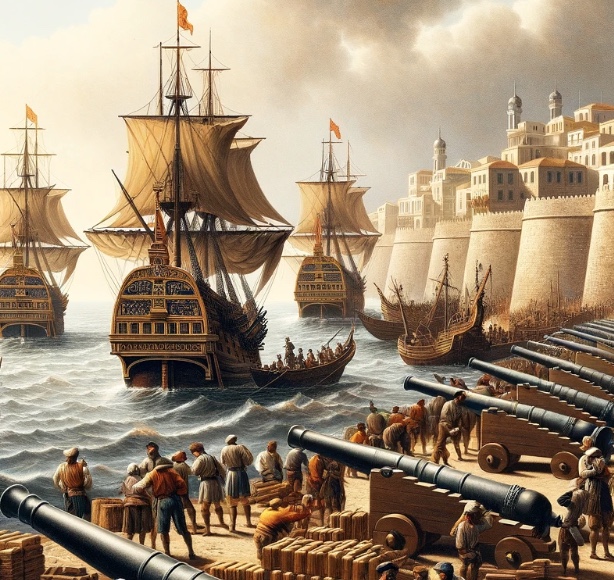
In the summer of 1647 the Ottomans, who had already taken Chania and Rethymno, brought heavy guns to the island and began to throw up earthworks – the prelude to the siege of Candia. The city withstood countless assaults and could not be taken, but it was shut in from the landward side. In 1660 Louis XIV and the Duke of Savoy sent substantial reinforcements. In 1667 Venice dispatched Francesco Morosini to Candia; in the same year the grand vizier Köprülü Fazıl Ahmed arrived with the largest Ottoman army ever assembled on Crete, and the struggle went underground, with at least eighty mines exploded in the single month of July. Further relief forces from the French king followed in 1668 and 1669. The Duke of Beaufort landed on 19 June 1669 with more than 6,000 men and was killed five days later in a premature sortie; on 24 July the French flagship Thérèse blew up with the loss of 286 of her crew, and on 21 August the Duke of Navailles took most of the contingent home. For all the heroism, Candia fell in 1669 after more than twenty years of siege and an appalling loss of life: in the last twenty-two months alone some 70,000 Turks, 38,000 Cretans and slaves, and 29,088 of the Christian defenders are said to have died. Morosini, left with about 4,000 men fit to fight, negotiated terms with the Ottomans that allowed his troops to leave freely, with their artillery and without indemnity, and to take the city’s historical archive with them.
After the devastating siege Candia fell into decline, and its population shrank; the harbour silted up, and in 1849 the Ottomans moved the seat of government to Chania. The town recovered only in the course of the 18th century, and then the earthquake of 12 October 1856 destroyed most of what stood: of more than 3,600 houses only eighteen were left undamaged, and 538 people were killed. Another catastrophe came in August 1898, when the British on the island were charged with enforcing the terms of Cretan autonomy. On 25 August – the feast of St Titus – an enraged mob, with the connivance of the Ottoman side, fell on the Christian population; hundreds died, among them seventeen British soldiers and the British vice-consul, Lysimachos Kalokairinos, and whole streets were burnt out. The bloodbath roused the Great Powers, became the turning point in the island’s history and led to the withdrawal of the Ottoman troops. The main street from the harbour into the town has borne the name of 25 August ever since.
Since then Heraklion has grown steadily and spilled far beyond the old walls. Crete was united with Greece in 1913, and the arrival of large numbers of refugees from Asia Minor after 1922 gave the town its particular character. German bombing in 1941 did further damage. Since 1971 Heraklion has again been the capital of the island, its economic and administrative centre; the municipality counted 179,302 inhabitants at the census of 2021. The University of Crete and the Foundation for Research and Technology have their seat here and help to shape the face of the modern city.
The Venetians’ labour of Sisyphus: the sea fortress of Koules
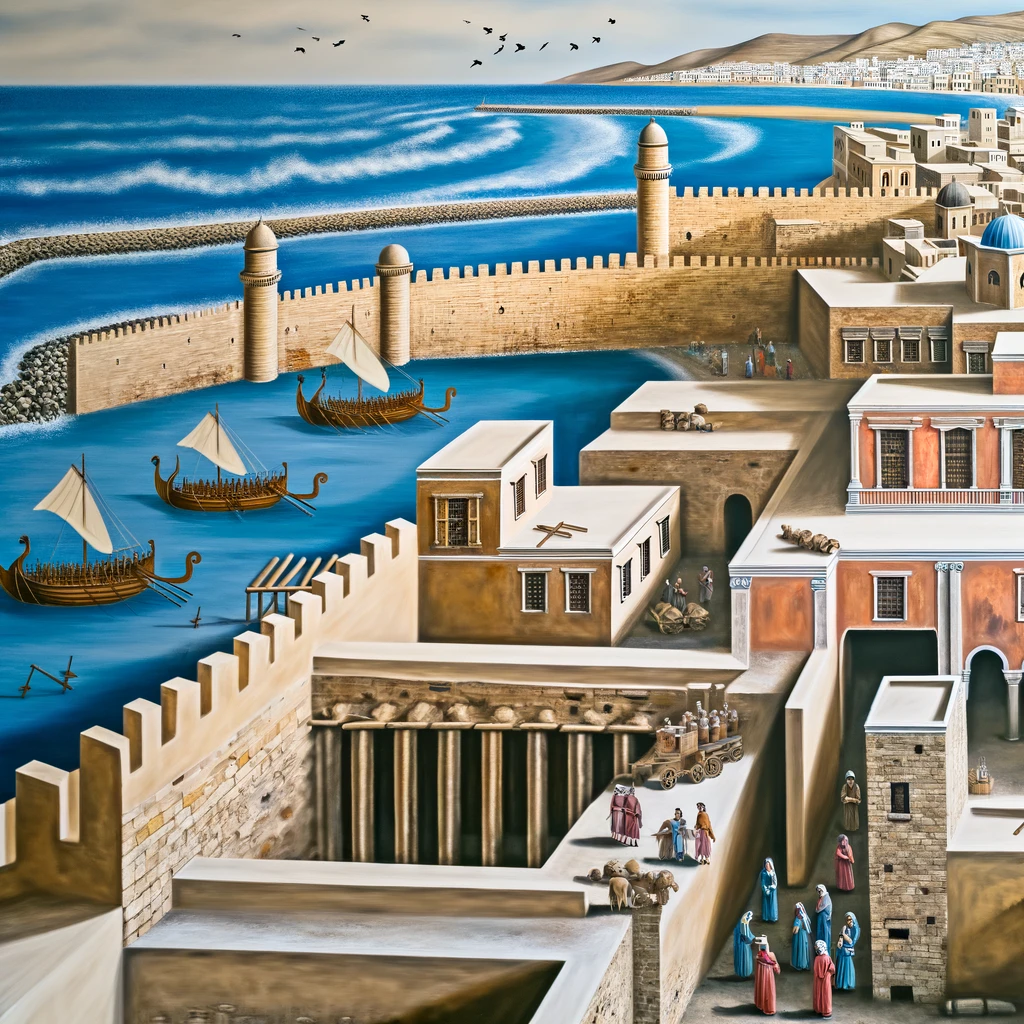
A harbour grew up in the sheltered bay of Heraklion in antiquity. To the north this natural basin was screened by a chain of rocks and reefs, as though nature herself had built a defence against storm and enemy. The Arabs were the first to see the advantage and probably fortified the spot in the 9th or 10th century, though modestly; under Byzantium a tower stood here that the documents call the Castellum Comunis, which was thrown down by the earthquake of 1303 and patched up again. The Venetians, who established themselves on the island in 1210, crowned the rocks with a mighty fortress meant to withstand the next conquerors, the Ottomans. The great new work was decided on in 1523, when the old tower was pulled down to make way for it; the Venetians called it the Rocca a Mare or Castello a Mare.
Who designed it is not known; the plans are thought to have been drawn by Antonio Saracini or by Giovanni da Como. Work began with the enormous task of laying foundations under water, and for this the Venetians resorted to a curious method: they filled old ships and boats with stone and sank them, so forming a breakwater on which to build. The stone was brought from the islands of Dia and Fraskia. By November 1530 the substructure went down sixteen metres, and three weeks after the masonry proper had been started Alessandro Contarini was able to report considerable progress on the outer walls and the imminent start of work on the interior.
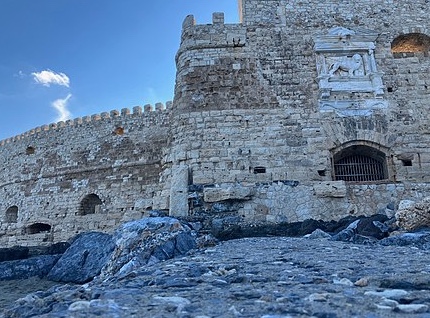
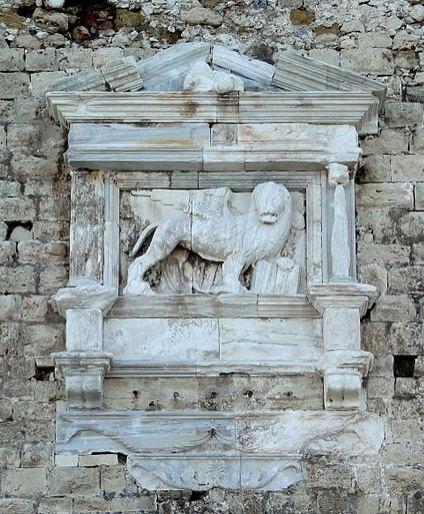
In the winter months building stopped because of the weather. In 1533 the monumental relief of the Lion of St Mark was set over the entrance; winged lions in marble adorn three sides of the fortress to this day, and are its emblem. The main gate is on the west side, and there were two lesser entrances to the north and south-west.
In 1539 a commemorative tablet was set on the stair to the upper levels, recording the end of the work; the building was finally finished in 1540. What had been made was a two-storey bulwark covering some 3,600 square metres, a tall rectangular block towards the south-west and a slightly lower, half-elliptical one towards the north-east, with outer walls up to nine metres thick and inner walls of as much as three. On the ground floor were twenty-six vaulted rooms: quarters for the garrison and its officers, stores for food and powder, cisterns, a chapel and dungeons. Five of them were gun casemates, soon given up because the smoke would not clear and the gunners could see little. The guns therefore stood on the upper platform, together with a mill, a bread oven and a beacon light.
As time went on the fortress needed mending again and again, for the surf never let it alone. The Venetians tirelessly strengthened the north-west side, protecting it against scouring with fresh boulders and breakwaters. In 1552 part of the mole that shielded the castle from the storms collapsed. The silting of the harbour was a further worry. Gianmatteo Bembo – the governor who gave the town its first fountain – proposed a rebuilding in which the fortress would be extended to the north-east, towards the shallows. By September 1556 the restoration of the mole was all but complete; its base consisted of blocks of eight to ten tonnes held together with metal cramps. Two years later, however, the work was damaged once more.
In 1566 Giulio Savorgnan, one of the engineers of the land walls, advised giving the outer walls a batter to make them more resistant to the winter seas. In 1570, during work on the roof, a crack opened in the mole that could no longer be closed. Until the end of the 16th century a whole series of schemes was considered for protecting the fortress from the elements, yet the mole was almost wholly destroyed, cracks were appearing in the walls, and the foundations were so far undermined that seawater was getting into the freshwater cistern. Venice set aside considerable sums for the repairs.
For all that was spent on its upkeep, the castle played only a minor part in the siege of Candia by the Ottomans. Towards the end of the siege the attackers managed to silence its guns with the heaviest artillery, which they had sited at Trypiti, and with siege works at the Sabbionara, and so won command of the harbour. After the long years of siege the city was surrendered on 27 September 1669; the Venetians had secured acceptable terms for their withdrawal.
The Ottoman period
Ottoman rule over the city began with the repair of the damage done by the artillery and the addition of battlements, fire steps and gun embrasures to the bulwark. Within the fortress walls the Ottomans built the mosque of Kaplan Mustafa Pasha, and on the landward side a smaller fort known as the Little Koules, which was demolished in 1936. The traveller Evliya Celebi, who described these parts, calls the castle Su Kalesi or Su Kulesi, the Water Fortress – whence the present name Koules – and notes that work on its restoration was still going on years after the fall of Candia in 1669. When part of the walls collapsed in 1719 the damage was quickly put right; the repair, together with other improvements in the harbour, cost 5,000 kurus. At times the fortress served as a prison, in whose damp vaults Cretan insurgents languished. The Frenchmen Bonneval and Dumas, who inspected it at the end of the 18th century, report its neglect and two tiers of cannon. The lighthouse at the north-eastern corner dates from the decade of Egyptian rule, 1830 to 1840.
In the end the fortress did not help the Ottomans to hold the island either. After a succession of Cretan uprisings and the intervention of the Great Powers at the end of the 19th century they had to give up the castle, having – like the Venetians before them – negotiated tolerable terms for their departure. The age of the modern Greek state began, and once again the stability of the structure was a cause for concern.
The fortress today
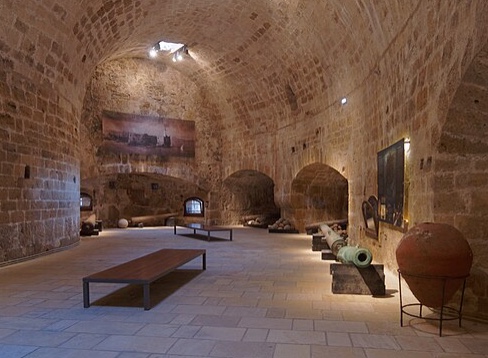
Restoration began in 1959 under the direction of the archaeologist Stylianos Alexiou; the Ottoman parapets were renewed and later additions removed. Between 1972 and 1975 the castle was made ready for visitors, parts of the defences were reinstated and a promenade with planted areas was laid out. In 2000 the walls, battered by the winter storms, were consolidated, and after a further campaign of repairs lasting several years the Koules is open once more. In the vaults an exhibition tells the story of the fortress and displays finds from shipwrecks; from the platform, which also serves as a stage for concerts and plays, the view takes in the harbour, the Venetian arsenals and the long mole where the people of Heraklion take their evening walk. The fortress is closed on Tuesdays.
The church of St Titus
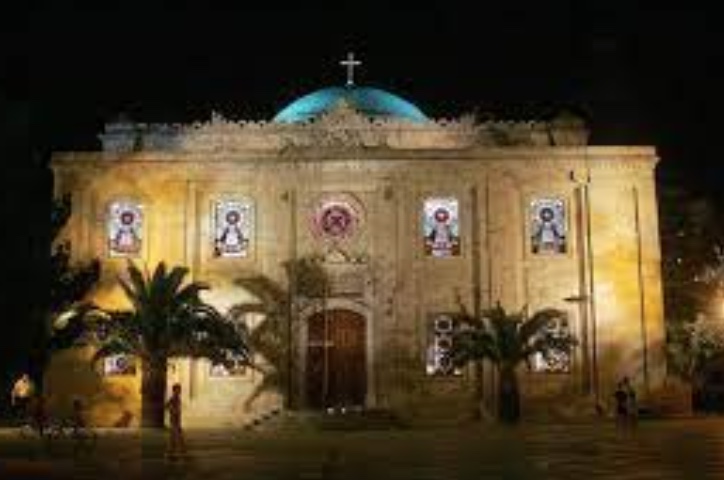
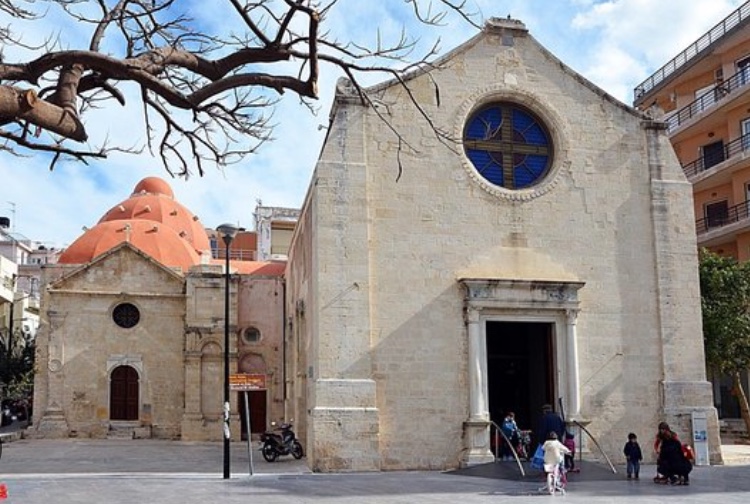
In the long panorama of Cretan history, with its breaks between eras and its turns of fortune, the church of Agios Titos stands for the persistence of faith. It goes back to 961, when the Byzantines recovered the city and moved the island’s episcopal seat here from Gortyn, the former capital; the new metropolitan church was dedicated to Titus, the disciple of the Apostle Paul who had founded Christianity on the island. The building, at first a modest single-aisled one, held precious relics, among them the head of the saint and an icon of the Mother of God revered as miracle-working, the Panagia Mesopantitissa.
With the arrival of the Venetians in 1210 the church underwent its first transformation: it became the seat of the Latin archbishop, and acquired a bell tower. From then on it witnessed many reversals. Before the middle of the 15th century the old building was lost; it rose again as a three-aisled basilica and was consecrated on 3 January 1446. It was damaged in 1508, burnt out on 3 April 1544 and rebuilt in 1557. The centuries of Ottoman rule brought the next break: the church became a mosque, the Vezir Mosque, dedicated to the conqueror of Candia, Köprülü Fazıl Ahmed Pasha, while the Venetians had taken relic and icon away with them to Venice in 1669 – where the icon remains.
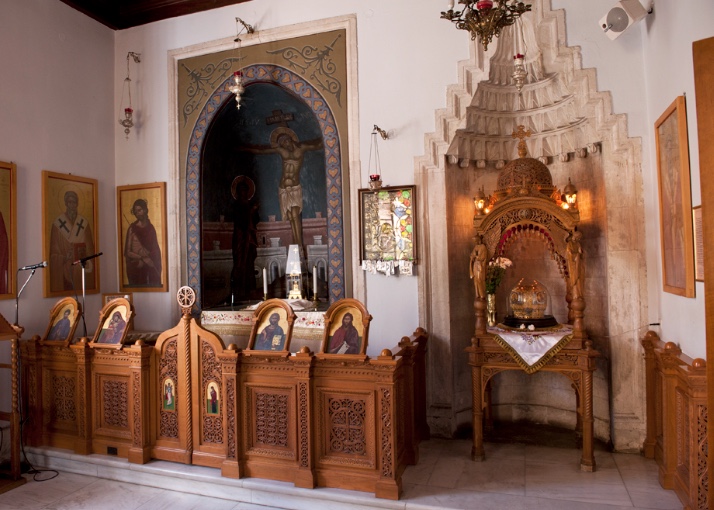
The earthquake of 1856 left nothing of the former splendour but rubble. On the ruins a new mosque was built from 1869 to plans by Athanasios Mousis, the architect of the cathedral of Agios Minas – and that is the building we see today. It was soon to return to its first purpose. After the union of Crete with Greece and the departure of the Muslim population the minaret was taken down, and on 3 May 1925 the building was given over once more to Orthodox worship. The head of St Titus came back from Venice on 15 May 1966 and has been venerated ever since in a side chapel, in a silver reliquary.
The transformations, restorations and repairs of the centuries have only confirmed the standing of Agios Titos as the spiritual centre of the islanders. In 2013 that rank was recognised when Archbishop Irenaeus raised it to the status of a cathedral of the Archdiocese of Crete. The saint’s feast falls on 25 August, the date the street outside commemorates for a darker reason.
From the old harbour one climbs 25 August Street, the Venetian Ruga Maistra and now the city’s promenade, lined with neoclassical façades put up after the destruction of 1898 to give Heraklion the air of a modern town. On it, a few steps from Agios Titos, stands the graceful Loggia.
The Venetian Loggia
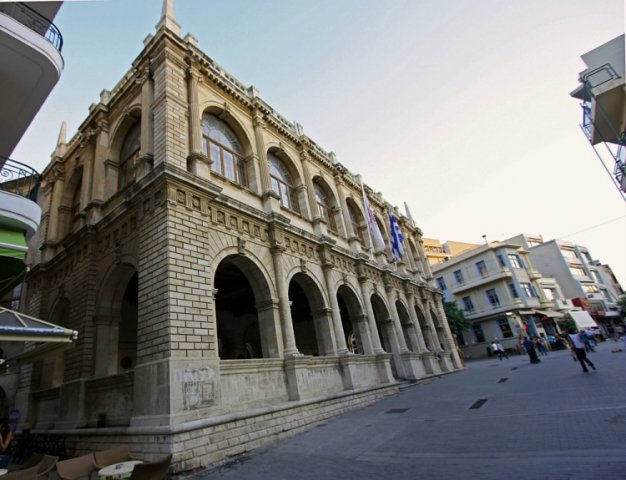
The arcaded building in the Palladian manner was put up between 1626 and 1628 under the Provveditore Generale Francesco Morosini, the fourth and last loggia the Venetians built in the city: Doric half-columns below, Ionic above, and between them a frieze of trophies and Lions of St Mark, eighty-two carved panels in all. Its model was Palladio’s Basilica in Vicenza. In the course of its history the Loggia suffered severe destruction – the Ottomans used it to house the treasury of Crete, it was decaying by 1898 and was largely taken down in the early 20th century – but it was completely reconstructed using all the surviving fragments, its arcades and its sculptural decoration. The rebuilding, begun in 1915 under the Italian engineer Ongaro and interrupted by the Second World War, was honoured in 1987 with a Europa Nostra award.
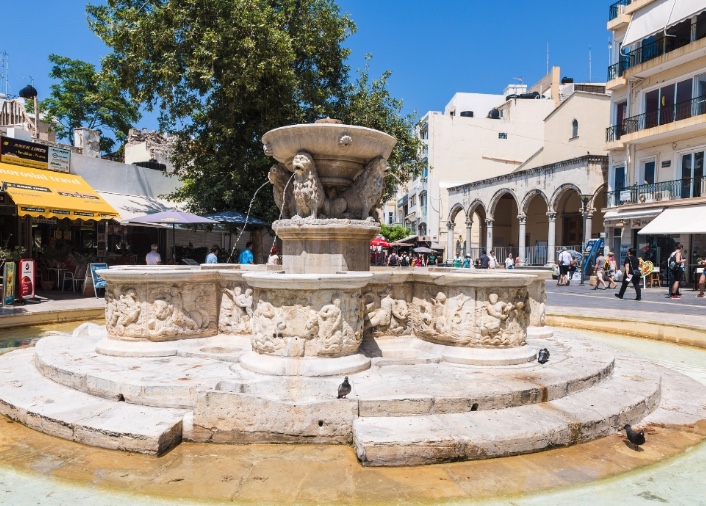
A little further on the Lions Square opens out – officially Eleftheriou Venizelou Square – with the Morosini Fountain, inaugurated on 25 April 1628 after fourteen months’ work. Its eight-lobed basin, carved with tritons, dolphins and nymphs, once received the water of Archanes, brought down a fifteen-kilometre aqueduct; four lions carry the upper bowl, which was originally crowned by a colossal marble Poseidon, long since lost. On this square stands the church of St Mark.
The church of St Mark
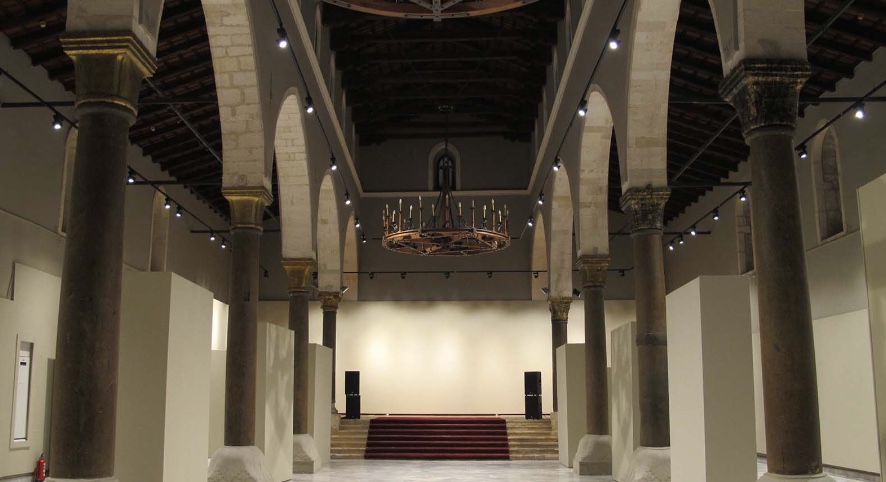
The basilica of San Marco (Agios Markos) is one of the defining monuments of Heraklion. It was built in 1239 as the church of the Duke of Candia and a sign of the Venetian protecting power – state ceremonies were held in it and Venetian nobles were buried there – was partly destroyed by the earthquakes of 1303 and 1508, and was renewed after the second. It is a basilica with a portico on six columns; outside it has features of the Renaissance, inside of the Gothic. A tall bell tower with a clock once stood at its south-west corner. In Ottoman times it served as the mosque of Defterdar Ahmet Pasha, and the tower was replaced by a minaret, which came down in turn in 1924. Restored to its original form by the Society of Cretan Historical Studies between 1956 and 1960, it is now used as an exhibition space, the Municipal Art Gallery, in which the city stages art exhibitions and concerts.
Monuments of the old town
1866 Street, the lively market lane with its stalls of cheese, herbs, honey and raki, named after the great Cretan rising of that year, leads up to the square that bears the name of the poet Vitsentzos Kornaros. Here stands another Venetian fountain.
The Bembo Fountain
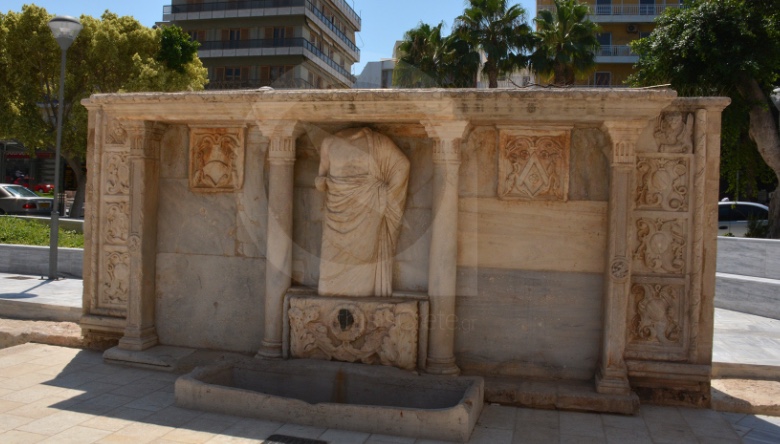
It is named after its donor, Gianmatteo Bembo, who used fragments of a Roman sarcophagus and a headless statue, brought from Ierapetra, to make it. It was built in 1552–54, during Bembo’s term as captain of the city, and it was then that the people of Candia first saw running water within their walls. Right beside it stands a polygonal Ottoman fountain house, the sebil of Haci Ibrahim Agha, who is said to have had snow carried down from Psiloritis in summer to chill the water; it now houses a coffee house.
On St Catherine’s Square rises the city’s cathedral.
The cathedral of St Minas
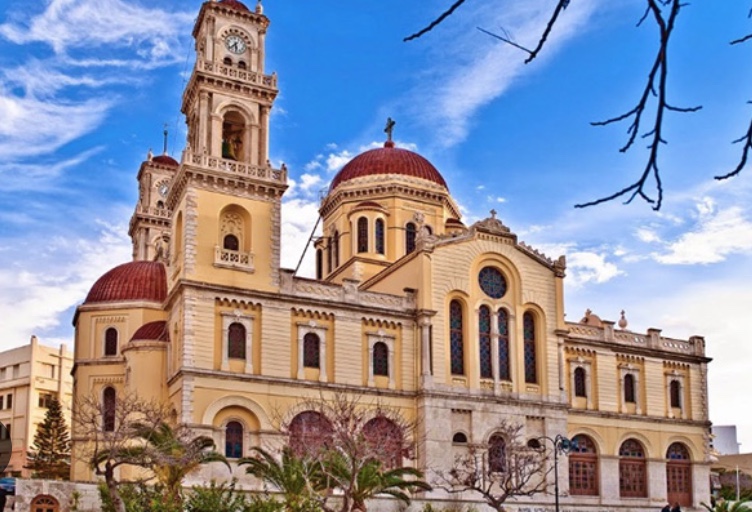
Agios Minas, built between 1862 and 1895, is the largest church on Crete and one of the largest in Greece: 43 metres long and 29.5 wide, cruciform, with a central dome and a bell tower at each of its eastern corners. The design was by Athanasios Mousis; the rising of 1866 broke off the work, which was not resumed until 1883. The architecture deliberately takes up motifs from the traditional church building of Crete and mixes them with elements of the Renaissance, of neoclassicism and of the East. It is the seat of the Archbishop of Crete. St Minas, a martyr of the 4th century, is the patron saint of Heraklion, and his feast on 11 November is a public holiday in the city. Beside the great building the small, older church of St Minas, of 1735, still stands and is still in use, with its precious icon screens.
On the same square, in the shadow of the cathedral, stands a third and lower church.
The church of St Catherine
Agia Ekaterini was founded in the 16th century and belonged to the monastery of St Catherine on Mount Sinai, whose dependency here maintained a school famous far and wide. In the graceful building, now a museum of ecclesiastical art, hang six icons by the great Cretan painter Michael Damaskinos – masterpieces of the Cretan School, which tradition says were kept at the monastery of Vrontisi until 1800.
The Heraklion Archaeological Museum
North of Liberty Square, the Plateia Eleftherias, lies the Archaeological Museum, guardian of the treasures of the Minoan age. The city has other museums as well: the Museum of Icons and Relics of the Archdiocese of Crete, the Historical Museum and the Natural History Museum of Crete.
The Heraklion Archaeological Museum is one of the largest and most important museums in Greece and holds a prominent place among the museums of Europe. It began in 1883 as a modest collection of antiquities; the Cretan archaeologists Iosif Hatzidakis and Stefanos Xanthoudidis saw the first purpose-built museum through between 1904 and 1912, and the present building, an earthquake-resistant work of modernist architecture by Patroklos Karantinos, went up between 1937 and 1940 on the site of a Roman Catholic monastery destroyed in 1856. The collection came through the Second World War intact; the galleries were thoroughly renovated from 2006 and reopened in 2013. The display brings together chosen pieces from every period of Cretan prehistory and history, across some 5,500 years from the Neolithic to Roman times. Pride of place goes to the incomparable works of Minoan art in the whole course of its development: the Phaistos Disc, the Snake Goddesses and the Bull-Leaping fresco from Knossos, the Bull’s Head Rhyton, the Harvester Vase and the painted sarcophagus from Agia Triada, the bee pendant from Malia. The collection of Minoan antiquities is the most complete in the world, which is why the museum is the undisputed centre for the study of Minoan civilisation. A visit is best made before the drive out to Knossos, whose originals are on show here.