The most complete guide to Crete: 221 places on the map, 23 routes and 49 articles — with photos, videos and the story behind every place. No sign-up, no trackers.
Routes drawn along real roads
Weather at every stop
Full-text search
“Near me” by geolocation
Create your own printable itinerary
Satellite, terrain, dark mode
Works offline
⌕
Searches 1.7 million characters of descriptions, not just names
—places
4regions
—routes
—with video
Search results
—
Interactive map
Find what is near you
Filters narrow the map and the list at once. Zoom out and pins group together.
Region
Category
Фильтры карты
Landmarks
Featured places
RegionCategory
Routes
Ready-made day trips
Individual places
Articles about landmarks
Archanes: a town set among Minoan monuments
Archanes (Αρχάνες) lies some 14 kilometres south of Heraklion and only about seven from the palace of Knossos, in an enclosed basin threaded by the Kairatos – the same stream that runs on through its little gorge to Knossos. To the west, above the vineyards and olive groves, rises Mount Juktas, whose long ridge gives the place its skyline; on the other side the valley is closed by the heights of Kefala. The town, home to a little under 4,000 people and since 2011 part of the municipality of Archanes-Asterousia, has kept its traditional buildings, and it stands at the centre of one of the island’s richest archaeological landscapes: around the modern settlement, and beneath its houses, lie Minoan centres, sanctuaries, farming estates and burial grounds.
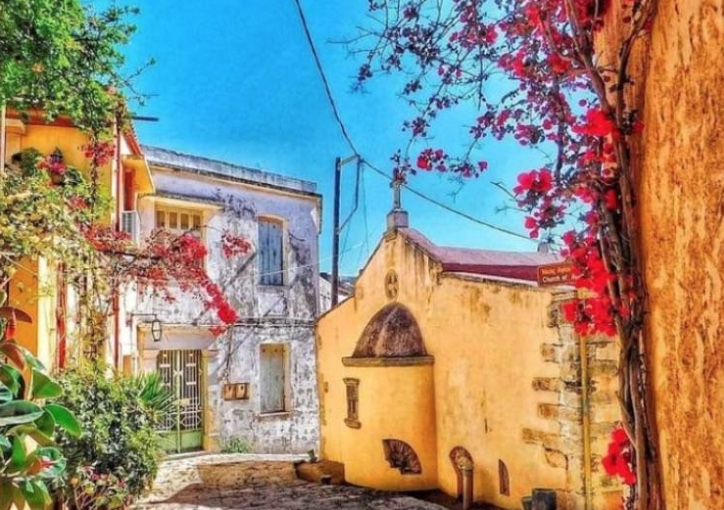
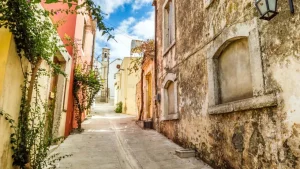
The town is made up of Kato Archanes, the lower village, and Epano or Ano Archanes, the upper. The lower part lies at around 360 metres above sea level; from there the road climbs to the upper settlement, which spreads out at about 380 metres. Here narrow paved lanes, old mansions, wooden shop signs and street lanterns survive. Many of the boldly colour-washed, carefully repaired houses date from Ottoman times or from the years of the Cretan State, when prosperous wine merchants had neoclassical residences built for themselves. Venetian, Cretan and neoclassical elements sit side by side, but this is no museum set: the houses are lived in, and the square remains the centre of daily life.
From the Minoans to the 20th century
Excavation shows that the valley was already settled in the Neolithic, to judge by tools of the Late and Final Neolithic; its great age fell between about 2500 and 1400 BC, when the springs of Archanes were tapped for Knossos by a Minoan aqueduct and spring-house. A severe earthquake around 1450 BC wrecked the town, though the central building went on in use. Local tradition derives the name from an ancient city called Acharna; the form Archanes itself is first attested in the Classical period, and after the Roman conquest under Metellus in 67 BC the district belonged to the territory of Knossos. The Venetians, too, valued the local springs: in 1628 the provveditore generale Francesco Morosini had their water carried by aqueduct to Candia, where it fed the Lion Fountain that bears his name. During the rising of 1897 Archanes was the seat of the revolutionary committee for eastern Crete, and in the Battle of Crete in May 1941 the Greek forces had their command post and a field hospital here; later the German occupiers installed a divisional headquarters in the town.
Squares, churches and the life of the town
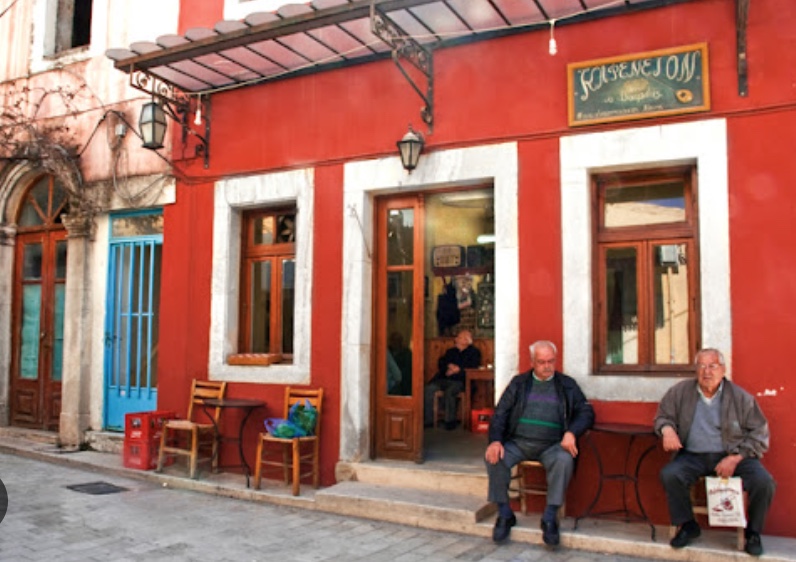
Around the main square of Epano Archanes stand coffee houses, tavernas and rakadika – plain establishments where small dishes of island cooking are served with raki, the Cretan spirit distilled from the pressed grape skins. The square is a good place to pause before visiting the excavations, and anyone who sits here quickly grasps that the archaeology of Archanes lies not on the margins but in the thick of the modern town’s life. A women’s cooperative makes rusks, pastries and preserved fruit to old recipes.
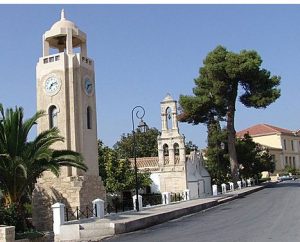
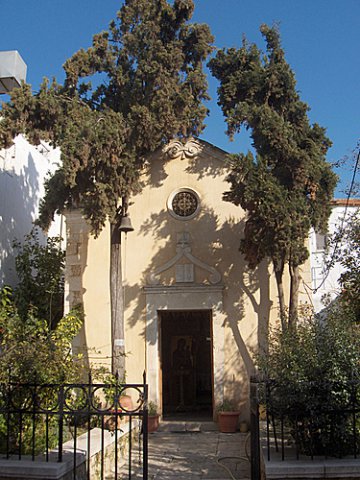
Not far from the square stands the three-aisled church of the Panagia, known locally as Panagia Kera, which took its present form in the 18th century. Its stone bell tower and finely cut masonry set it apart from the row of houses; the clock tower was added in 1930, paid for by donations from emigrant Archaniots in New York and Boston. The church of St Nicholas, patron of the town, was built in 1857; the year is given in the inscription over the entrance. There are also Byzantine churches of the 14th century: Agia Triada, the church of the Holy Trinity, and Agia Paraskevi.
Archanes is also one of the best-known wine villages in Crete. The district has its own protected designation of origin for dry red wine from the Kotsifali and Mandilari grapes; in addition, table grapes of the Rosaki variety and excellent olive oil have been produced here for generations. Vines and olives between them account for almost all of the valley’s farm produce – some 96 per cent – and the growers’ cooperative, founded in the early 1930s and among the oldest in Greece, sends wine to Germany, France and the Netherlands. The grape harvest is marked by a growers’ festival. On the hillsides grow dittany and thyme, sold in the town’s shops as herbal tea and seasoning.
The archaeological collection of Archanes
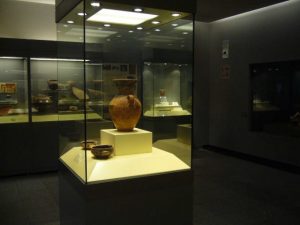
The archaeological collection, opened in 1993 in a neoclassical building, traces the history of the region from the Late Neolithic to historical times. On show are pottery, seals, objects of stone and metal, jewellery, and finds from the surrounding excavations – among them storage jars for wine, clay wine presses and household ware. The small museum thus tells not only of palaces but equally of craft, trade, burial customs and the everyday life of the inhabitants. As a rule it is open from the morning until early afternoon; on Tuesdays it is closed.
The museum is closely bound up with the decades of excavation by the archaeologist couple Yannis and Efi Sakellarakis. Yannis Sakellarakis (1936–2010), an Athenian who came to think of himself as a naturalised Cretan, served as curator of the Heraklion Archaeological Museum from 1963 to 1968 and as its director from 1980 to 1987; with his wife and lifelong collaborator, Efi Sapouna-Sakellaraki, he also brought to light the large Minoan building at Zominthos, some 1,200 metres up on the northern foothills of Psiloritis. Their research in Archanes, on Fourni and on Juktas greatly enlarged our picture of the political and religious order of Minoan Crete; their work was recognised by the state as well – he received the Golden Cross of the Order of Honour and the Gold Medal of the University of Crete, and was elected to the Academy of Athens. Those with more time will also find a folk museum in a restored mansion in the town.
Fourni: the cemetery between the two Archanes
The hill of Fourni (Φουρνί) lies between upper and lower Archanes, among olive trees, vines and a wood of pines. It owes its name to a domed tomb that local people took for a baking oven – the Greek word “fournos” means oven. The excavations begun in 1964 by Yannis and Efi Sakellarakis, a few years after the site was first noticed, uncovered a burial ground in use from about 2400 to 1200 BC, that is, for well over a thousand years. Fourni is regarded as the most important cemetery in Crete and one of the most significant in the whole Creto-Mycenaean world.
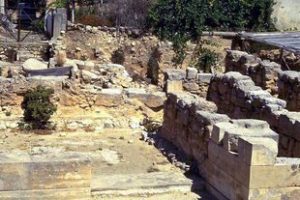
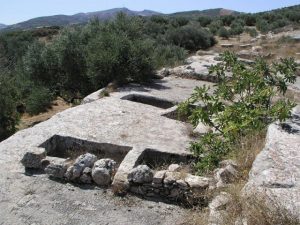
Fourni is not a single tomb but a city of the dead in many parts, spread over some 6,600 square metres. So far 26 buildings have been examined: five tholos tombs, chamber tombs, burial buildings with sarcophagi, paved paths, annexes and structures of ritual or secular purpose. The oldest is Tholos E, with burials of about 2400–2300 BC; Tholos C, a little later, has a window, an unusual feature; Building 19 is the only apsidal funerary building known in Crete; and Tholos B, begun before 2000 BC and used until the 14th century BC, grew into a complex of twelve rooms. Building 4, of about 1550–1500 BC, was not a tomb at all but a secular building serving the cemetery. At the northern end a Mycenaean grave enclosure holds seven graves cut into the rock. The plan of the cemetery shows that burials were accompanied by regulated rites, that equipment was stored, and even that rainwater was drained away in an orderly fashion. A quarry worked specifically to supply the cemetery is unique. Today’s approach follows an old path leading up the hill from Kato Archanes.
Among the most important discoveries is an undisturbed princely burial in a sarcophagus, which had survived the millennia in the side chamber of one of the domed tombs – Tholos A, built in the 14th century BC. The grave goods included gold jewellery, signet rings, vessels of bronze and ivory, and beads of carnelian and glass paste. The burial had been honoured with unusual sacrifices: the remains of a dismembered horse and the skull of a bull were found with it. Across the cemetery the excavators recovered 136 sealstones, cut from stone, bone, boar’s tusk and hippopotamus ivory, and an Egyptian vase of diorite. Some of the finds are now kept in the Archaeological Museum of Heraklion. They bear witness to highly developed craftsmanship, far-reaching connections and the social stratification of Minoan society.
Juktas and the sanctuary of Anemospilia
Mount Juktas (Γιούχτας), 811 metres high, draws an unmistakable line above Archanes and was regarded as a sacred mountain from antiquity. Seen from the north-west its ridge resembles the profile of a recumbent, bearded face gazing at the sky; tradition saw in it Zeus at rest and placed his tomb here. On the summit lay the sanctuary of Psili Korifi, the “high peak” of Juktas, which was linked with Knossos – among the most important peak sanctuaries of the Minoan world, and probably the earliest. Evans made the first excavation in 1909; the work resumed by Alexandra Karetsou in 1974 revealed two stepped terraces reached by a ramp, an altar 4.7 metres long standing at the edge of a fissure in the rock, and a row of five rooms. The complex comprised rooms for accommodation, for storage and for the rites, mighty enclosure walls – a Cyclopean circuit 735 metres long, more than three metres thick and some 3.5 metres high – and countless votive figurines of people and animals, together with bronze double axes and stone offering tables inscribed in Linear A; its position shows how the Minoans bound together authority, religion and the mountain landscape.
The ancient cult gave way to Christian worship: the multi-aisled summit chapel of Afentis Christos, built in 1443 and standing about a kilometre south of the Minoan sanctuary, celebrates its feast on 6 August, the Transfiguration, when pilgrims make their way up on foot or by car, bringing flowers. The mountain has been protected since 1982 and belongs to the Natura 2000 network; some 360 plant species and more than 40 species of bird have been recorded, among them griffon vultures and Eleonora’s falcons. The E4 European long-distance path passes this way, and at about 720 metres on the mountain opens the cave of Chosto Nero.
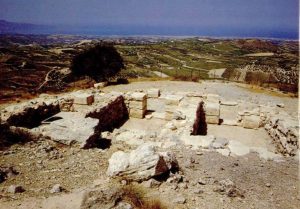
On the northern slope of Juktas, at the spot called Anemospilia – “caves of the wind” – Yannis and Efi Sakellarakis discovered in 1979 a cult building of around 1700 BC, destroyed by an earthquake a few decades after it was built. Behind an antechamber lay three narrow rooms; some 150 vessels, large storage pithoi and a stepped altar came to light, and in the central room a pair of clay feet that had formed the base of a life-size wooden cult statue. In the western room were found the remains of a young man of about eighteen, lying on his side with his legs drawn tightly up on a table-like platform, beside him a bronze blade 40 centimetres long, incised with an animal head that has the snout and tusks of a boar, and traces of a ritual that have been interpreted as a possible human sacrifice. Three more people were killed by the falling masonry and the fire: a powerfully built man in his late thirties, wearing a ring of iron and silver and carrying a finely engraved seal, a woman of about twenty-eight, and a fourth figure crushed in the antechamber. This is rare and disputed evidence – one critic has argued that the blade is an ornate spearhead that simply fell from a shelf above – and the find matters precisely because such rites are not thought to have been an ordinary feature of Minoan religion. The site, whose walls survive barely to hip height and from which Heraklion can be seen in the distance, is fenced and not open to visitors.
Vathypetro: Minoan country estate and working farm
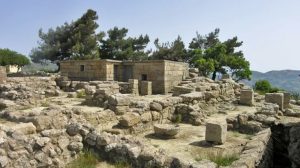
About four kilometres south of Archanes, at the place called Piso Livadia on the south-eastern slope of Juktas, lies Vathypetro (Βαθύπετρο). Here Spyridon Marinatos, digging from 1949 to 1956, uncovered a Minoan country house dated to around 1600 BC. Building seems to have begun about 1580 BC and was never carried through – only the west wing was finished – before the house was ruined, perhaps by an earthquake, around 1550 BC and afterwards restored in part. Unlike a palatial centre, it was a large working farmstead geared to growing and processing the harvest – with a view over broad, fertile hill country.
The building, which rose to two storeys in places, preserves a grape press and an installation for extracting olive oil; the press is often described as one of the oldest in the world. Beside them are a potter’s kiln, a storeroom with sixteen great jars, a portico of three columns, a hall with four square pillars and a small tripartite shrine; the walls were finished in coloured plaster, not painted with frescoes. These installations bring the technical side of Bronze Age life vividly before the eye: the cultivation of vines and olives, storage, the organisation of labour and the exchange of what was produced. Vathypetro thus completes the picture given by Fourni and Juktas: Archanes was not only a religious centre but a district with a many-layered economy. An asphalt road leads to the site, where one restored room holds a small display of pottery from the house.
Today Archanes makes a good base for a tour of the southern hinterland of Heraklion: from the churches and the museum collection the route leads on to Fourni, to Juktas and to Vathypetro. Together these places show how continuous human presence has been here – from the Minoan settlements and sanctuaries to the present-day town, which looks after its historic surroundings with care.