The most complete guide to Crete: 221 places on the map, 23 routes and 49 articles — with photos, videos and the story behind every place. Everything is open and free: no sign-up, no paid sections and no advertising, open or hidden. You can install the guide on your smartphone as an app.
Routes drawn along real roads
Weather at every stop
Full-text search
“Near me” by geolocation
Create your own printable itinerary
Satellite, terrain, dark mode
Works offline
⌕
Searches 1.7 million characters of descriptions, not just names
—places
4regions
—routes
—with video
Search results
—
Interactive map
Find what is near you
Filters narrow the map and the list at once. Zoom out and pins group together.
Region
Category
Фильтры карты
Landmarks
Featured places
RegionCategory
Routes
Ready-made day trips
Individual places
Articles about landmarks
Amnisos and the “Plain of the Navel”
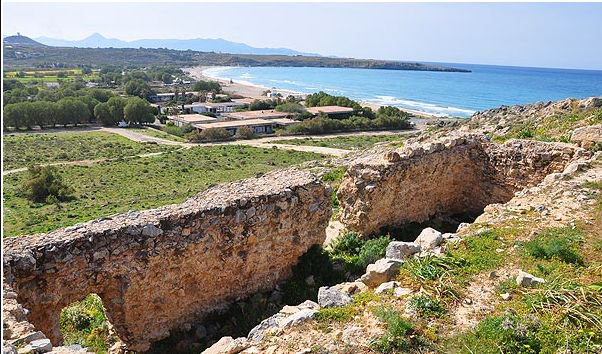
Anyone driving along the coast road east of Heraklion airport sees at first only a long sandy beach and an unremarkable rocky hillock close to the water, at the eastern end of the Bay of Karteros, which runs for some three and a half kilometres from the mouth of the Karteros gorge. This hillock, known as Palaiochora, is the heart of ancient Amnisos; people were living on and around it by the 19th century BC. A legend of the infant Zeus is attached to it: as the newborn child was being carried away from his birthplace to be hidden from his father Cronus, his umbilical cord is said to have fallen off here. The plain behind the hill is therefore called the “Omphalion Pedion”, the Plain of the Navel; the Hellenistic poet Callimachus already tells the story in his Hymn to Zeus. The name belongs, of course, to the mythical memory of the place and is not something archaeology can confirm.
The harbour of Knossos in the ancient authors
Amnisos was the harbour of Knossos and one of the most important places on the Minoan coast. Around its bay stood installations that served seafaring and probably the provisioning and maintenance of ships. The place name can already be read on the Linear B tablets from Knossos, written a-mi-ni-so – one of the words that helped Michael Ventris to decipher the script – and it appears even further afield, in the list of Aegean places carved around 1380 BC on a statue base of Amenhotep III at Kom el-Hetan in Egypt. Homer names Amnisos and the Cave of Eileithyia; later the geographer Strabo wrote that Minos had used Amnisos as his harbour, and noted a sanctuary of Eileithyia there. In the Iliad Idomeneus leads the Cretans against Troy, and in the Odyssey Amnisos figures among the places of the homecoming story: in Book 19 Odysseus, not yet recognised, tells his wife Penelope that a storm drove the hero, on his way to Troy, to Amnisos, “where the cave of Eileithyia is”, a difficult harbour to make. Callimachus, finally, has the young Artemis ask her father for twenty nymphs of the river Amnisos as her handmaidens – the Amnisiades, as he calls them. The river is today’s Karteros, which reaches the sea here and shrinks to a trickle in the dry months.
The Minoan “House of the Lilies” and the ancient harbour
Excavation on the hill began in 1929. In 1932 Spyridon Marinatos investigated, at its eastern foot, the Minoan “House of the Lilies”, a two-storey building of carefully dressed ashlar with a paved court on the seaward side. Its ten or so rooms included a hall opening through a row of doors, a kitchen, a small shrine and a bathroom. It was probably built in the 17th century BC and destroyed around 1500 BC – whether by earthquake, fire or a great wave is disputed, though the walls bear clear traces of burning. It owes its name to the frescoes from the upper floor, on which white and red lilies rise from the ground against a coloured field, accompanied by mint, iris and papyrus; the restored panel stands 1.8 metres high, and part of it was made in an unusual technique, the flowers being inlaid in coloured plaster into the red ground rather than simply painted. They are among the finest plant pictures in Minoan art and have been read as images of a tended, perhaps sacred, garden. The finds from Amnisos are kept in the Heraklion Archaeological Museum. Unlike the villa, other buildings on the hill remained in use until the 12th century BC. On the western side the archaeologists also uncovered an open-air sanctuary with an ash altar, bounded by a massive wall of large blocks, which was dedicated to Zeus Thenatas from the 7th century BC until the 2nd century AD, and on the shore the remains of the ancient harbour. Part of it now lies under water – the sea stands some three metres higher than in the Bronze Age, and house walls can be made out from the beach – which is explained by shifts in the coastline attributed partly to the eruption of the volcano of Thera (Santorini) and partly to the gradual rise in sea level. During the Second World War German soldiers damaged the ruin of the villa. Stylianos Alexiou later dug part of the Mycenaean settlement, and between 1983 and 1985 a team from the University of Heidelberg under Jörg Schäfer cleaned and recorded all the buildings afresh.
The island of Dia and the memory of Theseus
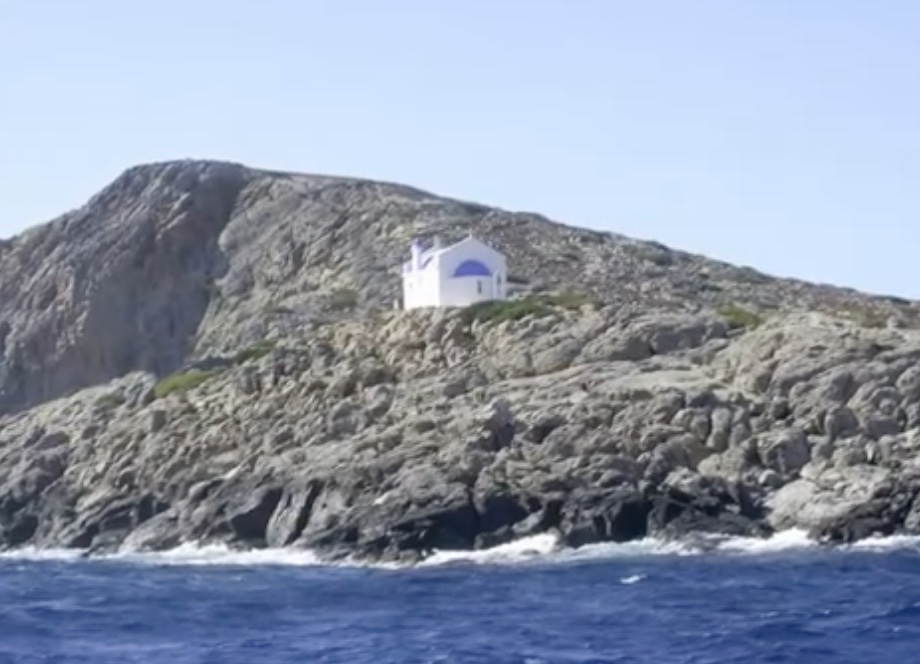
From the shore at Amnisos the uninhabited island of Dia lies on the horizon like an animal at rest – a likeness the Cretans explained with the tale that Zeus turned a giant lizard to stone with a thunderbolt. It is about five kilometres long and three wide, rises to 220 metres and lies some 13 kilometres north of Heraklion; four sheltered coves indent its south coast, and for centuries, under the Venetian name of Standia, they served as the roadstead for ships too large for the city’s own harbour. Mythical tradition occasionally links the island with Theseus and Ariadne – in Homer, Ariadne dies on Dia by the arrows of Artemis – whereas the most widespread version of the story has Theseus abandoning her on Naxos. In 1974 and 1975 Jacques-Yves Cousteau explored the waters off Dia and found remains of Minoan structures that were interpreted as a harbour, living quarters and stretches of walling. These finds show how much the sea around Crete mattered; they do not prove any particular mythical tale. Today Dia is a protected nature reserve within the Natura 2000 network, with a large breeding colony of Eleonora’s falcon; boats visit for the day, but no one may camp there.
The Cave of Eileithyia
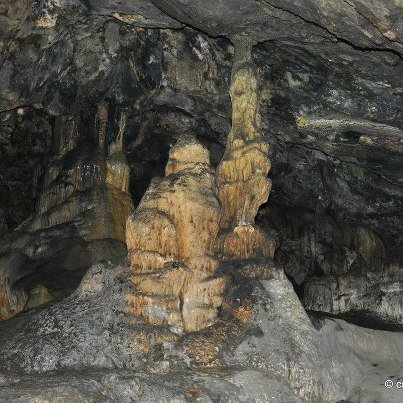
The most important sight at Amnisos is the Cave of Eileithyia (Σπήλαιο Ειλειθυίας), about a kilometre inland on the eastern slope of the Karteros valley, some 85 metres above the sea beside the old road that led up to Knossos; an old fig tree marks the entrance. It runs east to west for roughly 60 metres, is 9 to 12 metres wide and up to four and a half metres high, and is divided into several chambers on different levels. Inside are stalactites and stalagmites, a pool of water and a rectangular altar; near the entrance lies a rounded boss of rock, 78 centimetres high and more than two metres across, which is interpreted as a “navel”. Two large stalagmites, enclosed in antiquity by a low wall, recall human figures and were seen as a woman and child; it was here, at the centre of the cave, that worship was concentrated. The sanctuary was discovered in 1885 by Iosif Chatzidakis; the systematic excavation was carried out by Marinatos between 1929 and 1938. In front of the entrance he came upon an open space with altars and upon buildings of the 14th and 13th centuries BC, which are thought to have housed the priesthood.
The cult of the goddess of childbirth
Eileithyia was the goddess of childbirth, protector of pregnant women and of the newborn. Homer calls her a daughter of Zeus and Hera, and a local tradition has it that she was herself born in this cave. The grotto served as a place of worship from the early Neolithic and kept its importance through Minoan, Geometric and Roman times – down to the 5th century AD, and according to some scholars a little longer, for the excavators also found traces of early Christian use. A Linear B tablet from Knossos, written in the 14th century BC, records one jar of honey for “Eleuthia” at Amnisos and another for all the gods: the oldest written notice of an offering at this place. Honey, milk, oil and wool are thought to have been the usual gifts. Among the finds, which include vessels and lamps, clay figures of women giving birth, nursing or praying, animal figurines, shells and Neolithic tools, an unusually large group of Egyptian and Egyptianising pieces stands out – notably four vases in human form of the 7th century BC that resemble Egyptian images of Isis suckling the infant Horus; they are now on display in the Heraklion museum.
Reading the landscape of Amnisos
Amnisos is best understood as a single archaeological landscape: the harbour of Knossos, the “House of the Lilies”, the sanctuary of Zeus, the coast facing Dia and the Cave of Eileithyia tell several interwoven stories here – one of the sea, one of myth and one of religion. The ruins on the hill are fenced and can only be surveyed from outside, which takes no more than a quarter of an hour; the cave is locked to protect its formations and is opened only by arrangement with the Archaeological Service. A visit combines well with a swim from the beach of Amnisos, a quieter stretch of fine golden sand with the rocky islet of Monocharako some 300 metres offshore, or from the neighbouring beach of Karteros. Both are served by the town buses from Heraklion, and both lie open to the north wind, so the sea is often lively.