The most complete guide to Crete: 221 places on the map, 23 routes and 49 articles — with photos, videos and the story behind every place. Everything is open and free: no sign-up, no paid sections and no advertising, open or hidden. You can install the guide on your smartphone as an app.
Routes drawn along real roads
Weather at every stop
Full-text search
“Near me” by geolocation
Create your own printable itinerary
Satellite, terrain, dark mode
Works offline
⌕
Searches 1.7 million characters of descriptions, not just names
—places
4regions
—routes
—with video
Search results
—
Interactive map
Find what is near you
Filters narrow the map and the list at once. Zoom out and pins group together.
Region
Category
Фильтры карты
Landmarks
Featured places
RegionCategory
Routes
Ready-made day trips
Individual places
Articles about landmarks
Beaches and the resort today
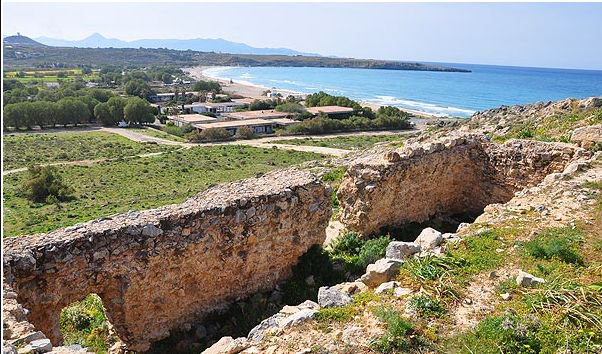
Kokkini Chani (Κοκκίνη Χάνι) lies about 14 kilometres east of Heraklion and only ten minutes or so by car from the airport. Golden sandy beaches alternate here with small sheltered coves, with tavernas and hotels in between; the main beach is some 400 metres long and up to 50 metres wide, and although most of the others lie in front of hotels they remain open to everyone. The coast is suited to bathing and to a quiet stay – evenings here are a good deal calmer than at Hersonissos or Malia – and in places short artificial piers break the swell, leaving shallow turquoise water behind them. The village has a good 1,500 permanent residents, who live from tourism and from growing vegetables under glass; in the centre stands the church of the Agii Anargyri, the physician saints Cosmas and Damian, built in 1940. Shops, bakeries and a pharmacy are strung out along the old main road for nearly three kilometres, and buses between Heraklion and the east stop frequently. The archaeological site of Nirou lies directly beside that road, a short walk from the beach.
From wayside inn to resort
The name goes back to a chani, an inn, that belonged to Dimitrios Kokkinis, nephew of the Cretan irregular leader Emmanouil Kokkinis. In the 19th and early 20th centuries such stations offered travellers and their pack animals a bed for the night, fodder and a meal – here, those on the road to Lasithi and Sitia as well as the farmers taking their produce to market in Heraklion. The inn had already closed by the beginning of the 20th century, but its name remained: Kokkini Chani, the chani of Kokkinis. The locality itself had been known from of old as Armylides. The present resort came much later: electricity and the telephone reached the district in the early 1960s, and the first hotels were built at about the same time.
The Megaron of Nirou – a Minoan house by the sea
On the eastern edge of the village lies the Megaron of Nirou, also called Nirou Chani, a two-storey Minoan complex covering about 1,000 square metres. It belongs to the Late Minoan period, roughly the 16th and 15th centuries BC, and is thus a contemporary of the New Palaces of Knossos and Phaistos; the ground floor alone comprised some forty rooms, with several corridors, two paved courts to the east and north, a light well, a shrine wing and storerooms. The house stood close to the sea and probably served a community in which harbour and cult belonged together and which was tied to the sea routes. Its anchorage lay a little further along the coast at Agii Theodori, at the eastern end of the beach of Vathianos Kambos: there, remains of walls have sunk beneath the water – the Bronze Age shoreline now lies about two metres down – and a rectangular basin cut into the rock, some 48 metres long, 12 metres wide and 1.80 metres deep, was interpreted by Spyridon Marinatos, who explored the bay in 1926–27, as a Minoan shipyard. Around the middle of the 15th century BC the house perished in a fire and was never reoccupied.
Archaeology and layout of the building
Research on the monument began in the early 20th century. The excavation of 1918 and 1919 is linked with the name of the Cretan archaeologist Stefanos Xanthoudidis, who published his results in 1922; Spyridon Marinatos later continued the investigations. The walls were braced with a timber frame, thickly coated in lime plaster and faced with dressed stone on the show fronts. The courts are paved with large slabs, and the technical solutions – water supply, the lighting of the inner rooms by way of the light well, controlled drainage – bear witness to the high standard of Minoan building. The main room opened through columns and a row of doors on to the eastern court, in the arrangement archaeologists call a Minoan hall; beside it a smaller room was lined with benches faced in gypsum. To the north lay the storerooms with their great clay jars for oil and wine and built bins for grain, while the cult equipment was kept in the southern part of the house.
Cult equipment and frescoes
At the entrance, set on a low wall, were found the “sacred horns” – κέρατα καθοσιώσεως, the horns of consecration, one of the best-known symbols of Minoan religion. Inside the house large vessels, pithoi, offering tables, bronze double axes and other ritual equipment came to light. Most famous are four outsize double axes of thin sheet bronze, found together in a single room and useless for any practical purpose, and dozens of painted clay tripod altars, which were discovered stacked one on top of another in three adjoining rooms, along with stone lamps and vases. Beneath a small shrine lay votive cups containing pumice from the eruption of Thera. In the northern part fragments of wall painting had survived, among them the image of a sacral knot, which came from one of the corridors. Arthur Evans therefore saw the building as the “House of the High Priest”; other scholars regard it as a depot from which cult equipment was shipped, or as a workshop in which it was made. The finds and the associated material are in the Heraklion Archaeological Museum.
Kokkini Chani in the wartime history of Crete
In the 20th century Kokkini Chani changed in a short time from a rural strip of coast into a densely built resort. The area is also bound up with the fighting for Kopsas hill, above neighbouring Gournes, during the German airborne invasion of Crete in May 1941, when paratroopers dropped east of Heraklion and the heights above the coast road were contested. On 21 May two companies of them gained the summit and pushed back the eighty Greek soldiers defending it, until their commander, Lieutenant Theodoros Kallinos, walked forward firing without cover and his men followed him in a counter-attack that retook the hill. A white cross and a marble plaque, put up in 1960 by the chapel of the American air station then based at Gournes, mark the spot. The episode is a reminder that the coastal plain – the approach to the city and its airfield – had military importance long before the first hotels stood here.
Combining beach and archaeology
Kokkini Chani is best visited at two speeds: in the morning, while the light still falls low across the walls, one looks round the Megaron of Nirou and pictures the Minoan harbour landscape; the rest of the day is left for the beach. The excavation is small; as a rule it is open only in the mornings and closed on one weekday. Those who want to see more can drive a few kilometres west to ancient Amnisos, walk or swim over the rock-cut shipyard at Agii Theodori, about two kilometres away, or seek out the double axes and tripod altars from Nirou in the Heraklion museum. Seen in this way the resort is not only a place for relaxation but a district with a history of several thousand years.